

bands alone. Spatial resolution, band narrowness, radiometric accuracy and specific image quality in terms of minimal atmospheric haze and surface reflectance
(sunglint) are also important factors. Image revisit times and cost of data are also
extremely important factors for change detection applications in particular.
To orientate oneself in the plethora of operational and planned image acquisition systems it is useful to understand the design constraints of an optical remote
sensing instrument. To achieve a certain radiometric accuracy in a passive optical
imaging system there is a design trade-off between spatial and spectral resolution.
Inside the instrument, the photons collected over the area of one pixel are separated into bins for quantifying the response in each spectral band. The rate of
photons collected in each bin must be sufficient to ensure a good signal above the
internal instrument noise. Collecting from a smaller spatial area implies a smaller
field-of-view, which means less photons and hence reduced capability to separate
those photons into numerous wavelength bands. As sensor technology improves,
overall achievable spatial and spectral resolutions increase, but for any point in
time the consequences of this design limitation are reflected in the range of
available instrumentation. For example, the ESA MERIS ocean color sensor
provides high radiometric accuracy in 15 narrow bands of approximately 10 nm
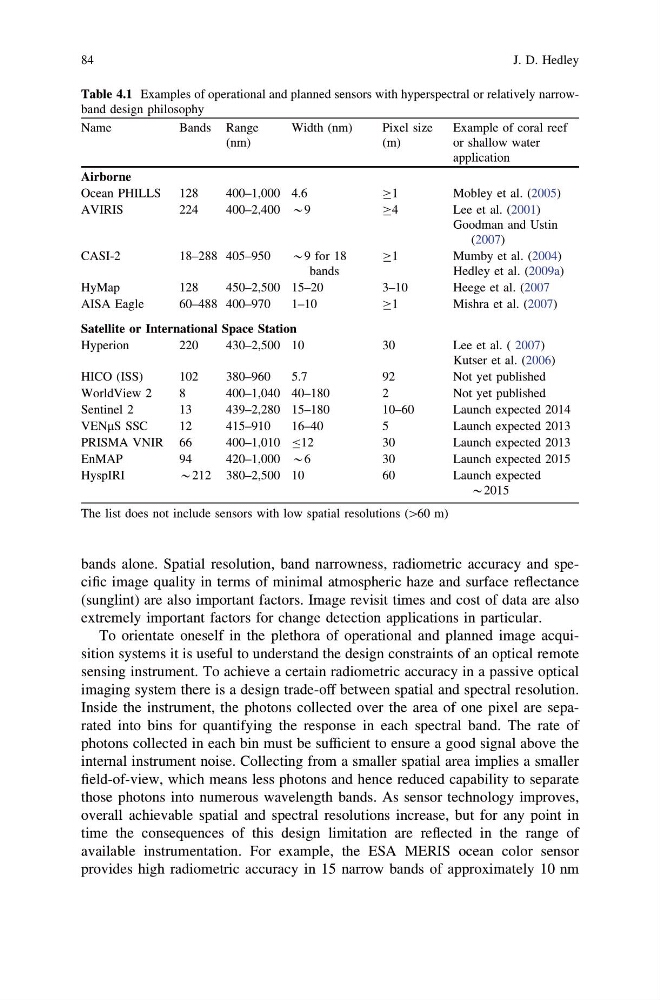
Table 4.1 Examples of operational and planned sensors with hyperspectral or relatively narrowband design philosophy
Name
Bands Range
(nm)
Width (nm)
Pixel size
(m)
Example of coral reef
or shallow water
application
Airborne
Ocean PHILLS 128
400–1,000 4.6
C1
Mobley et al. (2005)
AVIRIS
224
400–2,400 *9
C4
Lee et al. (2001)
Goodman and Ustin
(2007)
CASI-2
18–288 405–950
*9 for 18
bands
C1
Mumby et al. (2004)
Hedley et al. (2009a)
HyMap
128
450–2,500 15–20
3–10
Heege et al. (2007
AISA Eagle
60–488 400–970
1–10
C1
Mishra et al. (2007)
Satellite or International Space Station
Hyperion
220
430–2,500 10
30
Lee et al. ( 2007)
Kutser et al. (2006)
HICO (ISS)
102
380–960
5.7
92
Not yet published
WorldView 2
8
400–1,040 40–180
2
Not yet published
Sentinel 2
13
439–2,280 15–180
10–60
Launch expected 2014
VENlS SSC
12
415–910
16–40
5
Launch expected 2013
PRISMA VNIR 66
400–1,010 B12
30
Launch expected 2013
EnMAP
94
420–1,000 *6
30
Launch expected 2015
HyspIRI
*212 380–2,500 10
60
Launch expected
*2015
The list does not include sensors with low spatial resolutions ([60 m)
84
J. D. Hedley
(sunglint) are also important factors. Image revisit times and cost of data are also
extremely important factors for change detection applications in particular.
To orientate oneself in the plethora of operational and planned image acquisition systems it is useful to understand the design constraints of an optical remote
sensing instrument. To achieve a certain radiometric accuracy in a passive optical
imaging system there is a design trade-off between spatial and spectral resolution.
Inside the instrument, the photons collected over the area of one pixel are separated into bins for quantifying the response in each spectral band. The rate of
photons collected in each bin must be sufficient to ensure a good signal above the
internal instrument noise. Collecting from a smaller spatial area implies a smaller
field-of-view, which means less photons and hence reduced capability to separate
those photons into numerous wavelength bands. As sensor technology improves,
overall achievable spatial and spectral resolutions increase, but for any point in
time the consequences of this design limitation are reflected in the range of
available instrumentation. For example, the ESA MERIS ocean color sensor
provides high radiometric accuracy in 15 narrow bands of approximately 10 nm
Table 4.1 Examples of operational and planned sensors with hyperspectral or relatively narrowband design philosophy
Name
Bands Range
(nm)
Width (nm)
Pixel size
(m)
Example of coral reef
or shallow water
application
Airborne
Ocean PHILLS 128
400–1,000 4.6
C1
Mobley et al. (2005)
AVIRIS
224
400–2,400 *9
C4
Lee et al. (2001)
Goodman and Ustin
(2007)
CASI-2
18–288 405–950
*9 for 18
bands
C1
Mumby et al. (2004)
Hedley et al. (2009a)
HyMap
128
450–2,500 15–20
3–10
Heege et al. (2007
AISA Eagle
60–488 400–970
1–10
C1
Mishra et al. (2007)
Satellite or International Space Station
Hyperion
220
430–2,500 10
30
Lee et al. ( 2007)
Kutser et al. (2006)
HICO (ISS)
102
380–960
5.7
92
Not yet published
WorldView 2
8
400–1,040 40–180
2
Not yet published
Sentinel 2
13
439–2,280 15–180
10–60
Launch expected 2014
VENlS SSC
12
415–910
16–40
5
Launch expected 2013
PRISMA VNIR 66
400–1,010 B12
30
Launch expected 2013
EnMAP
94
420–1,000 *6
30
Launch expected 2015
HyspIRI
*212 380–2,500 10
60
Launch expected
*2015
The list does not include sensors with low spatial resolutions ([60 m)
84
J. D. Hedley