

(Mumby et al. 2001, 2004), live coral versus macroalgae (Goodman and Ustin
2007), or detection of coral bleaching events (Elvidge et al. 2004). Although the
cited studies and others have indicated positive results, at the time of writing these
kinds of objectives are not routinely achieved using hyperspectral data. Habitat
level classifications benefit greatly from airborne hyperspectral data in terms of the
number of classes that can be accurately estimated (Mumby et al. 1997). However,
this success may also be a function of higher spatial resolution and/or scale issues of
ground truth surveys, whose effects can co-vary and be hard to isolate (Caplosini
et al. 2003). The latest methods for shallow water mapping are based on developing
a model for the spectral light received at the instrument that is then ‘inverted’ to
simultaneously extract depth, water optical properties and benthic composition
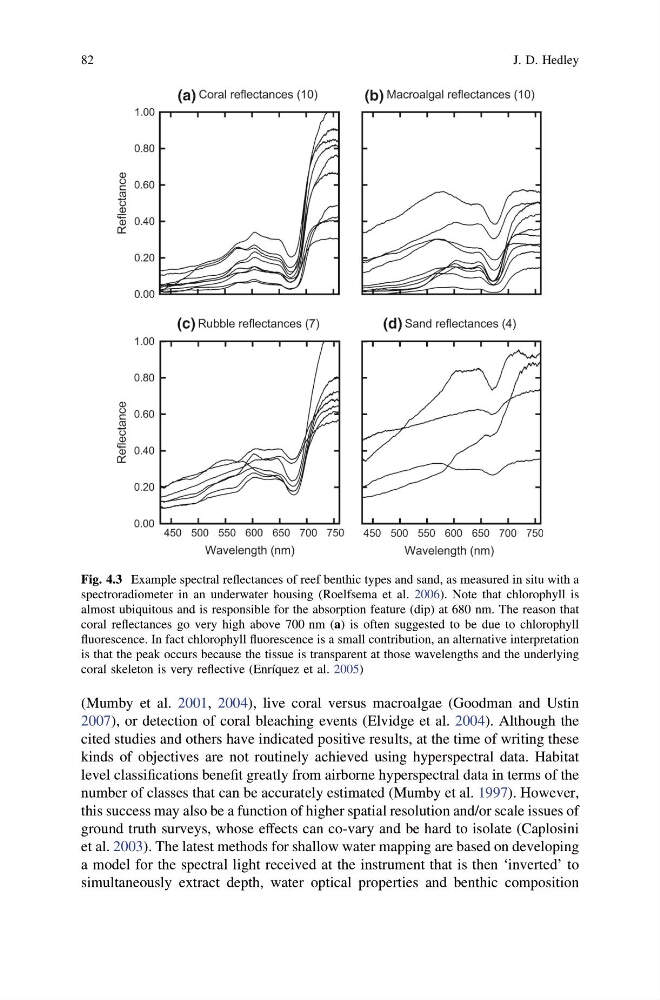
Fig. 4.3 Example spectral reflectances of reef benthic types and sand, as measured in situ with a
spectroradiometer in an underwater housing (Roelfsema et al. 2006). Note that chlorophyll is
almost ubiquitous and is responsible for the absorption feature (dip) at 680 nm. The reason that
coral reflectances go very high above 700 nm (a) is often suggested to be due to chlorophyll
fluorescence. In fact chlorophyll fluorescence is a small contribution, an alternative interpretation
is that the peak occurs because the tissue is transparent at those wavelengths and the underlying
coral skeleton is very reflective (Enríquez et al. 2005)
82
J. D. Hedley
2007), or detection of coral bleaching events (Elvidge et al. 2004). Although the
cited studies and others have indicated positive results, at the time of writing these
kinds of objectives are not routinely achieved using hyperspectral data. Habitat
level classifications benefit greatly from airborne hyperspectral data in terms of the
number of classes that can be accurately estimated (Mumby et al. 1997). However,
this success may also be a function of higher spatial resolution and/or scale issues of
ground truth surveys, whose effects can co-vary and be hard to isolate (Caplosini
et al. 2003). The latest methods for shallow water mapping are based on developing
a model for the spectral light received at the instrument that is then ‘inverted’ to
simultaneously extract depth, water optical properties and benthic composition
Fig. 4.3 Example spectral reflectances of reef benthic types and sand, as measured in situ with a
spectroradiometer in an underwater housing (Roelfsema et al. 2006). Note that chlorophyll is
almost ubiquitous and is responsible for the absorption feature (dip) at 680 nm. The reason that
coral reflectances go very high above 700 nm (a) is often suggested to be due to chlorophyll
fluorescence. In fact chlorophyll fluorescence is a small contribution, an alternative interpretation
is that the peak occurs because the tissue is transparent at those wavelengths and the underlying
coral skeleton is very reflective (Enríquez et al. 2005)
82
J. D. Hedley