

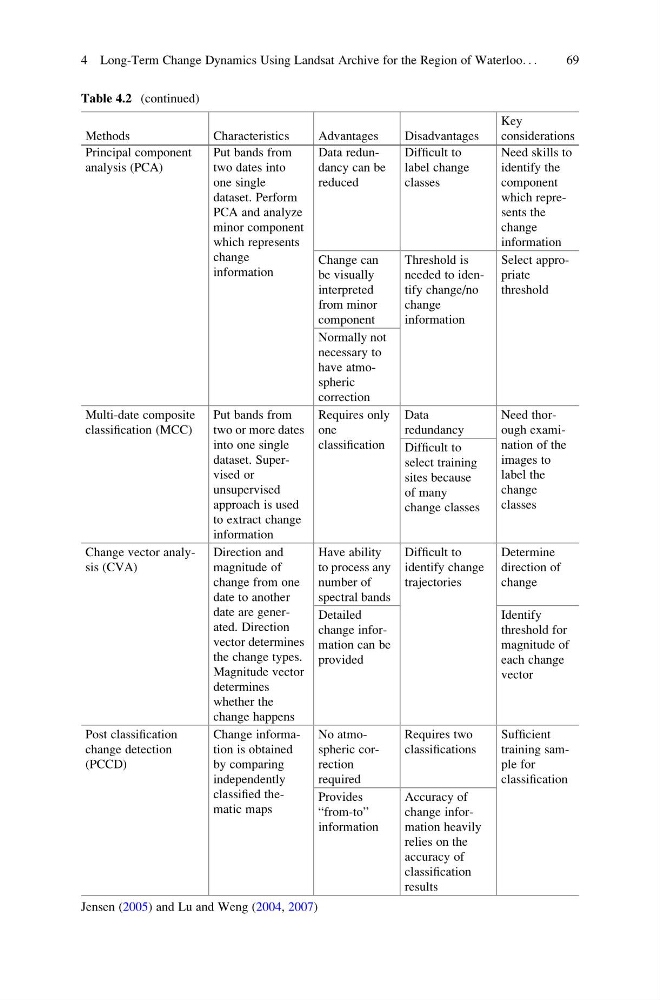
Table 4.2 (continued)
Methods
Characteristics
Advantages
Disadvantages
Key
considerations
Principal component
analysis (PCA)
Put bands from
two dates into
one single
dataset. Perform
PCA and analyze
minor component
which represents
change
information
Data redundancy can be
reduced
Difficult to
label change
classes
Need skills to
identify the
component
which represents the
change
information
Change can
be visually
interpreted
from minor
component
Threshold is
needed to identify change/no
change
information
Select appropriate
threshold
Normally not
necessary to
have atmospheric
correction
Multi-date composite
classification (MCC)
Put bands from
two or more dates
into one single
dataset. Supervised or
unsupervised
approach is used
to extract change
information
Requires only
one
classification
Data
redundancy
Need thorough examination of the
images to
label the
change
classes
Difficult to
select training
sites because
of many
change classes
Change vector analysis (CVA)
Direction and
magnitude of
change from one
date to another
date are generated. Direction
vector determines
the change types.
Magnitude vector
determines
whether the
change happens
Have ability
to process any
number of
spectral bands
Difficult to
identify change
trajectories
Determine
direction of
change
Detailed
change information can be
provided
Identify
threshold for
magnitude of
each change
vector
Post classification
change detection
(PCCD)
Change information is obtained
by comparing
independently
classified thematic maps
No atmospheric correction
required
Requires two
classifications
Sufficient
training sample for
classification
Provides
“from-to”
information
Accuracy of
change information heavily
relies on the
accuracy of
classification
results
Jensen (2005) and Lu and Weng (2004, 2007)
4 Long-Term Change Dynamics Using Landsat Archive for the Region of Waterloo. . .
69
Methods
Characteristics
Advantages
Disadvantages
Key
considerations
Principal component
analysis (PCA)
Put bands from
two dates into
one single
dataset. Perform
PCA and analyze
minor component
which represents
change
information
Data redundancy can be
reduced
Difficult to
label change
classes
Need skills to
identify the
component
which represents the
change
information
Change can
be visually
interpreted
from minor
component
Threshold is
needed to identify change/no
change
information
Select appropriate
threshold
Normally not
necessary to
have atmospheric
correction
Multi-date composite
classification (MCC)
Put bands from
two or more dates
into one single
dataset. Supervised or
unsupervised
approach is used
to extract change
information
Requires only
one
classification
Data
redundancy
Need thorough examination of the
images to
label the
change
classes
Difficult to
select training
sites because
of many
change classes
Change vector analysis (CVA)
Direction and
magnitude of
change from one
date to another
date are generated. Direction
vector determines
the change types.
Magnitude vector
determines
whether the
change happens
Have ability
to process any
number of
spectral bands
Difficult to
identify change
trajectories
Determine
direction of
change
Detailed
change information can be
provided
Identify
threshold for
magnitude of
each change
vector
Post classification
change detection
(PCCD)
Change information is obtained
by comparing
independently
classified thematic maps
No atmospheric correction
required
Requires two
classifications
Sufficient
training sample for
classification
Provides
“from-to”
information
Accuracy of
change information heavily
relies on the
accuracy of
classification
results
Jensen (2005) and Lu and Weng (2004, 2007)
4 Long-Term Change Dynamics Using Landsat Archive for the Region of Waterloo. . .
69