

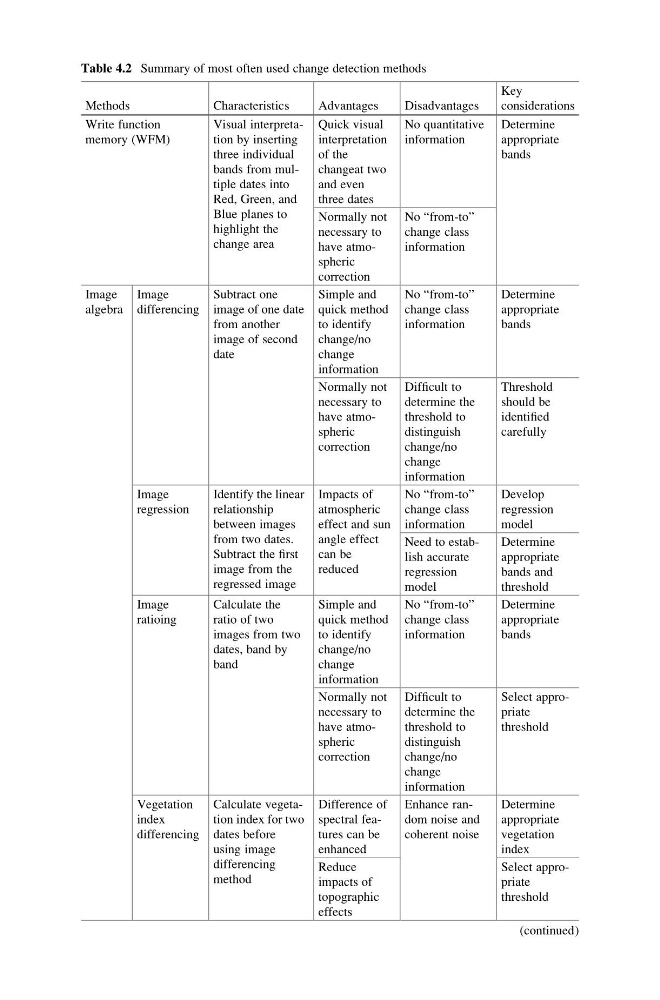
Table 4.2 Summary of most often used change detection methods
Methods
Characteristics
Advantages
Disadvantages
Key
considerations
Write function
memory (WFM)
Visual interpretation by inserting
three individual
bands from multiple dates into
Red, Green, and
Blue planes to
highlight the
change area
Quick visual
interpretation
of the
changeat two
and even
three dates
No quantitative
information
Determine
appropriate
bands
Normally not
necessary to
have atmospheric
correction
No “from-to”
change class
information
Image
algebra
Image
differencing
Subtract one
image of one date
from another
image of second
date
Simple and
quick method
to identify
change/no
change
information
No “from-to”
change class
information
Determine
appropriate
bands
Normally not
necessary to
have atmospheric
correction
Difficult to
determine the
threshold to
distinguish
change/no
change
information
Threshold
should be
identified
carefully
Image
regression
Identify the linear
relationship
between images
from two dates.
Subtract the first
image from the
regressed image
Impacts of
atmospheric
effect and sun
angle effect
can be
reduced
No “from-to”
change class
information
Develop
regression
model
Need to establish accurate
regression
model
Determine
appropriate
bands and
threshold
Image
ratioing
Calculate the
ratio of two
images from two
dates, band by
band
Simple and
quick method
to identify
change/no
change
information
No “from-to”
change class
information
Determine
appropriate
bands
Normally not
necessary to
have atmospheric
correction
Difficult to
determine the
threshold to
distinguish
change/no
change
information
Select appropriate
threshold
Vegetation
index
differencing
Calculate vegetation index for two
dates before
using image
differencing
method
Difference of
spectral features can be
enhanced
Enhance random noise and
coherent noise
Determine
appropriate
vegetation
index
Reduce
impacts of
topographic
effects
Select appropriate
threshold
(continued)
Methods
Characteristics
Advantages
Disadvantages
Key
considerations
Write function
memory (WFM)
Visual interpretation by inserting
three individual
bands from multiple dates into
Red, Green, and
Blue planes to
highlight the
change area
Quick visual
interpretation
of the
changeat two
and even
three dates
No quantitative
information
Determine
appropriate
bands
Normally not
necessary to
have atmospheric
correction
No “from-to”
change class
information
Image
algebra
Image
differencing
Subtract one
image of one date
from another
image of second
date
Simple and
quick method
to identify
change/no
change
information
No “from-to”
change class
information
Determine
appropriate
bands
Normally not
necessary to
have atmospheric
correction
Difficult to
determine the
threshold to
distinguish
change/no
change
information
Threshold
should be
identified
carefully
Image
regression
Identify the linear
relationship
between images
from two dates.
Subtract the first
image from the
regressed image
Impacts of
atmospheric
effect and sun
angle effect
can be
reduced
No “from-to”
change class
information
Develop
regression
model
Need to establish accurate
regression
model
Determine
appropriate
bands and
threshold
Image
ratioing
Calculate the
ratio of two
images from two
dates, band by
band
Simple and
quick method
to identify
change/no
change
information
No “from-to”
change class
information
Determine
appropriate
bands
Normally not
necessary to
have atmospheric
correction
Difficult to
determine the
threshold to
distinguish
change/no
change
information
Select appropriate
threshold
Vegetation
index
differencing
Calculate vegetation index for two
dates before
using image
differencing
method
Difference of
spectral features can be
enhanced
Enhance random noise and
coherent noise
Determine
appropriate
vegetation
index
Reduce
impacts of
topographic
effects
Select appropriate
threshold
(continued)