

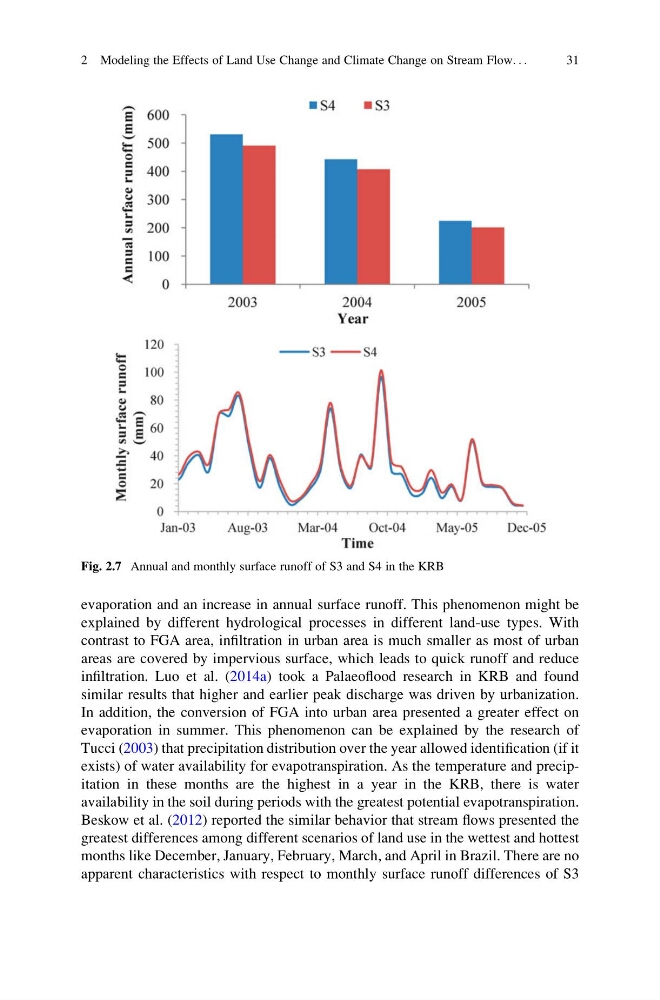
evaporation and an increase in annual surface runoff. This phenomenon might be
explained by different hydrological processes in different land-use types. With
contrast to FGA area, infiltration in urban area is much smaller as most of urban
areas are covered by impervious surface, which leads to quick runoff and reduce
infiltration. Luo et al. (2014a) took a Palaeoflood research in KRB and found
similar results that higher and earlier peak discharge was driven by urbanization.
In addition, the conversion of FGA into urban area presented a greater effect on
evaporation in summer. This phenomenon can be explained by the research of
Tucci (2003) that precipitation distribution over the year allowed identification (if it
exists) of water availability for evapotranspiration. As the temperature and precipitation in these months are the highest in a year in the KRB, there is water
availability in the soil during periods with the greatest potential evapotranspiration.
Beskow et al. (2012) reported the similar behavior that stream flows presented the
greatest differences among different scenarios of land use in the wettest and hottest
months like December, January, February, March, and April in Brazil. There are no
apparent characteristics with respect to monthly surface runoff differences of S3
Fig. 2.7 Annual and monthly surface runoff of S3 and S4 in the KRB
2 Modeling the Effects of Land Use Change and Climate Change on Stream Flow. . .
31
explained by different hydrological processes in different land-use types. With
contrast to FGA area, infiltration in urban area is much smaller as most of urban
areas are covered by impervious surface, which leads to quick runoff and reduce
infiltration. Luo et al. (2014a) took a Palaeoflood research in KRB and found
similar results that higher and earlier peak discharge was driven by urbanization.
In addition, the conversion of FGA into urban area presented a greater effect on
evaporation in summer. This phenomenon can be explained by the research of
Tucci (2003) that precipitation distribution over the year allowed identification (if it
exists) of water availability for evapotranspiration. As the temperature and precipitation in these months are the highest in a year in the KRB, there is water
availability in the soil during periods with the greatest potential evapotranspiration.
Beskow et al. (2012) reported the similar behavior that stream flows presented the
greatest differences among different scenarios of land use in the wettest and hottest
months like December, January, February, March, and April in Brazil. There are no
apparent characteristics with respect to monthly surface runoff differences of S3
Fig. 2.7 Annual and monthly surface runoff of S3 and S4 in the KRB
2 Modeling the Effects of Land Use Change and Climate Change on Stream Flow. . .
31