

SWAT-model by averaging SWC within a 1-m block of soil, (iv) water content in
the potato plant, and (v) surface roughness from July through September.
Despite demonstrating fairly strong relationships between WI and estimates of
SWC (both observed and modeled), this study has a number of limitations, namely
(i) As only three radar images and data from seven field sites were used in this
study (i.e., two in dense forests, three in sparse forests, one in a bare field, and
one in a potato-production area), we feel that a greater number of radar images
and field measurements are required for a more comprehensive evaluation of
the method.
(ii) WI-vs.-SWC comparisons for the three landcover types (Fig. 15.5) revealed
that WI is to some extent dependent on canopy density, and, therefore, LAI.
As a result, refine mapping of SWC should consider landcover. At this
moment, landcover effects on SWC are outside the scope of this work.
(iii) For an improved comprehension of the temporal dynamics of WI, acquiring
radar-images for the spring and fall periods would complement the current
summer images.
(iv) Question of applying the SWAT-model to the forest sites is a critical one,
given that the SWAT model requires a number of inputs, which are not
commonly available from forested sites.
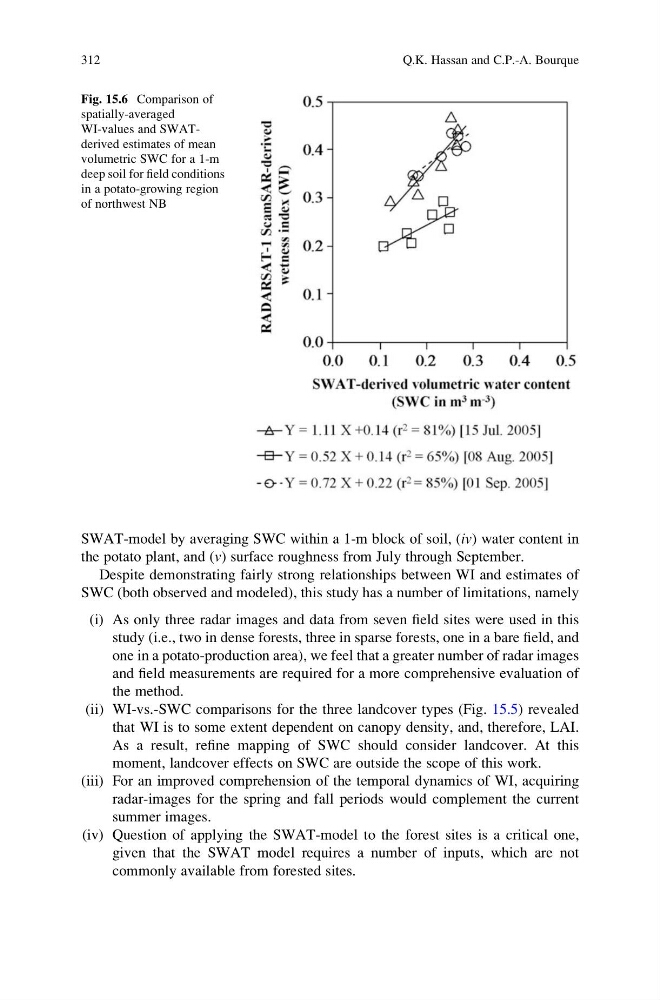
Fig. 15.6 Comparison of
spatially-averaged
WI-values and SWATderived estimates of mean
volumetric SWC for a 1-m
deep soil for field conditions
in a potato-growing region
of northwest NB
312
Q.K. Hassan and C.P.-A. Bourque
the potato plant, and (v) surface roughness from July through September.
Despite demonstrating fairly strong relationships between WI and estimates of
SWC (both observed and modeled), this study has a number of limitations, namely
(i) As only three radar images and data from seven field sites were used in this
study (i.e., two in dense forests, three in sparse forests, one in a bare field, and
one in a potato-production area), we feel that a greater number of radar images
and field measurements are required for a more comprehensive evaluation of
the method.
(ii) WI-vs.-SWC comparisons for the three landcover types (Fig. 15.5) revealed
that WI is to some extent dependent on canopy density, and, therefore, LAI.
As a result, refine mapping of SWC should consider landcover. At this
moment, landcover effects on SWC are outside the scope of this work.
(iii) For an improved comprehension of the temporal dynamics of WI, acquiring
radar-images for the spring and fall periods would complement the current
summer images.
(iv) Question of applying the SWAT-model to the forest sites is a critical one,
given that the SWAT model requires a number of inputs, which are not
commonly available from forested sites.
Fig. 15.6 Comparison of
spatially-averaged
WI-values and SWATderived estimates of mean
volumetric SWC for a 1-m
deep soil for field conditions
in a potato-growing region
of northwest NB
312
Q.K. Hassan and C.P.-A. Bourque