

features is concerned with of significance to the radar backscatter? Secondly, which
ground parameter(s) determine(s) a ‘boundary’ or tonal change?
14.7.1 Tone
The visual interpretation of a radar image attempts to infer significant features in an
area from observed tonal variation. Unlike aerial photography, where changes in
tone are related to the reflection characteristics of an illuminated surface averaged
over a relatively broad spectrum, radar image tone is the result of reflection at only
one wavelength. The tonal expression in a SAR scene is generally a function of the
strength of the radar backscatter form a corresponding ground area. The variations
in the average backscatter cross-section σ
o for a given target has a profound
influence on radar image tone, and therefore on the interpretability. σ
o is a function
of many parameters:
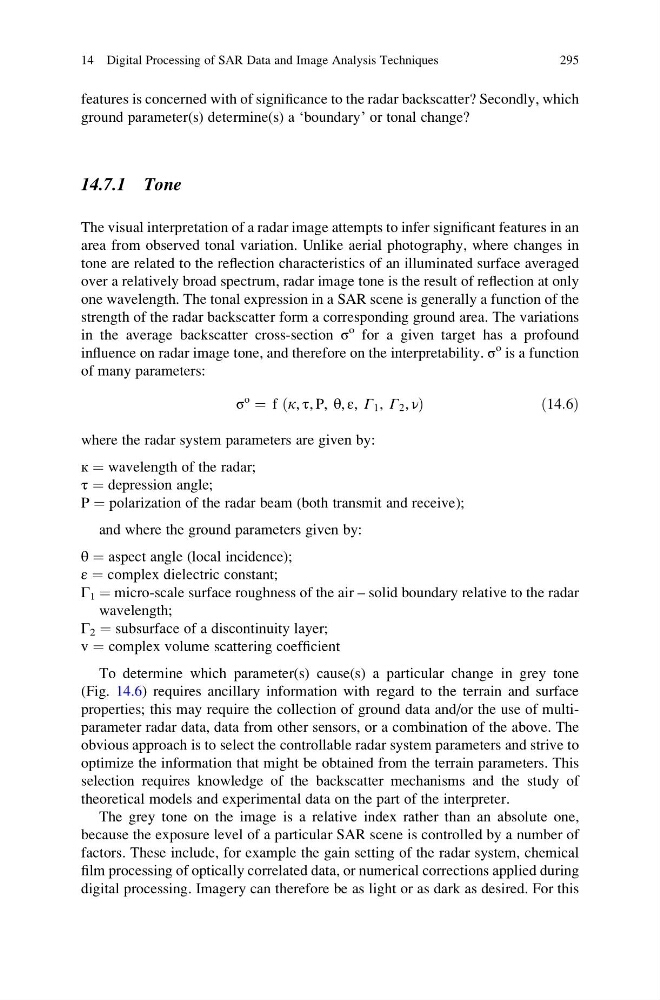
σ
o
¼ f к, τ, P, θ, ε, Γ 1 , Γ 2 , ν
ð
Þ
ð 14:6Þ
where the radar system parameters are given by:
к ¼ wavelength of the radar;
τ ¼ depression angle;
P ¼ polarization of the radar beam (both transmit and receive);
and where the ground parameters given by:
θ ¼ aspect angle (local incidence);
ε ¼ complex dielectric constant;
Γ 1 ¼ micro-scale surface roughness of the air – solid boundary relative to the radar
wavelength;
Γ 2 ¼ subsurface of a discontinuity layer;
v ¼ complex volume scattering coefficient
To determine which parameter(s) cause(s) a particular change in grey tone
(Fig. 14.6) requires ancillary information with regard to the terrain and surface
properties; this may require the collection of ground data and/or the use of multiparameter radar data, data from other sensors, or a combination of the above. The
obvious approach is to select the controllable radar system parameters and strive to
optimize the information that might be obtained from the terrain parameters. This
selection requires knowledge of the backscatter mechanisms and the study of
theoretical models and experimental data on the part of the interpreter.
The grey tone on the image is a relative index rather than an absolute one,
because the exposure level of a particular SAR scene is controlled by a number of
factors. These include, for example the gain setting of the radar system, chemical
film processing of optically correlated data, or numerical corrections applied during
digital processing. Imagery can therefore be as light or as dark as desired. For this
14 Digital Processing of SAR Data and Image Analysis Techniques
295
ground parameter(s) determine(s) a ‘boundary’ or tonal change?
14.7.1 Tone
The visual interpretation of a radar image attempts to infer significant features in an
area from observed tonal variation. Unlike aerial photography, where changes in
tone are related to the reflection characteristics of an illuminated surface averaged
over a relatively broad spectrum, radar image tone is the result of reflection at only
one wavelength. The tonal expression in a SAR scene is generally a function of the
strength of the radar backscatter form a corresponding ground area. The variations
in the average backscatter cross-section σ
o for a given target has a profound
influence on radar image tone, and therefore on the interpretability. σ
o is a function
of many parameters:
σ
o
¼ f к, τ, P, θ, ε, Γ 1 , Γ 2 , ν
ð
Þ
ð 14:6Þ
where the radar system parameters are given by:
к ¼ wavelength of the radar;
τ ¼ depression angle;
P ¼ polarization of the radar beam (both transmit and receive);
and where the ground parameters given by:
θ ¼ aspect angle (local incidence);
ε ¼ complex dielectric constant;
Γ 1 ¼ micro-scale surface roughness of the air – solid boundary relative to the radar
wavelength;
Γ 2 ¼ subsurface of a discontinuity layer;
v ¼ complex volume scattering coefficient
To determine which parameter(s) cause(s) a particular change in grey tone
(Fig. 14.6) requires ancillary information with regard to the terrain and surface
properties; this may require the collection of ground data and/or the use of multiparameter radar data, data from other sensors, or a combination of the above. The
obvious approach is to select the controllable radar system parameters and strive to
optimize the information that might be obtained from the terrain parameters. This
selection requires knowledge of the backscatter mechanisms and the study of
theoretical models and experimental data on the part of the interpreter.
The grey tone on the image is a relative index rather than an absolute one,
because the exposure level of a particular SAR scene is controlled by a number of
factors. These include, for example the gain setting of the radar system, chemical
film processing of optically correlated data, or numerical corrections applied during
digital processing. Imagery can therefore be as light or as dark as desired. For this
14 Digital Processing of SAR Data and Image Analysis Techniques
295