

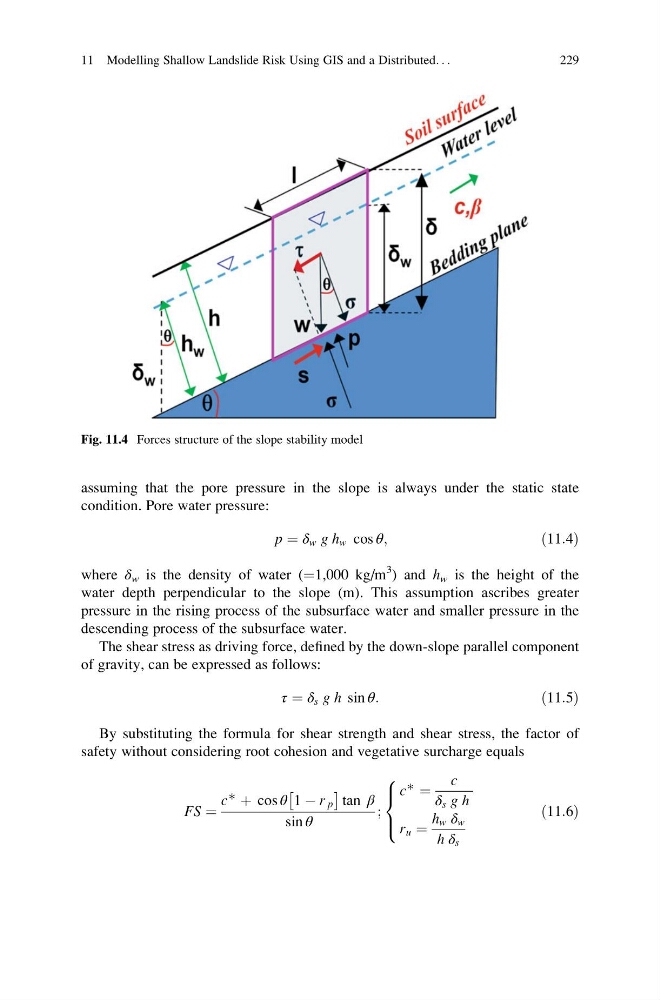
assuming that the pore pressure in the slope is always under the static state
condition. Pore water pressure:
p ¼ δ w g h w cos θ;
ð11:4Þ
where δ w is the density of water (¼1,000 kg/m
3 ) and h w is the height of the
water depth perpendicular to the slope (m). This assumption ascribes greater
pressure in the rising process of the subsurface water and smaller pressure in the
descending process of the subsurface water.
The shear stress as driving force, defined by the down-slope parallel component
of gravity, can be expressed as follows:
τ ¼ δ s g h sin θ:
ð11:5Þ
By substituting the formula for shear strength and shear stress, the factor of
safety without considering root cohesion and vegetative surcharge equals
FS ¼
c
∗
þ cos θ 1 À r p
Â
Ã
tan β
sin θ
;
c
∗
¼
c
δ s g h
r u ¼
h w δ w
h δ s
8
> <
> :
ð11:6Þ
Fig. 11.4 Forces structure of the slope stability model
11 Modelling Shallow Landslide Risk Using GIS and a Distributed. . .
229
condition. Pore water pressure:
p ¼ δ w g h w cos θ;
ð11:4Þ
where δ w is the density of water (¼1,000 kg/m
3 ) and h w is the height of the
water depth perpendicular to the slope (m). This assumption ascribes greater
pressure in the rising process of the subsurface water and smaller pressure in the
descending process of the subsurface water.
The shear stress as driving force, defined by the down-slope parallel component
of gravity, can be expressed as follows:
τ ¼ δ s g h sin θ:
ð11:5Þ
By substituting the formula for shear strength and shear stress, the factor of
safety without considering root cohesion and vegetative surcharge equals
FS ¼
c
∗
þ cos θ 1 À r p
Â
Ã
tan β
sin θ
;
c
∗
¼
c
δ s g h
r u ¼
h w δ w
h δ s
8
> <
> :
ð11:6Þ
Fig. 11.4 Forces structure of the slope stability model
11 Modelling Shallow Landslide Risk Using GIS and a Distributed. . .
229