

Logarithmic projection should be adopted as a pre-processing step for SAR sea
ice image segmentation in general. Most statistical methods, e.g. PCA, K-Means
and GMM rely on symmetric distributed noise with constant noise level. However,
this requirement cannot be satisfied in the case of SAR imagery, where the
multiplicative speckle noise assumes “heavy-tailed” distribution with unstable
variance. Nevertheless, after mapping nonlinearly into logarithmic domain, the
PDF of speckle noise is close to Gaussian distribution, with constant mean and
variance (Hoekman 2001). This conclusion is confirmed by experiments. For
example, in Figs. 6.8, 6.9, and 6.10, where the classical K-Means method
misclassified seawater with gray ice, the log K-Means, which works in logarithmic
domain, demonstrated better separation of different sea ice types.
Last, the proposed method is much more computationally efficient than other
advanced algorithms, i.e. GLCM and MRF. All the algorithms were implemented
in MATLAB, and ran on a PC with an Inter(R) 2.40GHZ Quad-Core processor. To
process a 256 Â 256 pixels sub-image, it took K-Means, proposed method, GLCM
and MRF 0.038, 0.619, 113.090, and 5049.462 s, respectively.
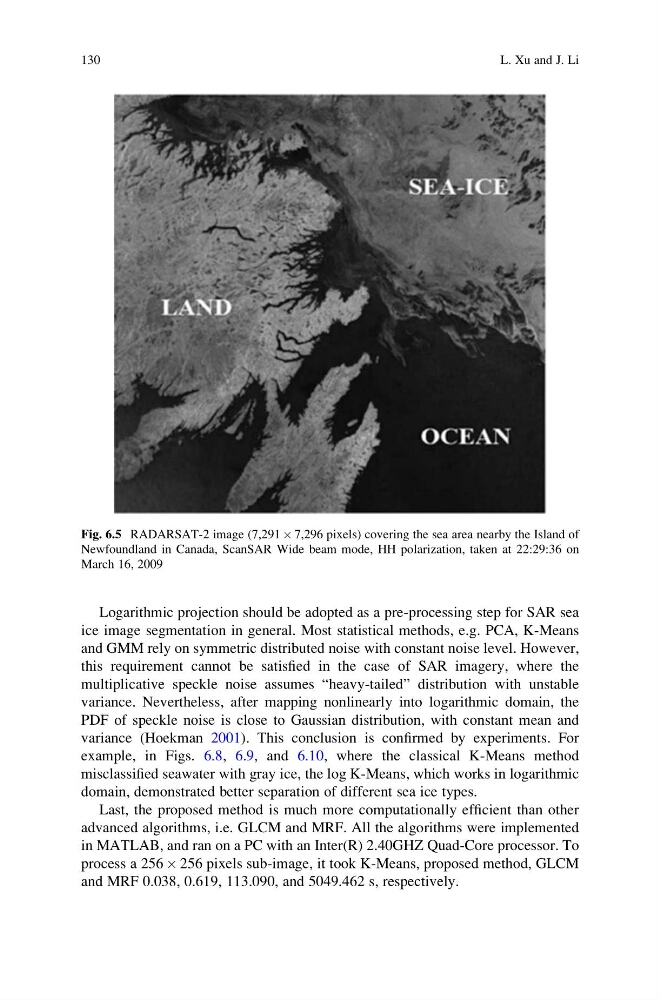
Fig. 6.5 RADARSAT-2 image (7,291 Â 7,296 pixels) covering the sea area nearby the Island of
Newfoundland in Canada, ScanSAR Wide beam mode, HH polarization, taken at 22:29:36 on
March 16, 2009
130
L. Xu and J. Li
ice image segmentation in general. Most statistical methods, e.g. PCA, K-Means
and GMM rely on symmetric distributed noise with constant noise level. However,
this requirement cannot be satisfied in the case of SAR imagery, where the
multiplicative speckle noise assumes “heavy-tailed” distribution with unstable
variance. Nevertheless, after mapping nonlinearly into logarithmic domain, the
PDF of speckle noise is close to Gaussian distribution, with constant mean and
variance (Hoekman 2001). This conclusion is confirmed by experiments. For
example, in Figs. 6.8, 6.9, and 6.10, where the classical K-Means method
misclassified seawater with gray ice, the log K-Means, which works in logarithmic
domain, demonstrated better separation of different sea ice types.
Last, the proposed method is much more computationally efficient than other
advanced algorithms, i.e. GLCM and MRF. All the algorithms were implemented
in MATLAB, and ran on a PC with an Inter(R) 2.40GHZ Quad-Core processor. To
process a 256 Â 256 pixels sub-image, it took K-Means, proposed method, GLCM
and MRF 0.038, 0.619, 113.090, and 5049.462 s, respectively.
Fig. 6.5 RADARSAT-2 image (7,291 Â 7,296 pixels) covering the sea area nearby the Island of
Newfoundland in Canada, ScanSAR Wide beam mode, HH polarization, taken at 22:29:36 on
March 16, 2009
130
L. Xu and J. Li