

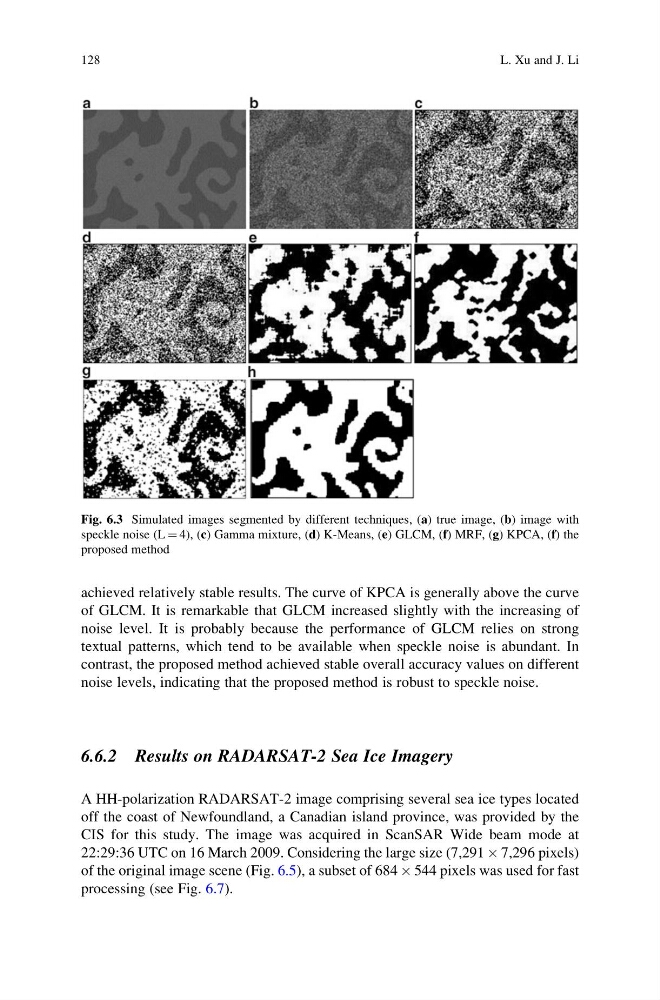
achieved relatively stable results. The curve of KPCA is generally above the curve
of GLCM. It is remarkable that GLCM increased slightly with the increasing of
noise level. It is probably because the performance of GLCM relies on strong
textual patterns, which tend to be available when speckle noise is abundant. In
contrast, the proposed method achieved stable overall accuracy values on different
noise levels, indicating that the proposed method is robust to speckle noise.
6.6.2 Results on RADARSAT-2 Sea Ice Imagery
A HH-polarization RADARSAT-2 image comprising several sea ice types located
off the coast of Newfoundland, a Canadian island province, was provided by the
CIS for this study. The image was acquired in ScanSAR Wide beam mode at
22:29:36 UTC on 16 March 2009. Considering the large size (7,291 Â 7,296 pixels)
of the original image scene (Fig. 6.5), a subset of 684 Â 544 pixels was used for fast
processing (see Fig. 6.7).
Fig. 6.3 Simulated images segmented by different techniques, (a) true image, (b) image with
speckle noise (L ¼ 4), (c) Gamma mixture, (d) K-Means, (e) GLCM, (f) MRF, (g) KPCA, (f) the
proposed method
128
L. Xu and J. Li
of GLCM. It is remarkable that GLCM increased slightly with the increasing of
noise level. It is probably because the performance of GLCM relies on strong
textual patterns, which tend to be available when speckle noise is abundant. In
contrast, the proposed method achieved stable overall accuracy values on different
noise levels, indicating that the proposed method is robust to speckle noise.
6.6.2 Results on RADARSAT-2 Sea Ice Imagery
A HH-polarization RADARSAT-2 image comprising several sea ice types located
off the coast of Newfoundland, a Canadian island province, was provided by the
CIS for this study. The image was acquired in ScanSAR Wide beam mode at
22:29:36 UTC on 16 March 2009. Considering the large size (7,291 Â 7,296 pixels)
of the original image scene (Fig. 6.5), a subset of 684 Â 544 pixels was used for fast
processing (see Fig. 6.7).
Fig. 6.3 Simulated images segmented by different techniques, (a) true image, (b) image with
speckle noise (L ¼ 4), (c) Gamma mixture, (d) K-Means, (e) GLCM, (f) MRF, (g) KPCA, (f) the
proposed method
128
L. Xu and J. Li