

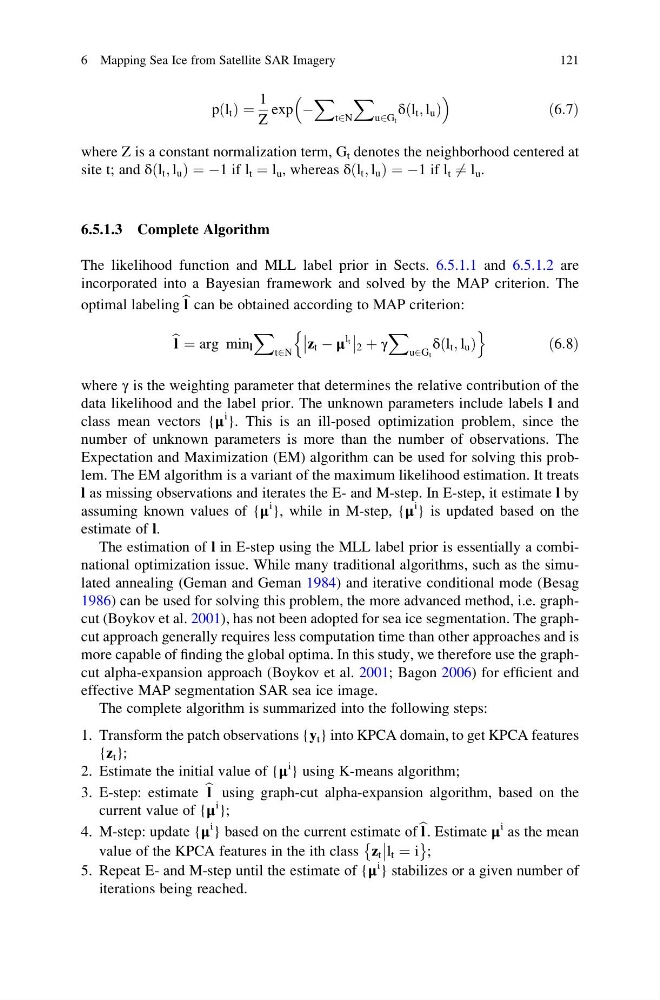
p l t
ð Þ ¼
1
Z
exp À
X
t2N
X
u2G t
δ l t ; l u
ð
Þ
ð6:7Þ
where Z is a constant normalization term, G t denotes the neighborhood centered at
site t; and δ l t ; l u
ð
Þ ¼ À1 if l t ¼ l u , whereas δ l t ; l u
ð
Þ ¼ À1 if l t 6 ¼ l u .
6.5.1.3 Complete Algorithm
The likelihood function and MLL label prior in Sects. 6.5.1.1 and 6.5.1.2 are
incorporated into a Bayesian framework and solved by the MAP criterion. The
optimal labeling b l can be obtained according to MAP criterion:
b l ¼ arg min l
X
t2N
z t À μ
l t
2 þ γ
X
u2G t
δ l t ; l u
ð
Þ
n
o
ð6:8Þ
where γ is the weighting parameter that determines the relative contribution of the
data likelihood and the label prior. The unknown parameters include labels l and
class mean vectors {μ
i
}. This is an ill-posed optimization problem, since the
number of unknown parameters is more than the number of observations. The
Expectation and Maximization (EM) algorithm can be used for solving this problem. The EM algorithm is a variant of the maximum likelihood estimation. It treats
l as missing observations and iterates the E- and M-step. In E-step, it estimate l by
assuming known values of {μ
i
}, while in M-step, {μ
i
} is updated based on the
estimate of l.
The estimation of l in E-step using the MLL label prior is essentially a combinational optimization issue. While many traditional algorithms, such as the simulated annealing (Geman and Geman 1984) and iterative conditional mode (Besag
1986) can be used for solving this problem, the more advanced method, i.e. graphcut (Boykov et al. 2001), has not been adopted for sea ice segmentation. The graphcut approach generally requires less computation time than other approaches and is
more capable of finding the global optima. In this study, we therefore use the graphcut alpha-expansion approach (Boykov et al. 2001; Bagon 2006) for efficient and
effective MAP segmentation SAR sea ice image.
The complete algorithm is summarized into the following steps:
1. Transform the patch observations {y t } into KPCA domain, to get KPCA features
{z t };
2. Estimate the initial value of {μ
i
} using K-means algorithm;
3. E-step: estimate b l using graph-cut alpha-expansion algorithm, based on the
current value of {μ
i
};
4. M-step: update {μ
i
} based on the current estimate of b l . Estimate μ
i as the mean
value of the KPCA features in the ith class z t
l t ¼ i
È
É
;
5. Repeat E- and M-step until the estimate of {μ
i } stabilizes or a given number of
iterations being reached.
6 Mapping Sea Ice from Satellite SAR Imagery
121
ð Þ ¼
1
Z
exp À
X
t2N
X
u2G t
δ l t ; l u
ð
Þ
ð6:7Þ
where Z is a constant normalization term, G t denotes the neighborhood centered at
site t; and δ l t ; l u
ð
Þ ¼ À1 if l t ¼ l u , whereas δ l t ; l u
ð
Þ ¼ À1 if l t 6 ¼ l u .
6.5.1.3 Complete Algorithm
The likelihood function and MLL label prior in Sects. 6.5.1.1 and 6.5.1.2 are
incorporated into a Bayesian framework and solved by the MAP criterion. The
optimal labeling b l can be obtained according to MAP criterion:
b l ¼ arg min l
X
t2N
z t À μ
l t
2 þ γ
X
u2G t
δ l t ; l u
ð
Þ
n
o
ð6:8Þ
where γ is the weighting parameter that determines the relative contribution of the
data likelihood and the label prior. The unknown parameters include labels l and
class mean vectors {μ
i
}. This is an ill-posed optimization problem, since the
number of unknown parameters is more than the number of observations. The
Expectation and Maximization (EM) algorithm can be used for solving this problem. The EM algorithm is a variant of the maximum likelihood estimation. It treats
l as missing observations and iterates the E- and M-step. In E-step, it estimate l by
assuming known values of {μ
i
}, while in M-step, {μ
i
} is updated based on the
estimate of l.
The estimation of l in E-step using the MLL label prior is essentially a combinational optimization issue. While many traditional algorithms, such as the simulated annealing (Geman and Geman 1984) and iterative conditional mode (Besag
1986) can be used for solving this problem, the more advanced method, i.e. graphcut (Boykov et al. 2001), has not been adopted for sea ice segmentation. The graphcut approach generally requires less computation time than other approaches and is
more capable of finding the global optima. In this study, we therefore use the graphcut alpha-expansion approach (Boykov et al. 2001; Bagon 2006) for efficient and
effective MAP segmentation SAR sea ice image.
The complete algorithm is summarized into the following steps:
1. Transform the patch observations {y t } into KPCA domain, to get KPCA features
{z t };
2. Estimate the initial value of {μ
i
} using K-means algorithm;
3. E-step: estimate b l using graph-cut alpha-expansion algorithm, based on the
current value of {μ
i
};
4. M-step: update {μ
i
} based on the current estimate of b l . Estimate μ
i as the mean
value of the KPCA features in the ith class z t
l t ¼ i
È
É
;
5. Repeat E- and M-step until the estimate of {μ
i } stabilizes or a given number of
iterations being reached.
6 Mapping Sea Ice from Satellite SAR Imagery
121