

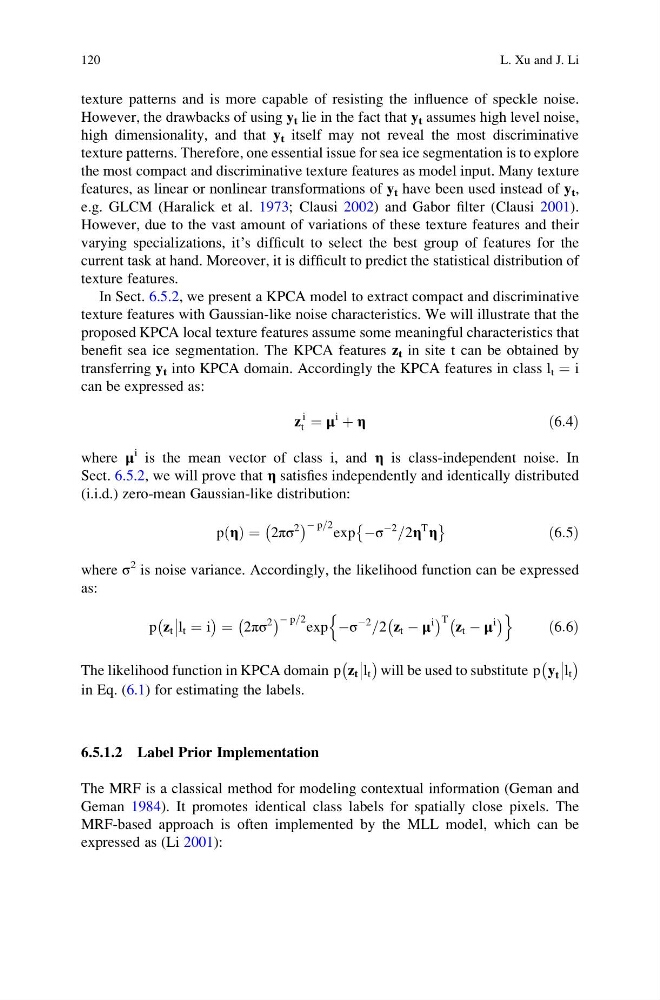
texture patterns and is more capable of resisting the influence of speckle noise.
However, the drawbacks of using y t lie in the fact that y t assumes high level noise,
high dimensionality, and that y t itself may not reveal the most discriminative
texture patterns. Therefore, one essential issue for sea ice segmentation is to explore
the most compact and discriminative texture features as model input. Many texture
features, as linear or nonlinear transformations of y t have been used instead of y t ,
e.g. GLCM (Haralick et al. 1973; Clausi 2002) and Gabor filter (Clausi 2001).
However, due to the vast amount of variations of these texture features and their
varying specializations, it’s difficult to select the best group of features for the
current task at hand. Moreover, it is difficult to predict the statistical distribution of
texture features.
In Sect. 6.5.2, we present a KPCA model to extract compact and discriminative
texture features with Gaussian-like noise characteristics. We will illustrate that the
proposed KPCA local texture features assume some meaningful characteristics that
benefit sea ice segmentation. The KPCA features z t in site t can be obtained by
transferring y t into KPCA domain. Accordingly the KPCA features in class l t ¼ i
can be expressed as:
z
i
t ¼ μ
i
þ η
ð6:4Þ
where μ
i is the mean vector of class i, and η is class-independent noise. In
Sect. 6.5.2, we will prove that η satisfies independently and identically distributed
(i.i.d.) zero-mean Gaussian-like distribution:
p η
ð Þ ¼ 2πσ
2
À
Á À p=2 exp Àσ
À2
=2η
T
η
È
É
ð6:5Þ
where σ
2 is noise variance. Accordingly, the likelihood function can be expressed
as:
p z t
l t ¼ i
À
Á ¼ 2πσ
2
À
Á À p=2 exp Àσ
À2
=2 z t À μ
i
À
Á T z t À μ
i
À
Á
n
o
ð6:6Þ
The likelihood function in KPCA domain p z t
l t
À
Á
will be used to substitute p y t
l t
À
Á
in Eq. (6.1) for estimating the labels.
6.5.1.2 Label Prior Implementation
The MRF is a classical method for modeling contextual information (Geman and
Geman 1984). It promotes identical class labels for spatially close pixels. The
MRF-based approach is often implemented by the MLL model, which can be
expressed as (Li 2001):
120
L. Xu and J. Li
However, the drawbacks of using y t lie in the fact that y t assumes high level noise,
high dimensionality, and that y t itself may not reveal the most discriminative
texture patterns. Therefore, one essential issue for sea ice segmentation is to explore
the most compact and discriminative texture features as model input. Many texture
features, as linear or nonlinear transformations of y t have been used instead of y t ,
e.g. GLCM (Haralick et al. 1973; Clausi 2002) and Gabor filter (Clausi 2001).
However, due to the vast amount of variations of these texture features and their
varying specializations, it’s difficult to select the best group of features for the
current task at hand. Moreover, it is difficult to predict the statistical distribution of
texture features.
In Sect. 6.5.2, we present a KPCA model to extract compact and discriminative
texture features with Gaussian-like noise characteristics. We will illustrate that the
proposed KPCA local texture features assume some meaningful characteristics that
benefit sea ice segmentation. The KPCA features z t in site t can be obtained by
transferring y t into KPCA domain. Accordingly the KPCA features in class l t ¼ i
can be expressed as:
z
i
t ¼ μ
i
þ η
ð6:4Þ
where μ
i is the mean vector of class i, and η is class-independent noise. In
Sect. 6.5.2, we will prove that η satisfies independently and identically distributed
(i.i.d.) zero-mean Gaussian-like distribution:
p η
ð Þ ¼ 2πσ
2
À
Á À p=2 exp Àσ
À2
=2η
T
η
È
É
ð6:5Þ
where σ
2 is noise variance. Accordingly, the likelihood function can be expressed
as:
p z t
l t ¼ i
À
Á ¼ 2πσ
2
À
Á À p=2 exp Àσ
À2
=2 z t À μ
i
À
Á T z t À μ
i
À
Á
n
o
ð6:6Þ
The likelihood function in KPCA domain p z t
l t
À
Á
will be used to substitute p y t
l t
À
Á
in Eq. (6.1) for estimating the labels.
6.5.1.2 Label Prior Implementation
The MRF is a classical method for modeling contextual information (Geman and
Geman 1984). It promotes identical class labels for spatially close pixels. The
MRF-based approach is often implemented by the MLL model, which can be
expressed as (Li 2001):
120
L. Xu and J. Li