

60
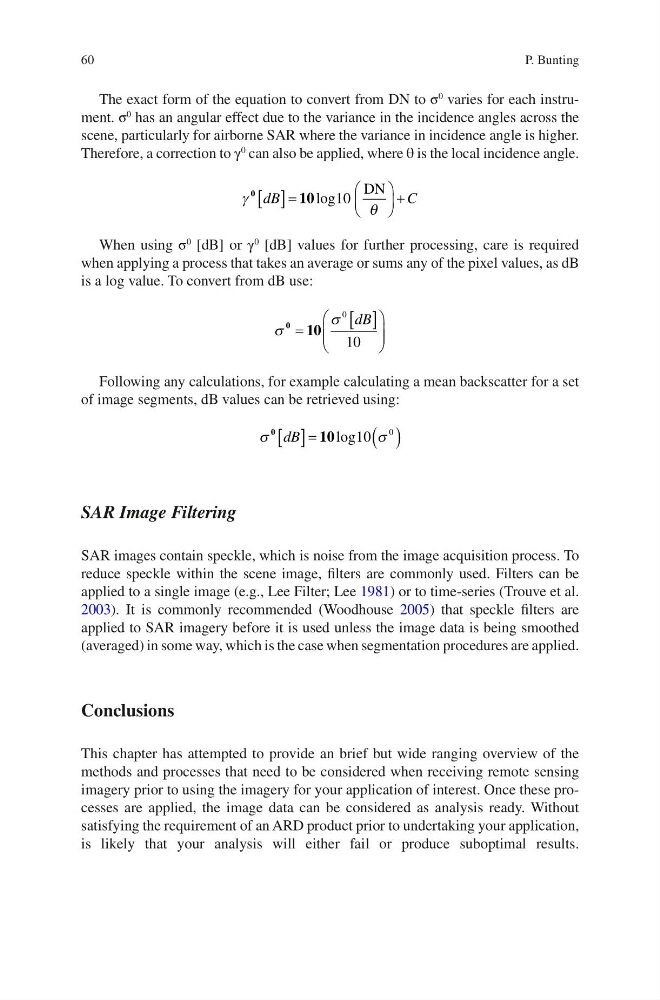
The exact form of the equation to convert from DN to σ
0
varies for each instrument. σ
0
has an angular effect due to the variance in the incidence angles across the
scene, particularly for airborne SAR where the variance in incidence angle is higher.
Therefore, a correction to γ
0
can also be applied, where θ is the local incidence angle.
g
q
0
10
dB
C
[ ]=
æ
è
ç
ö
ø
÷ +
log10
DN
When using σ
0
[dB] or γ
0
[dB] values for further processing, care is required
when applying a process that takes an average or sums any of the pixel values, as dB
is a log value. To convert from dB use:
s
s
0
10
=
[ ]
æ
è
ç ç
ö
ø
÷ ÷
0
10
dB
Following any calculations, for example calculating a mean backscatter for a set
of image segments, dB values can be retrieved using:
s
s
0
10
dB
[ ]=
( )
log10
0
SAR Image Filtering
SAR images contain speckle, which is noise from the image acquisition process. To
reduce speckle within the scene image, filters are commonly used. Filters can be
applied to a single image (e.g., Lee Filter; Lee 1981) or to time-series (Trouve et al.
2003). It is commonly recommended (Woodhouse 2005) that speckle filters are
applied to SAR imagery before it is used unless the image data is being smoothed
(averaged) in some way, which is the case when segmentation procedures are applied.
Conclusions
This chapter has attempted to provide an brief but wide ranging overview of the
methods and processes that need to be considered when receiving remote sensing
imagery prior to using the imagery for your application of interest. Once these processes are applied, the image data can be considered as analysis ready. Without
satisfying the requirement of an ARD product prior to undertaking your application,
is likely that your analysis will either fail or produce suboptimal results.
P. Bunting
The exact form of the equation to convert from DN to σ
0
varies for each instrument. σ
0
has an angular effect due to the variance in the incidence angles across the
scene, particularly for airborne SAR where the variance in incidence angle is higher.
Therefore, a correction to γ
0
can also be applied, where θ is the local incidence angle.
g
q
0
10
dB
C
[ ]=
æ
è
ç
ö
ø
÷ +
log10
DN
When using σ
0
[dB] or γ
0
[dB] values for further processing, care is required
when applying a process that takes an average or sums any of the pixel values, as dB
is a log value. To convert from dB use:
s
s
0
10
=
[ ]
æ
è
ç ç
ö
ø
÷ ÷
0
10
dB
Following any calculations, for example calculating a mean backscatter for a set
of image segments, dB values can be retrieved using:
s
s
0
10
dB
[ ]=
( )
log10
0
SAR Image Filtering
SAR images contain speckle, which is noise from the image acquisition process. To
reduce speckle within the scene image, filters are commonly used. Filters can be
applied to a single image (e.g., Lee Filter; Lee 1981) or to time-series (Trouve et al.
2003). It is commonly recommended (Woodhouse 2005) that speckle filters are
applied to SAR imagery before it is used unless the image data is being smoothed
(averaged) in some way, which is the case when segmentation procedures are applied.
Conclusions
This chapter has attempted to provide an brief but wide ranging overview of the
methods and processes that need to be considered when receiving remote sensing
imagery prior to using the imagery for your application of interest. Once these processes are applied, the image data can be considered as analysis ready. Without
satisfying the requirement of an ARD product prior to undertaking your application,
is likely that your analysis will either fail or produce suboptimal results.
P. Bunting