

304
and increased river discharge). The accumulation of evidence to support the interpretation of the change event or process provides the user with information to facilitate a response and manage change effectively.
Whilst the LCCS-2 provides a means to describe land covers, few taxonomies
are available for describing and documenting change. However, a review of transition events and processes conducted in support of the EODESM change detection
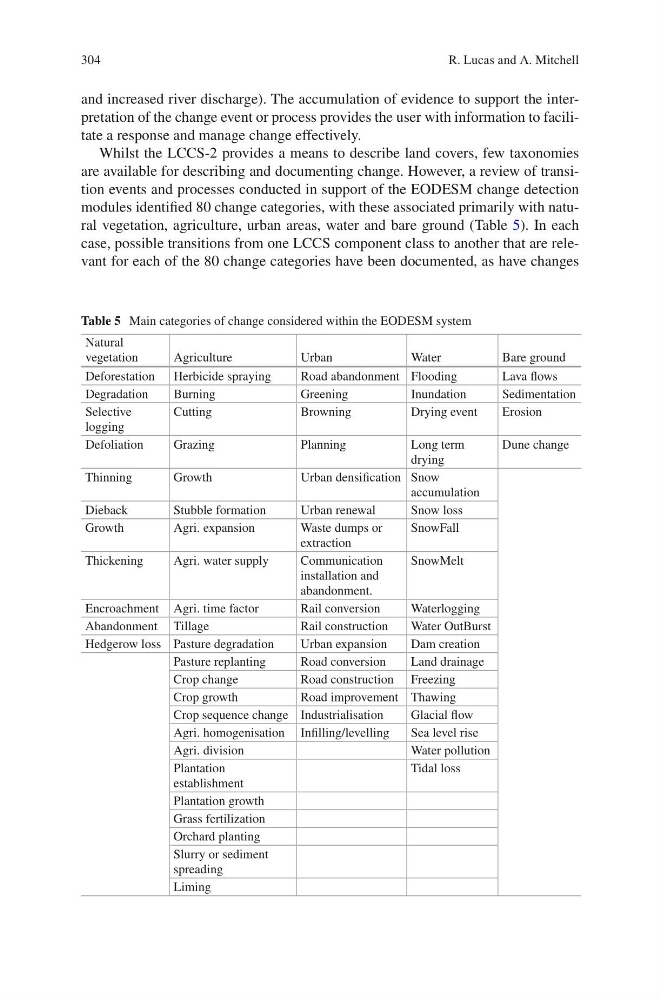
modules identified 80 change categories, with these associated primarily with natural vegetation, agriculture, urban areas, water and bare ground (Table 5). In each
case, possible transitions from one LCCS component class to another that are relevant for each of the 80 change categories have been documented, as have changes
Table 5 Main categories of change considered within the EODESM system
Natural
vegetation
Agriculture
Urban
Water
Bare ground
Deforestation Herbicide spraying
Road abandonment Flooding
Lava flows
Degradation
Burning
Greening
Inundation
Sedimentation
Selective
logging
Cutting
Browning
Drying event
Erosion
Defoliation
Grazing
Planning
Long term
drying
Dune change
Thinning
Growth
Urban densification Snow
accumulation
Dieback
Stubble formation
Urban renewal
Snow loss
Growth
Agri. expansion
Waste dumps or
extraction
SnowFall
Thickening
Agri. water supply
Communication
installation and
abandonment.
SnowMelt
Encroachment Agri. time factor
Rail conversion
Waterlogging
Abandonment Tillage
Rail construction
Water OutBurst
Hedgerow loss Pasture degradation
Urban expansion
Dam creation
Pasture replanting
Road conversion
Land drainage
Crop change
Road construction Freezing
Crop growth
Road improvement Thawing
Crop sequence change Industrialisation
Glacial flow
Agri. homogenisation Infilling/levelling
Sea level rise
Agri. division
Water pollution
Plantation
establishment
Tidal loss
Plantation growth
Grass fertilization
Orchard planting
Slurry or sediment
spreading
Liming
R. Lucas and A. Mitchell
and increased river discharge). The accumulation of evidence to support the interpretation of the change event or process provides the user with information to facilitate a response and manage change effectively.
Whilst the LCCS-2 provides a means to describe land covers, few taxonomies
are available for describing and documenting change. However, a review of transition events and processes conducted in support of the EODESM change detection
modules identified 80 change categories, with these associated primarily with natural vegetation, agriculture, urban areas, water and bare ground (Table 5). In each
case, possible transitions from one LCCS component class to another that are relevant for each of the 80 change categories have been documented, as have changes
Table 5 Main categories of change considered within the EODESM system
Natural
vegetation
Agriculture
Urban
Water
Bare ground
Deforestation Herbicide spraying
Road abandonment Flooding
Lava flows
Degradation
Burning
Greening
Inundation
Sedimentation
Selective
logging
Cutting
Browning
Drying event
Erosion
Defoliation
Grazing
Planning
Long term
drying
Dune change
Thinning
Growth
Urban densification Snow
accumulation
Dieback
Stubble formation
Urban renewal
Snow loss
Growth
Agri. expansion
Waste dumps or
extraction
SnowFall
Thickening
Agri. water supply
Communication
installation and
abandonment.
SnowMelt
Encroachment Agri. time factor
Rail conversion
Waterlogging
Abandonment Tillage
Rail construction
Water OutBurst
Hedgerow loss Pasture degradation
Urban expansion
Dam creation
Pasture replanting
Road conversion
Land drainage
Crop change
Road construction Freezing
Crop growth
Road improvement Thawing
Crop sequence change Industrialisation
Glacial flow
Agri. homogenisation Infilling/levelling
Sea level rise
Agri. division
Water pollution
Plantation
establishment
Tidal loss
Plantation growth
Grass fertilization
Orchard planting
Slurry or sediment
spreading
Liming
R. Lucas and A. Mitchell