

284
Methods for Identifying Birds From UAV Imagery
Photointerpretation
Photointerpretation of the orthomosaics was based on simple eye identification of
birds, either lying, standing or flying. A point vector file was created while onscreen digitizing at 1:50 scale. Clutches, whenever visible (temporarily uncovered
by the parent), were also located in the image. Nest position was assigned by the
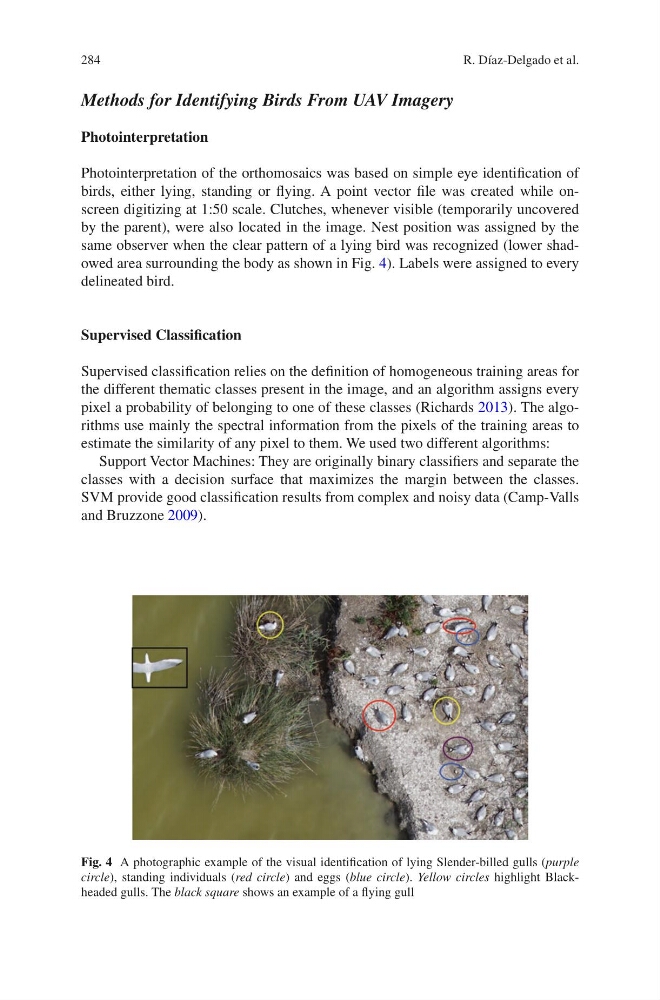
same observer when the clear pattern of a lying bird was recognized (lower shadowed area surrounding the body as shown in Fig. 4). Labels were assigned to every
delineated bird.
Supervised Classification
Supervised classification relies on the definition of homogeneous training areas for
the different thematic classes present in the image, and an algorithm assigns every
pixel a probability of belonging to one of these classes (Richards 2013). The algorithms use mainly the spectral information from the pixels of the training areas to
estimate the similarity of any pixel to them. We used two different algorithms:
Support Vector Machines: They are originally binary classifiers and separate the
classes with a decision surface that maximizes the margin between the classes.
SVM provide good classification results from complex and noisy data (Camp-Valls
and Bruzzone 2009).
Fig. 4 A photographic example of the visual identification of lying Slender-billed gulls (purple
circle), standing individuals (red circle) and eggs (blue circle). Yellow circles highlight Blackheaded gulls. The black square shows an example of a flying gull
R. Díaz-Delgado et al.
Methods for Identifying Birds From UAV Imagery
Photointerpretation
Photointerpretation of the orthomosaics was based on simple eye identification of
birds, either lying, standing or flying. A point vector file was created while onscreen digitizing at 1:50 scale. Clutches, whenever visible (temporarily uncovered
by the parent), were also located in the image. Nest position was assigned by the
same observer when the clear pattern of a lying bird was recognized (lower shadowed area surrounding the body as shown in Fig. 4). Labels were assigned to every
delineated bird.
Supervised Classification
Supervised classification relies on the definition of homogeneous training areas for
the different thematic classes present in the image, and an algorithm assigns every
pixel a probability of belonging to one of these classes (Richards 2013). The algorithms use mainly the spectral information from the pixels of the training areas to
estimate the similarity of any pixel to them. We used two different algorithms:
Support Vector Machines: They are originally binary classifiers and separate the
classes with a decision surface that maximizes the margin between the classes.
SVM provide good classification results from complex and noisy data (Camp-Valls
and Bruzzone 2009).
Fig. 4 A photographic example of the visual identification of lying Slender-billed gulls (purple
circle), standing individuals (red circle) and eggs (blue circle). Yellow circles highlight Blackheaded gulls. The black square shows an example of a flying gull
R. Díaz-Delgado et al.