

250
Introduction
Birdwatchers spend a lot of time counting birds, mostly to collect information for
their personal, regional and national archives, but also to contribute to nationally
organised surveillance schemes, such as the Wetland Bird Survey in the UK. Count
data can also feed back into conservation management (Rowell 2006), perhaps as
part of a monitoring project to trigger management change: this type of project
aligns well with Habitats Directive (European Commission 1992) obligations to
achieve favourable conservation status for internationally rare and declining
species.
The Levels of Observer Variation Associated with Bird Counts
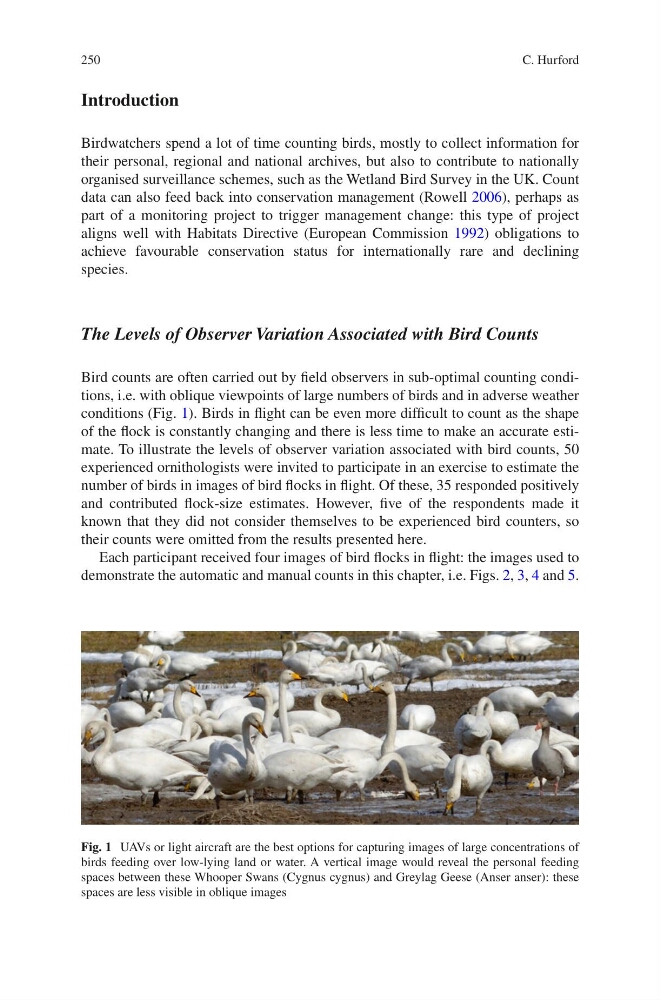
Bird counts are often carried out by field observers in sub-optimal counting conditions, i.e. with oblique viewpoints of large numbers of birds and in adverse weather
conditions (Fig. 1). Birds in flight can be even more difficult to count as the shape
of the flock is constantly changing and there is less time to make an accurate estimate. To illustrate the levels of observer variation associated with bird counts, 50
experienced ornithologists were invited to participate in an exercise to estimate the
number of birds in images of bird flocks in flight. Of these, 35 responded positively
and contributed flock-size estimates. However, five of the respondents made it
known that they did not consider themselves to be experienced bird counters, so
their counts were omitted from the results presented here.
Each participant received four images of bird flocks in flight: the images used to
demonstrate the automatic and manual counts in this chapter, i.e. Figs. 2, 3, 4 and 5.
Fig. 1 UAVs or light aircraft are the best options for capturing images of large concentrations of
birds feeding over low-lying land or water. A vertical image would reveal the personal feeding
spaces between these Whooper Swans (Cygnus cygnus) and Greylag Geese (Anser anser): these
spaces are less visible in oblique images
C. Hurford
Introduction
Birdwatchers spend a lot of time counting birds, mostly to collect information for
their personal, regional and national archives, but also to contribute to nationally
organised surveillance schemes, such as the Wetland Bird Survey in the UK. Count
data can also feed back into conservation management (Rowell 2006), perhaps as
part of a monitoring project to trigger management change: this type of project
aligns well with Habitats Directive (European Commission 1992) obligations to
achieve favourable conservation status for internationally rare and declining
species.
The Levels of Observer Variation Associated with Bird Counts
Bird counts are often carried out by field observers in sub-optimal counting conditions, i.e. with oblique viewpoints of large numbers of birds and in adverse weather
conditions (Fig. 1). Birds in flight can be even more difficult to count as the shape
of the flock is constantly changing and there is less time to make an accurate estimate. To illustrate the levels of observer variation associated with bird counts, 50
experienced ornithologists were invited to participate in an exercise to estimate the
number of birds in images of bird flocks in flight. Of these, 35 responded positively
and contributed flock-size estimates. However, five of the respondents made it
known that they did not consider themselves to be experienced bird counters, so
their counts were omitted from the results presented here.
Each participant received four images of bird flocks in flight: the images used to
demonstrate the automatic and manual counts in this chapter, i.e. Figs. 2, 3, 4 and 5.
Fig. 1 UAVs or light aircraft are the best options for capturing images of large concentrations of
birds feeding over low-lying land or water. A vertical image would reveal the personal feeding
spaces between these Whooper Swans (Cygnus cygnus) and Greylag Geese (Anser anser): these
spaces are less visible in oblique images
C. Hurford