

238
Land Cover Classifications and Carnivore Preferences
The classification of land covers for the IBMTCL is illustrated in Fig. 5. The majority of the lowland was occupied by closed moist mixed deciduous forests, with subtropical evergreen forest dominating the lower slopes and progressing into temperate
broadleaved and coniferous forests and then subalpine vegetation with increasing
elevation. Grasslands were found primarily in the south of the IBMTCL and riverine
vegetation and unconsolidated deposits occurred along the wide river channels.
Based on standard confusion matrices, the overall accuracy in the classification of
land covers was 81.5% (kappa coefficient of 0.78), with the majority of users’ or
producers’ accuracies exceeding 80% but being as low as 40% for some classes
(e.g., user’s accuracy 60% for cultivation and scrub, 56.7% for closed moist mixed
forests). Manas NP supported many of the habitats suitable for tigers including the
moist mixed deciduous forests (36.5%), semi-evergreen forest (19.1%), riverine
sandy areas (15.1%) and moist alluvial grassland (8.4%). During the observation
period, female tigers were most commonly recorded in the closed moist deciduous
forests, whereas males were also recorded in sandy riverine areas close to forests.
Although considered suitable because of the large numbers of prey, both sexes were
not recorded within the tall savanna grasslands but rather remained on the periphery.
Leopards and clouded leopards were observed primarily in the riverine areas.
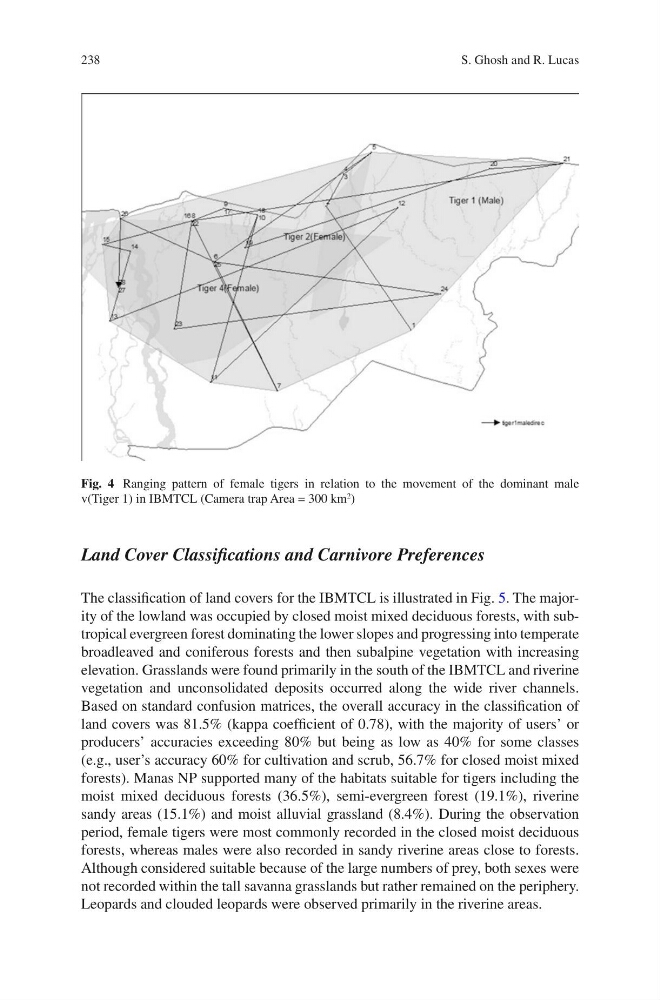
Fig. 4 Ranging pattern of female tigers in relation to the movement of the dominant male
v(Tiger 1) in IBMTCL (Camera trap Area = 300 km
2 )
S. Ghosh and R. Lucas
Land Cover Classifications and Carnivore Preferences
The classification of land covers for the IBMTCL is illustrated in Fig. 5. The majority of the lowland was occupied by closed moist mixed deciduous forests, with subtropical evergreen forest dominating the lower slopes and progressing into temperate
broadleaved and coniferous forests and then subalpine vegetation with increasing
elevation. Grasslands were found primarily in the south of the IBMTCL and riverine
vegetation and unconsolidated deposits occurred along the wide river channels.
Based on standard confusion matrices, the overall accuracy in the classification of
land covers was 81.5% (kappa coefficient of 0.78), with the majority of users’ or
producers’ accuracies exceeding 80% but being as low as 40% for some classes
(e.g., user’s accuracy 60% for cultivation and scrub, 56.7% for closed moist mixed
forests). Manas NP supported many of the habitats suitable for tigers including the
moist mixed deciduous forests (36.5%), semi-evergreen forest (19.1%), riverine
sandy areas (15.1%) and moist alluvial grassland (8.4%). During the observation
period, female tigers were most commonly recorded in the closed moist deciduous
forests, whereas males were also recorded in sandy riverine areas close to forests.
Although considered suitable because of the large numbers of prey, both sexes were
not recorded within the tall savanna grasslands but rather remained on the periphery.
Leopards and clouded leopards were observed primarily in the riverine areas.
Fig. 4 Ranging pattern of female tigers in relation to the movement of the dominant male
v(Tiger 1) in IBMTCL (Camera trap Area = 300 km
2 )
S. Ghosh and R. Lucas