

236
Ranging Pattern and Seasonal Home Range
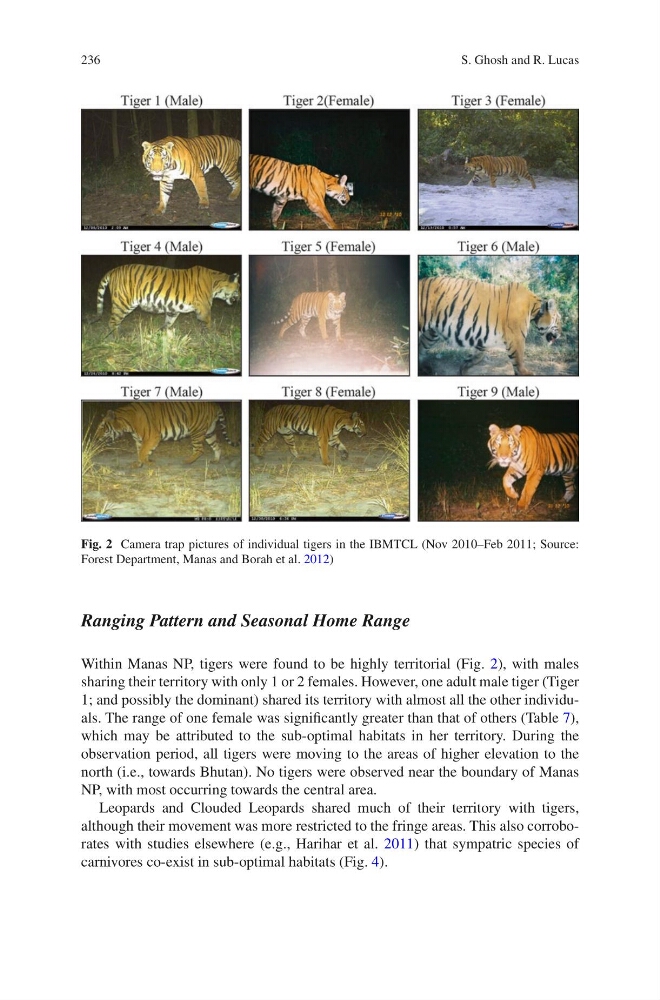
Within Manas NP, tigers were found to be highly territorial (Fig. 2), with males
sharing their territory with only 1 or 2 females. However, one adult male tiger (Tiger
1; and possibly the dominant) shared its territory with almost all the other individuals. The range of one female was significantly greater than that of others (Table 7),
which may be attributed to the sub-optimal habitats in her territory. During the
observation period, all tigers were moving to the areas of higher elevation to the
north (i.e., towards Bhutan). No tigers were observed near the boundary of Manas
NP, with most occurring towards the central area.
Leopards and Clouded Leopards shared much of their territory with tigers,
although their movement was more restricted to the fringe areas. This also corroborates with studies elsewhere (e.g., Harihar et al. 2011) that sympatric species of
carnivores co-exist in sub-optimal habitats (Fig. 4).
Fig. 2 Camera trap pictures of individual tigers in the IBMTCL (Nov 2010–Feb 2011; Source:
Forest Department, Manas and Borah et al. 2012)
S. Ghosh and R. Lucas
Ranging Pattern and Seasonal Home Range
Within Manas NP, tigers were found to be highly territorial (Fig. 2), with males
sharing their territory with only 1 or 2 females. However, one adult male tiger (Tiger
1; and possibly the dominant) shared its territory with almost all the other individuals. The range of one female was significantly greater than that of others (Table 7),
which may be attributed to the sub-optimal habitats in her territory. During the
observation period, all tigers were moving to the areas of higher elevation to the
north (i.e., towards Bhutan). No tigers were observed near the boundary of Manas
NP, with most occurring towards the central area.
Leopards and Clouded Leopards shared much of their territory with tigers,
although their movement was more restricted to the fringe areas. This also corroborates with studies elsewhere (e.g., Harihar et al. 2011) that sympatric species of
carnivores co-exist in sub-optimal habitats (Fig. 4).
Fig. 2 Camera trap pictures of individual tigers in the IBMTCL (Nov 2010–Feb 2011; Source:
Forest Department, Manas and Borah et al. 2012)
S. Ghosh and R. Lucas