

214
on bears and female reindeer that communicated with each other made this possible
(Karlsson et al. 2012).
GPS-equipped biotelemetry backpacks on golden eagles have also given important insights into home range sizes, home range use over time, dispersal of juveniles, and adult seasonal migrations. They also have supplied information on the
birds’ susceptibility to wind power plants and the mortality of eagles in general
(Singh et al. 2017).
Automatic Cameras
Today, automatic cameras are used widely, both in research and wildlife management as well as by the public. In wolverine surveillance, automatic cameras are
employed by County Administrations in Sweden to determine the occurrence and
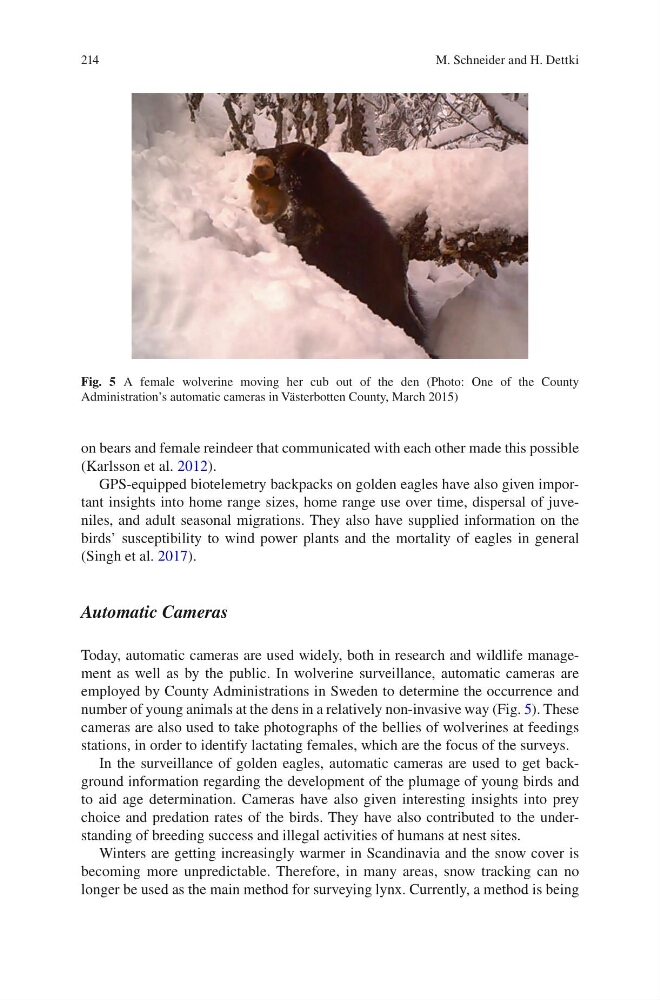
number of young animals at the dens in a relatively non-invasive way (Fig. 5). These
cameras are also used to take photographs of the bellies of wolverines at feedings
stations, in order to identify lactating females, which are the focus of the surveys.
In the surveillance of golden eagles, automatic cameras are used to get background information regarding the development of the plumage of young birds and
to aid age determination. Cameras have also given interesting insights into prey
choice and predation rates of the birds. They have also contributed to the understanding of breeding success and illegal activities of humans at nest sites.
Winters are getting increasingly warmer in Scandinavia and the snow cover is
becoming more unpredictable. Therefore, in many areas, snow tracking can no
longer be used as the main method for surveying lynx. Currently, a method is being
Fig. 5 A female wolverine moving her cub out of the den (Photo: One of the County
Administration’s automatic cameras in Västerbotten County, March 2015)
M. Schneider and H. Dettki
on bears and female reindeer that communicated with each other made this possible
(Karlsson et al. 2012).
GPS-equipped biotelemetry backpacks on golden eagles have also given important insights into home range sizes, home range use over time, dispersal of juveniles, and adult seasonal migrations. They also have supplied information on the
birds’ susceptibility to wind power plants and the mortality of eagles in general
(Singh et al. 2017).
Automatic Cameras
Today, automatic cameras are used widely, both in research and wildlife management as well as by the public. In wolverine surveillance, automatic cameras are
employed by County Administrations in Sweden to determine the occurrence and
number of young animals at the dens in a relatively non-invasive way (Fig. 5). These
cameras are also used to take photographs of the bellies of wolverines at feedings
stations, in order to identify lactating females, which are the focus of the surveys.
In the surveillance of golden eagles, automatic cameras are used to get background information regarding the development of the plumage of young birds and
to aid age determination. Cameras have also given interesting insights into prey
choice and predation rates of the birds. They have also contributed to the understanding of breeding success and illegal activities of humans at nest sites.
Winters are getting increasingly warmer in Scandinavia and the snow cover is
becoming more unpredictable. Therefore, in many areas, snow tracking can no
longer be used as the main method for surveying lynx. Currently, a method is being
Fig. 5 A female wolverine moving her cub out of the den (Photo: One of the County
Administration’s automatic cameras in Västerbotten County, March 2015)
M. Schneider and H. Dettki