

213
Results from GPS-tracked lynx have very much increased our understanding of
home range sizes and the animals’ movement within their ranges in different parts
of Scandinavia. These results are reflected in the spatio-temporal distance rules that
are applied when the number of family groups is determined during annual lynx
surveys (Gervasi et al. 2013).
Results from GPS-telemetry collars on wolves are regularly used to determine
which parts of the reindeer herding area these wolves have visited and for how long
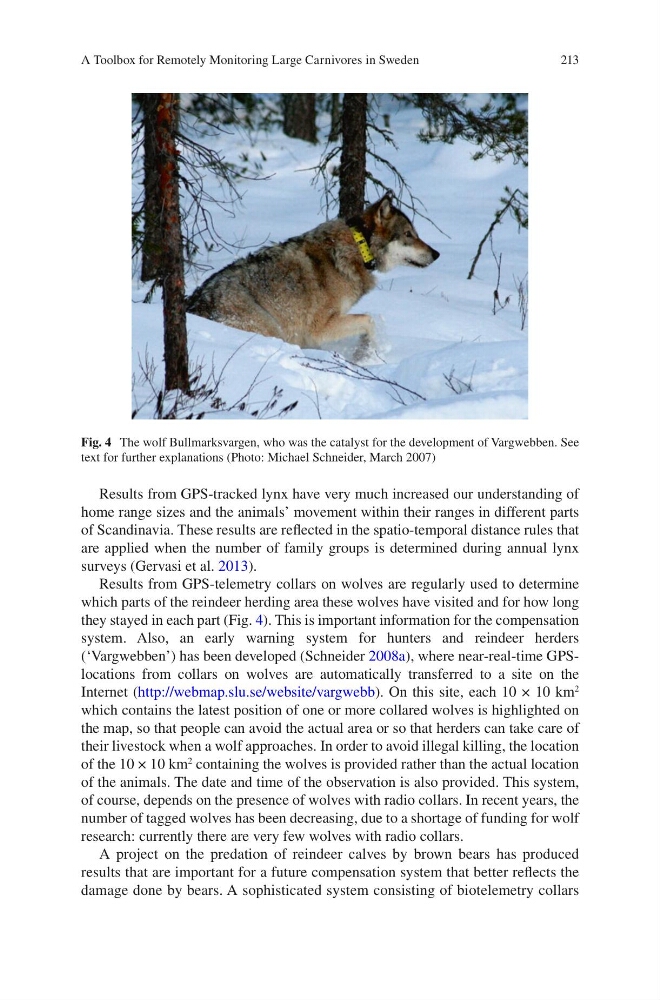
they stayed in each part (Fig. 4). This is important information for the compensation
system. Also, an early warning system for hunters and reindeer herders
(‘Vargwebben’) has been developed (Schneider 2008a), where near-real-time GPSlocations from collars on wolves are automatically transferred to a site on the
Internet (http://webmap.slu.se/website/vargwebb). On this site, each 10 × 10 km
2
which contains the latest position of one or more collared wolves is highlighted on
the map, so that people can avoid the actual area or so that herders can take care of
their livestock when a wolf approaches. In order to avoid illegal killing, the location
of the 10 × 10 km
2
containing the wolves is provided rather than the actual location
of the animals. The date and time of the observation is also provided. This system,
of course, depends on the presence of wolves with radio collars. In recent years, the
number of tagged wolves has been decreasing, due to a shortage of funding for wolf
research: currently there are very few wolves with radio collars.
A project on the predation of reindeer calves by brown bears has produced
results that are important for a future compensation system that better reflects the
damage done by bears. A sophisticated system consisting of biotelemetry collars
Fig. 4 The wolf Bullmarksvargen, who was the catalyst for the development of Vargwebben. See
text for further explanations (Photo: Michael Schneider, March 2007)
A Toolbox for Remotely Monitoring Large Carnivores in Sweden
Results from GPS-tracked lynx have very much increased our understanding of
home range sizes and the animals’ movement within their ranges in different parts
of Scandinavia. These results are reflected in the spatio-temporal distance rules that
are applied when the number of family groups is determined during annual lynx
surveys (Gervasi et al. 2013).
Results from GPS-telemetry collars on wolves are regularly used to determine
which parts of the reindeer herding area these wolves have visited and for how long
they stayed in each part (Fig. 4). This is important information for the compensation
system. Also, an early warning system for hunters and reindeer herders
(‘Vargwebben’) has been developed (Schneider 2008a), where near-real-time GPSlocations from collars on wolves are automatically transferred to a site on the
Internet (http://webmap.slu.se/website/vargwebb). On this site, each 10 × 10 km
2
which contains the latest position of one or more collared wolves is highlighted on
the map, so that people can avoid the actual area or so that herders can take care of
their livestock when a wolf approaches. In order to avoid illegal killing, the location
of the 10 × 10 km
2
containing the wolves is provided rather than the actual location
of the animals. The date and time of the observation is also provided. This system,
of course, depends on the presence of wolves with radio collars. In recent years, the
number of tagged wolves has been decreasing, due to a shortage of funding for wolf
research: currently there are very few wolves with radio collars.
A project on the predation of reindeer calves by brown bears has produced
results that are important for a future compensation system that better reflects the
damage done by bears. A sophisticated system consisting of biotelemetry collars
Fig. 4 The wolf Bullmarksvargen, who was the catalyst for the development of Vargwebben. See
text for further explanations (Photo: Michael Schneider, March 2007)
A Toolbox for Remotely Monitoring Large Carnivores in Sweden