

208
Snow Tracking
Large carnivores move over huge areas almost every day and therefore, in winter,
they leave tracks in the snow. Tracks reveal where carnivores move, what they do
and how many they are. Often, it is also possible to determine the sex of an animal
and, sometimes, its age (Aronson 2011).
Snow tracking is intensively used when surveying wolves, wolverines and lynx
in northern Sweden. Bears hibernate and, therefore, they leave very few tracks in the
snow. A pre-requisite for the method is a lasting snow cover, which makes it less
suitable in more southerly parts of Sweden or in warmer countries.
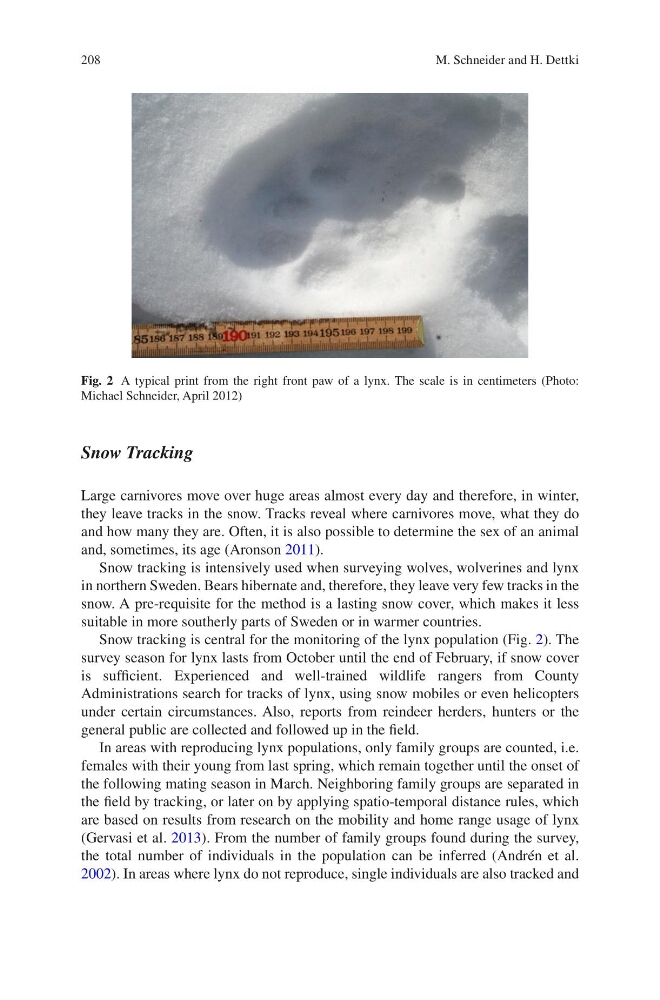
Snow tracking is central for the monitoring of the lynx population (Fig. 2). The
survey season for lynx lasts from October until the end of February, if snow cover
is sufficient. Experienced and well-trained wildlife rangers from County
Administrations search for tracks of lynx, using snow mobiles or even helicopters
under certain circumstances. Also, reports from reindeer herders, hunters or the
general public are collected and followed up in the field.
In areas with reproducing lynx populations, only family groups are counted, i.e.
females with their young from last spring, which remain together until the onset of
the following mating season in March. Neighboring family groups are separated in
the field by tracking, or later on by applying spatio-temporal distance rules, which
are based on results from research on the mobility and home range usage of lynx
(Gervasi et al. 2013). From the number of family groups found during the survey,
the total number of individuals in the population can be inferred (Andrén et al.
2002). In areas where lynx do not reproduce, single individuals are also tracked and
Fig. 2 A typical print from the right front paw of a lynx. The scale is in centimeters (Photo:
Michael Schneider, April 2012)
M. Schneider and H. Dettki
Snow Tracking
Large carnivores move over huge areas almost every day and therefore, in winter,
they leave tracks in the snow. Tracks reveal where carnivores move, what they do
and how many they are. Often, it is also possible to determine the sex of an animal
and, sometimes, its age (Aronson 2011).
Snow tracking is intensively used when surveying wolves, wolverines and lynx
in northern Sweden. Bears hibernate and, therefore, they leave very few tracks in the
snow. A pre-requisite for the method is a lasting snow cover, which makes it less
suitable in more southerly parts of Sweden or in warmer countries.
Snow tracking is central for the monitoring of the lynx population (Fig. 2). The
survey season for lynx lasts from October until the end of February, if snow cover
is sufficient. Experienced and well-trained wildlife rangers from County
Administrations search for tracks of lynx, using snow mobiles or even helicopters
under certain circumstances. Also, reports from reindeer herders, hunters or the
general public are collected and followed up in the field.
In areas with reproducing lynx populations, only family groups are counted, i.e.
females with their young from last spring, which remain together until the onset of
the following mating season in March. Neighboring family groups are separated in
the field by tracking, or later on by applying spatio-temporal distance rules, which
are based on results from research on the mobility and home range usage of lynx
(Gervasi et al. 2013). From the number of family groups found during the survey,
the total number of individuals in the population can be inferred (Andrén et al.
2002). In areas where lynx do not reproduce, single individuals are also tracked and
Fig. 2 A typical print from the right front paw of a lynx. The scale is in centimeters (Photo:
Michael Schneider, April 2012)
M. Schneider and H. Dettki