

188
several software solutions exist that promise to segment tree crowns from point
clouds and RGB imagery, such as the TIDA algorithm (Culvenor 2002), these algorithms are difficult to handle and come with their own error. As the number of polygons required was small, we preferred the manual approach of delineating tree
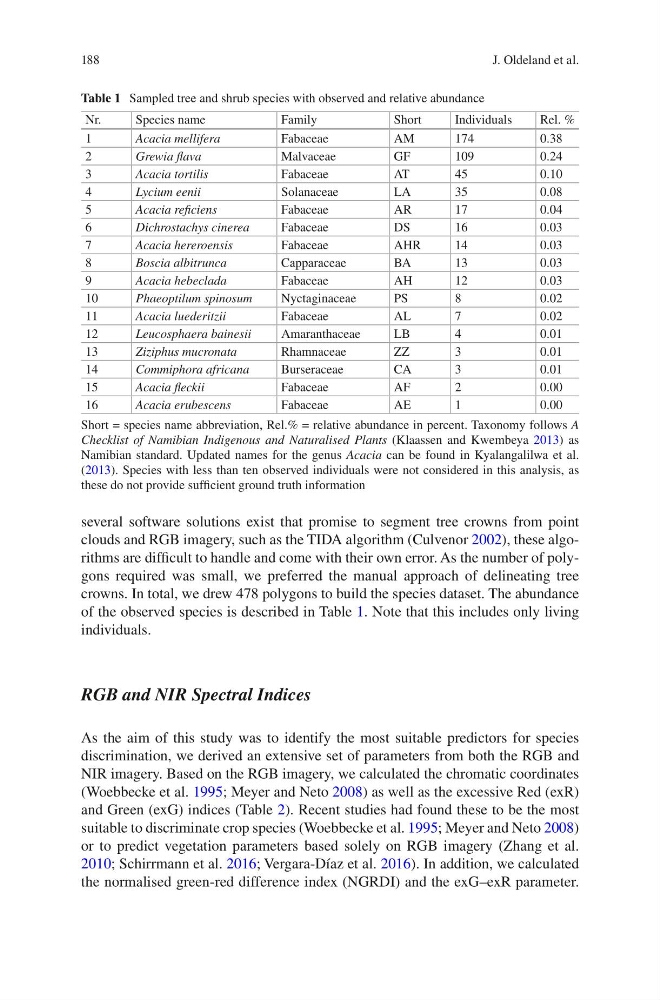
crowns. In total, we drew 478 polygons to build the species dataset. The abundance
of the observed species is described in Table 1. Note that this includes only living
individuals.
RGB and NIR Spectral Indices
As the aim of this study was to identify the most suitable predictors for species
discrimination, we derived an extensive set of parameters from both the RGB and
NIR imagery. Based on the RGB imagery, we calculated the chromatic coordinates
(Woebbecke et al. 1995; Meyer and Neto 2008) as well as the excessive Red (exR)
and Green (exG) indices (Table 2). Recent studies had found these to be the most
suitable to discriminate crop species (Woebbecke et al. 1995; Meyer and Neto 2008)
or to predict vegetation parameters based solely on RGB imagery (Zhang et al.
2010; Schirrmann et al. 2016; Vergara-Díaz et al. 2016). In addition, we calculated
the normalised green-red difference index (NGRDI) and the exG–exR parameter.
Table 1 Sampled tree and shrub species with observed and relative abundance
Nr.
Species name
Family
Short
Individuals
Rel. %
1
Acacia mellifera
Fabaceae
AM
174
0.38
2
Grewia flava
Malvaceae
GF
109
0.24
3
Acacia tortilis
Fabaceae
AT
45
0.10
4
Lycium eenii
Solanaceae
LA
35
0.08
5
Acacia reficiens
Fabaceae
AR
17
0.04
6
Dichrostachys cinerea
Fabaceae
DS
16
0.03
7
Acacia hereroensis
Fabaceae
AHR
14
0.03
8
Boscia albitrunca
Capparaceae
BA
13
0.03
9
Acacia hebeclada
Fabaceae
AH
12
0.03
10
Phaeoptilum spinosum
Nyctaginaceae
PS
8
0.02
11
Acacia luederitzii
Fabaceae
AL
7
0.02
12
Leucosphaera bainesii
Amaranthaceae
LB
4
0.01
13
Ziziphus mucronata
Rhamnaceae
ZZ
3
0.01
14
Commiphora africana
Burseraceae
CA
3
0.01
15
Acacia fleckii
Fabaceae
AF
2
0.00
16
Acacia erubescens
Fabaceae
AE
1
0.00
Short = species name abbreviation, Rel.% = relative abundance in percent. Taxonomy follows A
Checklist of Namibian Indigenous and Naturalised Plants (Klaassen and Kwembeya 2013) as
Namibian standard. Updated names for the genus Acacia can be found in Kyalangalilwa et al.
(2013). Species with less than ten observed individuals were not considered in this analysis, as
these do not provide sufficient ground truth information
J. Oldeland et al.
several software solutions exist that promise to segment tree crowns from point
clouds and RGB imagery, such as the TIDA algorithm (Culvenor 2002), these algorithms are difficult to handle and come with their own error. As the number of polygons required was small, we preferred the manual approach of delineating tree
crowns. In total, we drew 478 polygons to build the species dataset. The abundance
of the observed species is described in Table 1. Note that this includes only living
individuals.
RGB and NIR Spectral Indices
As the aim of this study was to identify the most suitable predictors for species
discrimination, we derived an extensive set of parameters from both the RGB and
NIR imagery. Based on the RGB imagery, we calculated the chromatic coordinates
(Woebbecke et al. 1995; Meyer and Neto 2008) as well as the excessive Red (exR)
and Green (exG) indices (Table 2). Recent studies had found these to be the most
suitable to discriminate crop species (Woebbecke et al. 1995; Meyer and Neto 2008)
or to predict vegetation parameters based solely on RGB imagery (Zhang et al.
2010; Schirrmann et al. 2016; Vergara-Díaz et al. 2016). In addition, we calculated
the normalised green-red difference index (NGRDI) and the exG–exR parameter.
Table 1 Sampled tree and shrub species with observed and relative abundance
Nr.
Species name
Family
Short
Individuals
Rel. %
1
Acacia mellifera
Fabaceae
AM
174
0.38
2
Grewia flava
Malvaceae
GF
109
0.24
3
Acacia tortilis
Fabaceae
AT
45
0.10
4
Lycium eenii
Solanaceae
LA
35
0.08
5
Acacia reficiens
Fabaceae
AR
17
0.04
6
Dichrostachys cinerea
Fabaceae
DS
16
0.03
7
Acacia hereroensis
Fabaceae
AHR
14
0.03
8
Boscia albitrunca
Capparaceae
BA
13
0.03
9
Acacia hebeclada
Fabaceae
AH
12
0.03
10
Phaeoptilum spinosum
Nyctaginaceae
PS
8
0.02
11
Acacia luederitzii
Fabaceae
AL
7
0.02
12
Leucosphaera bainesii
Amaranthaceae
LB
4
0.01
13
Ziziphus mucronata
Rhamnaceae
ZZ
3
0.01
14
Commiphora africana
Burseraceae
CA
3
0.01
15
Acacia fleckii
Fabaceae
AF
2
0.00
16
Acacia erubescens
Fabaceae
AE
1
0.00
Short = species name abbreviation, Rel.% = relative abundance in percent. Taxonomy follows A
Checklist of Namibian Indigenous and Naturalised Plants (Klaassen and Kwembeya 2013) as
Namibian standard. Updated names for the genus Acacia can be found in Kyalangalilwa et al.
(2013). Species with less than ten observed individuals were not considered in this analysis, as
these do not provide sufficient ground truth information
J. Oldeland et al.