

108
such as vector maps to be inputted as masks. As the basic land cover classes generated
using the EODHaM system were sufficiently accurate, these outputs where used as
baseline masks. Another key feature of maintaining the hierarchical nature of the
EODHaM system is the ability to classify the same class on different land covers. For
example, some of the discrepancies in the basic land cover classification were attributed to the presence of short sparse vegetation in primarily sandy areas known as
dune annuals communities, shifting dune and semi-fixed dune habitat. By running
that class on the bare ground mask, all those areas were targeted and mapped regardless of the known error in masks created from the EODHaM system. The class was
then combined to create the final Annex I habitat map (Fig. 13), which in this instance
was the Shifting Dunes along the shoreline with Ammophila arenaria (“white dunes”).
In addition, the dominant species within the Annex I habitats were also mapped,
which provides a proxy for condition and can help inform management decisions for
maintaining the site. An example of where knowing the dominant species in a slack
habitat indicates poorer condition is the presence of the grass Calamagrostis epigejos,
as it can become a near-monoculture and prevent other species from thriving.
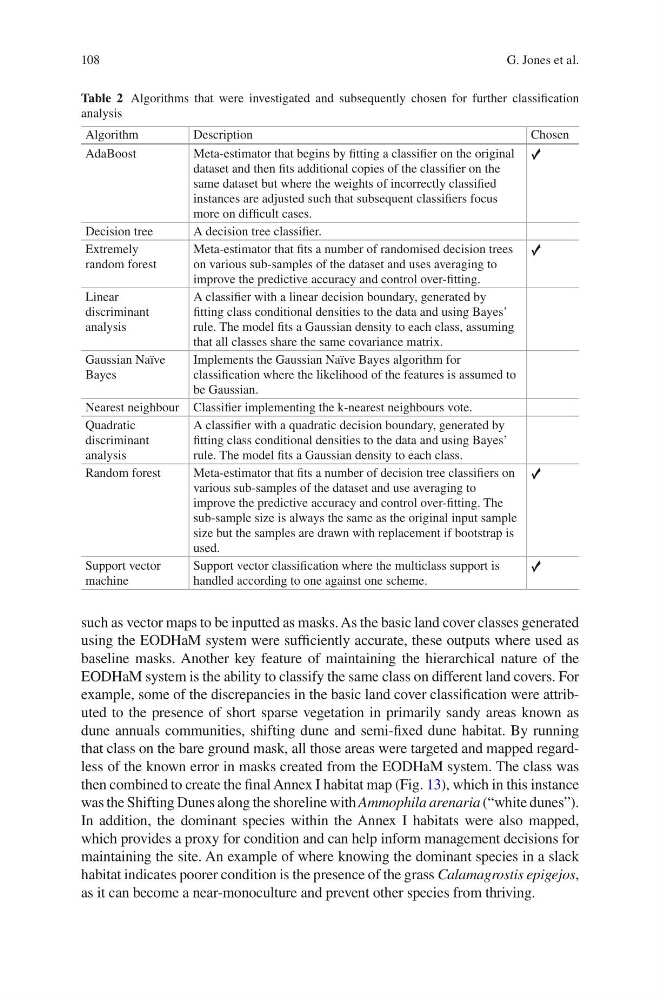
Table 2 Algorithms that were investigated and subsequently chosen for further classification
analysis
Algorithm
Description
Chosen
AdaBoost
Meta-estimator that begins by fitting a classifier on the original
dataset and then fits additional copies of the classifier on the
same dataset but where the weights of incorrectly classified
instances are adjusted such that subsequent classifiers focus
more on difficult cases.
✓
Decision tree
A decision tree classifier.
Extremely
random forest
Meta-estimator that fits a number of randomised decision trees
on various sub-samples of the dataset and uses averaging to
improve the predictive accuracy and control over-fitting.
✓
Linear
discriminant
analysis
A classifier with a linear decision boundary, generated by
fitting class conditional densities to the data and using Bayes’
rule. The model fits a Gaussian density to each class, assuming
that all classes share the same covariance matrix.
Gaussian Naïve
Bayes
Implements the Gaussian Naïve Bayes algorithm for
classification where the likelihood of the features is assumed to
be Gaussian.
Nearest neighbour Classifier implementing the k-nearest neighbours vote.
Quadratic
discriminant
analysis
A classifier with a quadratic decision boundary, generated by
fitting class conditional densities to the data and using Bayes’
rule. The model fits a Gaussian density to each class.
Random forest
Meta-estimator that fits a number of decision tree classifiers on
various sub-samples of the dataset and use averaging to
improve the predictive accuracy and control over-fitting. The
sub-sample size is always the same as the original input sample
size but the samples are drawn with replacement if bootstrap is
used.
✓
Support vector
machine
Support vector classification where the multiclass support is
handled according to one against one scheme.
✓
G. Jones et al.
such as vector maps to be inputted as masks. As the basic land cover classes generated
using the EODHaM system were sufficiently accurate, these outputs where used as
baseline masks. Another key feature of maintaining the hierarchical nature of the
EODHaM system is the ability to classify the same class on different land covers. For
example, some of the discrepancies in the basic land cover classification were attributed to the presence of short sparse vegetation in primarily sandy areas known as
dune annuals communities, shifting dune and semi-fixed dune habitat. By running
that class on the bare ground mask, all those areas were targeted and mapped regardless of the known error in masks created from the EODHaM system. The class was
then combined to create the final Annex I habitat map (Fig. 13), which in this instance
was the Shifting Dunes along the shoreline with Ammophila arenaria (“white dunes”).
In addition, the dominant species within the Annex I habitats were also mapped,
which provides a proxy for condition and can help inform management decisions for
maintaining the site. An example of where knowing the dominant species in a slack
habitat indicates poorer condition is the presence of the grass Calamagrostis epigejos,
as it can become a near-monoculture and prevent other species from thriving.
Table 2 Algorithms that were investigated and subsequently chosen for further classification
analysis
Algorithm
Description
Chosen
AdaBoost
Meta-estimator that begins by fitting a classifier on the original
dataset and then fits additional copies of the classifier on the
same dataset but where the weights of incorrectly classified
instances are adjusted such that subsequent classifiers focus
more on difficult cases.
✓
Decision tree
A decision tree classifier.
Extremely
random forest
Meta-estimator that fits a number of randomised decision trees
on various sub-samples of the dataset and uses averaging to
improve the predictive accuracy and control over-fitting.
✓
Linear
discriminant
analysis
A classifier with a linear decision boundary, generated by
fitting class conditional densities to the data and using Bayes’
rule. The model fits a Gaussian density to each class, assuming
that all classes share the same covariance matrix.
Gaussian Naïve
Bayes
Implements the Gaussian Naïve Bayes algorithm for
classification where the likelihood of the features is assumed to
be Gaussian.
Nearest neighbour Classifier implementing the k-nearest neighbours vote.
Quadratic
discriminant
analysis
A classifier with a quadratic decision boundary, generated by
fitting class conditional densities to the data and using Bayes’
rule. The model fits a Gaussian density to each class.
Random forest
Meta-estimator that fits a number of decision tree classifiers on
various sub-samples of the dataset and use averaging to
improve the predictive accuracy and control over-fitting. The
sub-sample size is always the same as the original input sample
size but the samples are drawn with replacement if bootstrap is
used.
✓
Support vector
machine
Support vector classification where the multiclass support is
handled according to one against one scheme.
✓
G. Jones et al.