

5 Model Generalization
87
a little longer. These raster structures can be based on simple (raster data pyramid) [17] or more advanced (wavelet compression) principles [8, 10, 16]. For example, JPEG2000 (wavelet-based) allows both compression and progressive data
transfer from the server to the end-user. Similar effects are more difficult to obtain
with vector data and require more advanced data structures, though recently there
are a number of interesting initiatives [2, 4, 9, 25]. (See Chap. 4 of this book for an
extensive overview of issues and possibilities in the field of progressive transfer of
vector data.)
5.2 Generalized Area Partitioning: The (t)GAP-tree
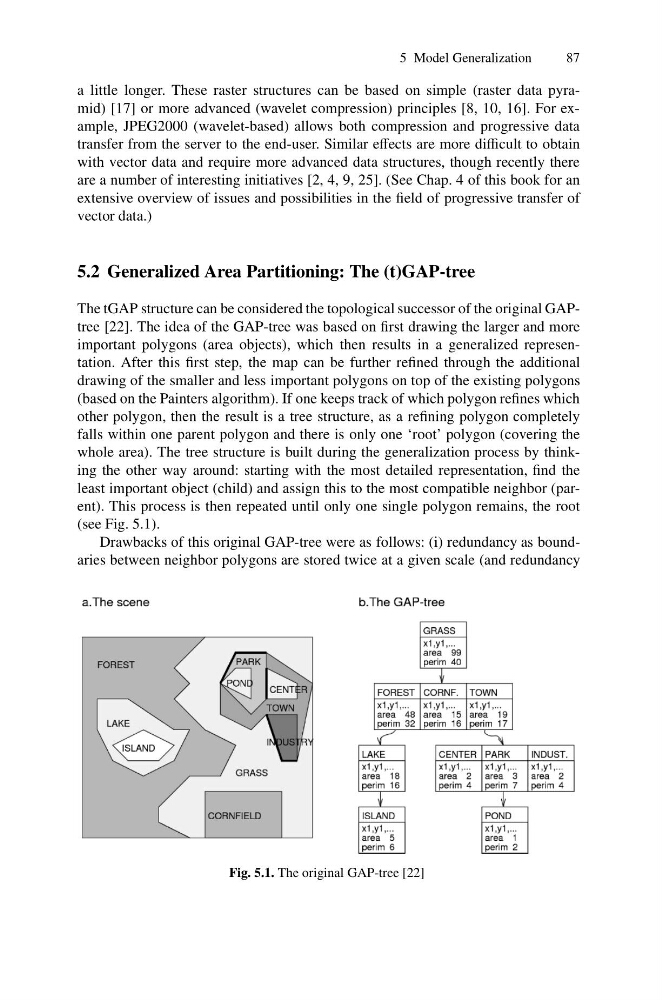
The tGAP structure can be considered the topological successor of the original GAPtree [22]. The idea of the GAP-tree was based on first drawing the larger and more
important polygons (area objects), which then results in a generalized representation. After this first step, the map can be further refined through the additional
drawing of the smaller and less important polygons on top of the existing polygons
(based on the Painters algorithm). If one keeps track of which polygon refines which
other polygon, then the result is a tree structure, as a refining polygon completely
falls within one parent polygon and there is only one ‘root’ polygon (covering the
whole area). The tree structure is built during the generalization process by thinking the other way around: starting with the most detailed representation, find the
least important object (child) and assign this to the most compatible neighbor (parent). This process is then repeated until only one single polygon remains, the root
(see Fig. 5.1).
Drawbacks of this original GAP-tree were as follows: (i) redundancy as boundaries between neighbor polygons are stored twice at a given scale (and redundancy
Fig. 5.1. The original GAP-tree [22]
87
a little longer. These raster structures can be based on simple (raster data pyramid) [17] or more advanced (wavelet compression) principles [8, 10, 16]. For example, JPEG2000 (wavelet-based) allows both compression and progressive data
transfer from the server to the end-user. Similar effects are more difficult to obtain
with vector data and require more advanced data structures, though recently there
are a number of interesting initiatives [2, 4, 9, 25]. (See Chap. 4 of this book for an
extensive overview of issues and possibilities in the field of progressive transfer of
vector data.)
5.2 Generalized Area Partitioning: The (t)GAP-tree
The tGAP structure can be considered the topological successor of the original GAPtree [22]. The idea of the GAP-tree was based on first drawing the larger and more
important polygons (area objects), which then results in a generalized representation. After this first step, the map can be further refined through the additional
drawing of the smaller and less important polygons on top of the existing polygons
(based on the Painters algorithm). If one keeps track of which polygon refines which
other polygon, then the result is a tree structure, as a refining polygon completely
falls within one parent polygon and there is only one ‘root’ polygon (covering the
whole area). The tree structure is built during the generalization process by thinking the other way around: starting with the most detailed representation, find the
least important object (child) and assign this to the most compatible neighbor (parent). This process is then repeated until only one single polygon remains, the root
(see Fig. 5.1).
Drawbacks of this original GAP-tree were as follows: (i) redundancy as boundaries between neighbor polygons are stored twice at a given scale (and redundancy
Fig. 5.1. The original GAP-tree [22]