

4 Progressive Techniques
77
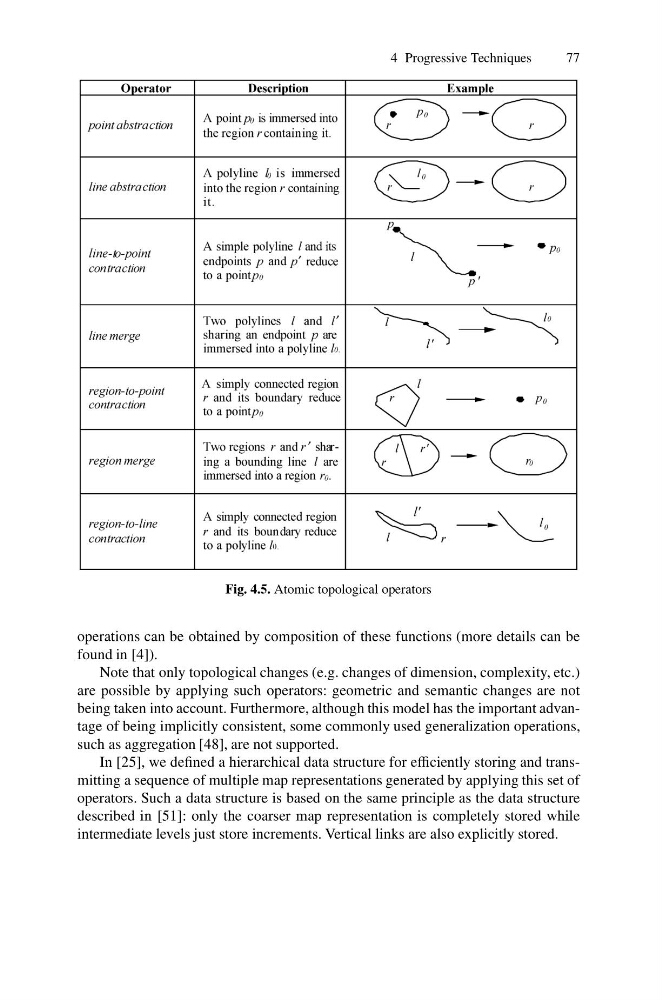
Fig. 4.5. Atomic topological operators
operations can be obtained by composition of these functions (more details can be
found in [4]).
Note that only topological changes (e.g. changes of dimension, complexity, etc.)
are possible by applying such operators: geometric and semantic changes are not
being taken into account. Furthermore, although this model has the important advantage of being implicitly consistent, some commonly used generalization operations,
such as aggregation [48], are not supported.
In [25], we defined a hierarchical data structure for efficiently storing and transmitting a sequence of multiple map representations generated by applying this set of
operators. Such a data structure is based on the same principle as the data structure
described in [51]: only the coarser map representation is completely stored while
intermediate levels just store increments. Vertical links are also explicitly stored.
77
Fig. 4.5. Atomic topological operators
operations can be obtained by composition of these functions (more details can be
found in [4]).
Note that only topological changes (e.g. changes of dimension, complexity, etc.)
are possible by applying such operators: geometric and semantic changes are not
being taken into account. Furthermore, although this model has the important advantage of being implicitly consistent, some commonly used generalization operations,
such as aggregation [48], are not supported.
In [25], we defined a hierarchical data structure for efficiently storing and transmitting a sequence of multiple map representations generated by applying this set of
operators. Such a data structure is based on the same principle as the data structure
described in [51]: only the coarser map representation is completely stored while
intermediate levels just store increments. Vertical links are also explicitly stored.