

13 Tracking of Moving Objects with Accuracy Guarantees
303
meaning of the solution is time. If there are two positive solutions, the solution with
the smaller value is the valid one (line 11). If the equation has no valid solution,
the result dt is equal to 0. In this case, prediction using constant speed is performed
(lines 12 and 13).
After the time required to reach the end of the acceleration interval is calculated,
this time is compared to the remaining prediction time t pred . If the time left for which
prediction should be done, t pred , is less than the time required to go a distance S , the
algorithm does prediction only for time t pred (line 14). Lines 15 and 16 then calculate
the predicted location m pred and the speed v pred . The prediction time is reduced in
line 17, and the loop is repeated if t pred > 0.
Finally, the coordinates corresponding to location m pred are calculated and returned. This is done in lines 18 and 19. If the predicted location m pred is beyond the
end of the route as described by polyline mopa.pl (line 18), the end point of the polyline is returned. This is done by comparing the predicted measure on the polyline
with the measure of the end point pl.p end of the polyline.
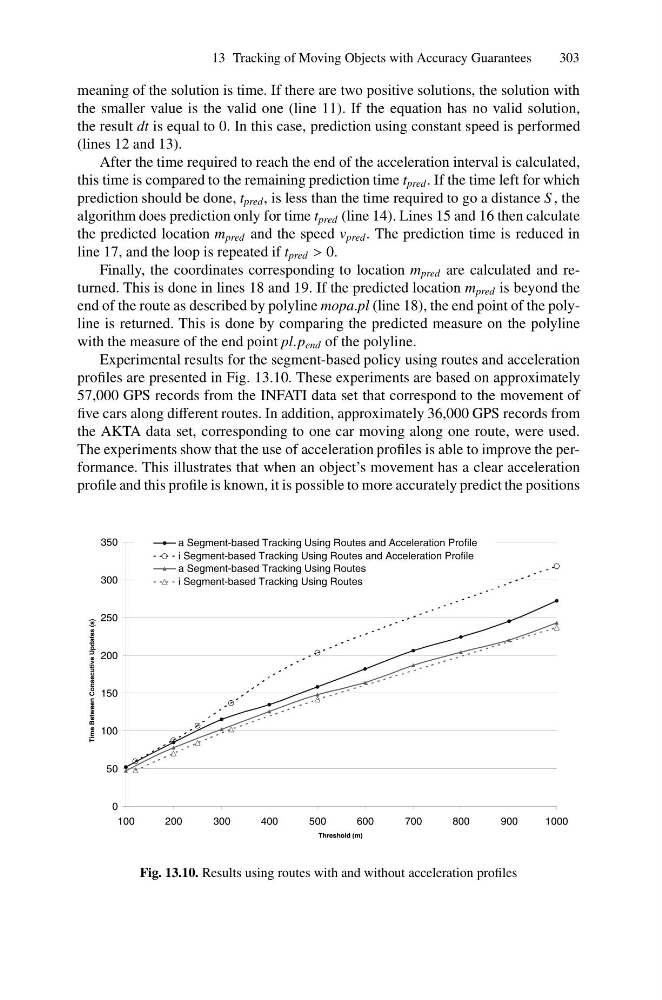
Experimental results for the segment-based policy using routes and acceleration
profiles are presented in Fig. 13.10. These experiments are based on approximately
57,000 GPS records from the INFATI data set that correspond to the movement of
five cars along different routes. In addition, approximately 36,000 GPS records from
the AKTA data set, corresponding to one car moving along one route, were used.
The experiments show that the use of acceleration profiles is able to improve the performance. This illustrates that when an object’s movement has a clear acceleration
profile and this profile is known, it is possible to more accurately predict the positions
0
50
100
150
200
250
300
350
100
200
300
400
500
600
700
800
900
1000
Threshold (m)
Time Between Consecutive Updates (s)
a Segment-based Tracking Using Routes and Acceleration Profile
i Segment-based Tracking Using Routes and Acceleration Profile
a Segment-based Tracking Using Routes
i Segment-based Tracking Using Routes
Fig. 13.10. Results using routes with and without acceleration profiles
303
meaning of the solution is time. If there are two positive solutions, the solution with
the smaller value is the valid one (line 11). If the equation has no valid solution,
the result dt is equal to 0. In this case, prediction using constant speed is performed
(lines 12 and 13).
After the time required to reach the end of the acceleration interval is calculated,
this time is compared to the remaining prediction time t pred . If the time left for which
prediction should be done, t pred , is less than the time required to go a distance S , the
algorithm does prediction only for time t pred (line 14). Lines 15 and 16 then calculate
the predicted location m pred and the speed v pred . The prediction time is reduced in
line 17, and the loop is repeated if t pred > 0.
Finally, the coordinates corresponding to location m pred are calculated and returned. This is done in lines 18 and 19. If the predicted location m pred is beyond the
end of the route as described by polyline mopa.pl (line 18), the end point of the polyline is returned. This is done by comparing the predicted measure on the polyline
with the measure of the end point pl.p end of the polyline.
Experimental results for the segment-based policy using routes and acceleration
profiles are presented in Fig. 13.10. These experiments are based on approximately
57,000 GPS records from the INFATI data set that correspond to the movement of
five cars along different routes. In addition, approximately 36,000 GPS records from
the AKTA data set, corresponding to one car moving along one route, were used.
The experiments show that the use of acceleration profiles is able to improve the performance. This illustrates that when an object’s movement has a clear acceleration
profile and this profile is known, it is possible to more accurately predict the positions
0
50
100
150
200
250
300
350
100
200
300
400
500
600
700
800
900
1000
Threshold (m)
Time Between Consecutive Updates (s)
a Segment-based Tracking Using Routes and Acceleration Profile
i Segment-based Tracking Using Routes and Acceleration Profile
a Segment-based Tracking Using Routes
i Segment-based Tracking Using Routes
Fig. 13.10. Results using routes with and without acceleration profiles