

13 Tracking of Moving Objects with Accuracy Guarantees
291
Here, an object’s position is given by a polyline mop.pl and a measure mop.m. The
predicted location is given as a new measure that is equal to the old measure (line 1)
plus the distance traveled since the last update, t cur − mop.t. The traveled distance is
negative if the object moves against the direction of the polyline. If the new measure
is outside the polyline (lines 2 and 3), the result is one of the end points of the
polyline.In this way, the position prediction stops at a boundary point of the polyline
(the first point pl.p 0 or the last point pl.p n ). Function M calculates the measure value
on a given polyline of a given coordinate point. Otherwise, the coordinate point of
m pred is calculated with the inverse function M
−1 that calculates the coordinate point
of a given measure value on a given polyline.
13.3.4 Comparison of Tracking Techniques
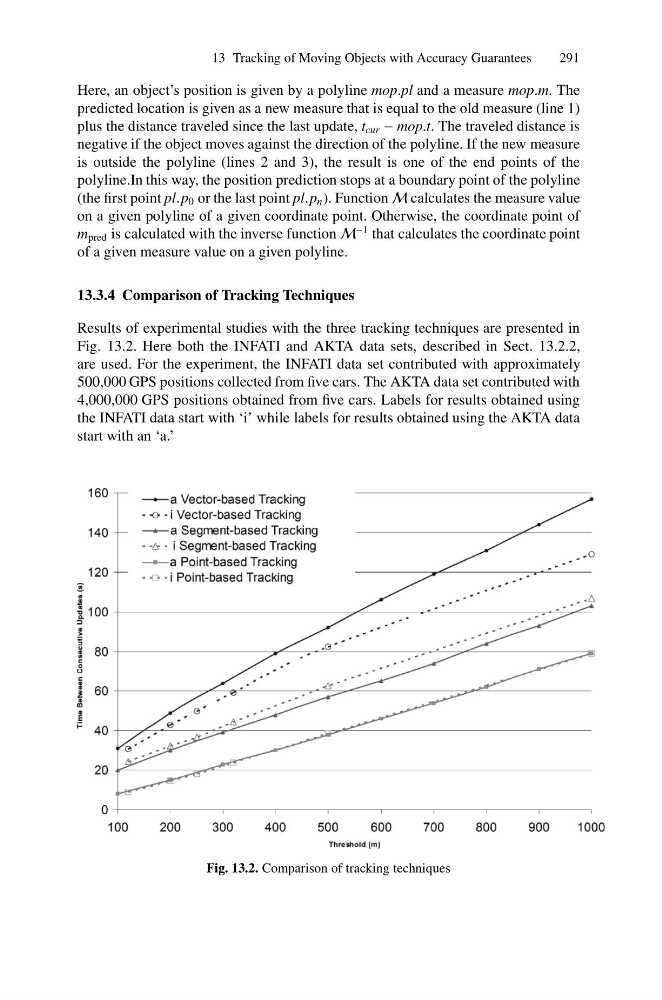
Results of experimental studies with the three tracking techniques are presented in
Fig. 13.2. Here both the INFATI and AKTA data sets, described in Sect. 13.2.2,
are used. For the experiment, the INFATI data set contributed with approximately
500,000 GPS positions collected from five cars. The AKTA data set contributed with
4,000,000 GPS positions obtained from five cars. Labels for results obtained using
the INFATI data start with ‘i’ while labels for results obtained using the AKTA data
start with an ‘a.’
Fig. 13.2. Comparison of tracking techniques
291
Here, an object’s position is given by a polyline mop.pl and a measure mop.m. The
predicted location is given as a new measure that is equal to the old measure (line 1)
plus the distance traveled since the last update, t cur − mop.t. The traveled distance is
negative if the object moves against the direction of the polyline. If the new measure
is outside the polyline (lines 2 and 3), the result is one of the end points of the
polyline.In this way, the position prediction stops at a boundary point of the polyline
(the first point pl.p 0 or the last point pl.p n ). Function M calculates the measure value
on a given polyline of a given coordinate point. Otherwise, the coordinate point of
m pred is calculated with the inverse function M
−1 that calculates the coordinate point
of a given measure value on a given polyline.
13.3.4 Comparison of Tracking Techniques
Results of experimental studies with the three tracking techniques are presented in
Fig. 13.2. Here both the INFATI and AKTA data sets, described in Sect. 13.2.2,
are used. For the experiment, the INFATI data set contributed with approximately
500,000 GPS positions collected from five cars. The AKTA data set contributed with
4,000,000 GPS positions obtained from five cars. Labels for results obtained using
the INFATI data start with ‘i’ while labels for results obtained using the AKTA data
start with an ‘a.’
Fig. 13.2. Comparison of tracking techniques