

240
Maria Calagna and Luigi V. Mancini
The Undetectability Requirement
Steganography is used by entities whose aim is to communicate secretly through
a public channel, without making the communication suspicious. An important requirement of such a communication is undetectability of the secret message. This
property may be under attack according to different criteria. Commonly, attacks
against stegosystems are referred to by the term “steganalysis.” A stegosystem is
insecure if an adversary can differentiate between cover-objects and stego-objects.
Steganalysis includes the following attacks: stego-only attack (only the observed
stego-object is available to the adversary), known cover-object, and known secret
attacks (if the cover-object is available or the possible hidden secret is known, then
the adversary may search for distinguishing patterns in the observed stego-object),
known stego attack (the steganography technique is available to the adversary), and
chosen secret attack (the steganography technique and the possible hidden secret are
available to the adversary, who may suspect a steganography technique was applied).
In [14], the undetectability requirement is defined in terms of the impossibility for a
polynomial time adversary to differentiate between cover-objects and stego-objects.
Other steganalysis attacks assume that the distribution of cover-objects is known [4],
that is, an adversary is able to discern if the observed object corresponds to a coverobject or a stego-object. In fact, an important class of steganalysis includes the statistical correlation-based attacks. These attacks can be used to discover the hidden
information since they are based on the idea that the hidden information may be more
random than the information in the cover it replaces. The amount of randomness may
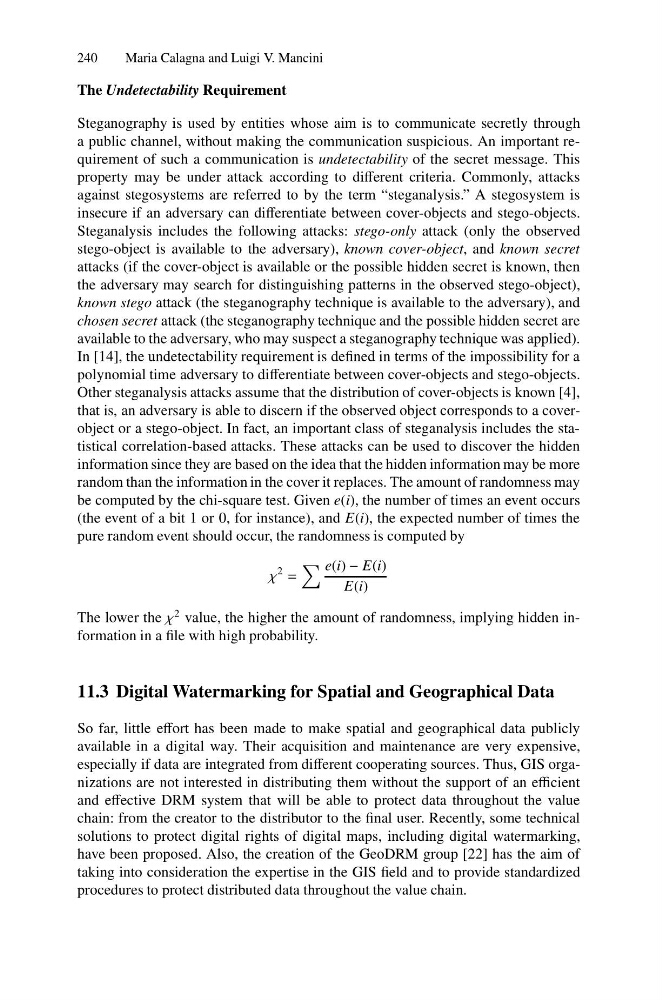
be computed by the chi-square test. Given e(i), the number of times an event occurs
(the event of a bit 1 or 0, for instance), and E(i), the expected number of times the
pure random event should occur, the randomness is computed by
χ
2
=
e(i) − E(i)
E(i)
The lower the χ
2 value, the higher the amount of randomness, implying hidden information in a file with high probability.
11.3 Digital Watermarking for Spatial and Geographical Data
So far, little effort has been made to make spatial and geographical data publicly
available in a digital way. Their acquisition and maintenance are very expensive,
especially if data are integrated from different cooperating sources. Thus, GIS organizations are not interested in distributing them without the support of an efficient
and effective DRM system that will be able to protect data throughout the value
chain: from the creator to the distributor to the final user. Recently, some technical
solutions to protect digital rights of digital maps, including digital watermarking,
have been proposed. Also, the creation of the GeoDRM group [22] has the aim of
taking into consideration the expertise in the GIS field and to provide standardized
procedures to protect distributed data throughout the value chain.
Maria Calagna and Luigi V. Mancini
The Undetectability Requirement
Steganography is used by entities whose aim is to communicate secretly through
a public channel, without making the communication suspicious. An important requirement of such a communication is undetectability of the secret message. This
property may be under attack according to different criteria. Commonly, attacks
against stegosystems are referred to by the term “steganalysis.” A stegosystem is
insecure if an adversary can differentiate between cover-objects and stego-objects.
Steganalysis includes the following attacks: stego-only attack (only the observed
stego-object is available to the adversary), known cover-object, and known secret
attacks (if the cover-object is available or the possible hidden secret is known, then
the adversary may search for distinguishing patterns in the observed stego-object),
known stego attack (the steganography technique is available to the adversary), and
chosen secret attack (the steganography technique and the possible hidden secret are
available to the adversary, who may suspect a steganography technique was applied).
In [14], the undetectability requirement is defined in terms of the impossibility for a
polynomial time adversary to differentiate between cover-objects and stego-objects.
Other steganalysis attacks assume that the distribution of cover-objects is known [4],
that is, an adversary is able to discern if the observed object corresponds to a coverobject or a stego-object. In fact, an important class of steganalysis includes the statistical correlation-based attacks. These attacks can be used to discover the hidden
information since they are based on the idea that the hidden information may be more
random than the information in the cover it replaces. The amount of randomness may
be computed by the chi-square test. Given e(i), the number of times an event occurs
(the event of a bit 1 or 0, for instance), and E(i), the expected number of times the
pure random event should occur, the randomness is computed by
χ
2
=
e(i) − E(i)
E(i)
The lower the χ
2 value, the higher the amount of randomness, implying hidden information in a file with high probability.
11.3 Digital Watermarking for Spatial and Geographical Data
So far, little effort has been made to make spatial and geographical data publicly
available in a digital way. Their acquisition and maintenance are very expensive,
especially if data are integrated from different cooperating sources. Thus, GIS organizations are not interested in distributing them without the support of an efficient
and effective DRM system that will be able to protect data throughout the value
chain: from the creator to the distributor to the final user. Recently, some technical
solutions to protect digital rights of digital maps, including digital watermarking,
have been proposed. Also, the creation of the GeoDRM group [22] has the aim of
taking into consideration the expertise in the GIS field and to provide standardized
procedures to protect distributed data throughout the value chain.