

8 Using Qualitative Information in Query Proc. over Multiresolution Maps
173
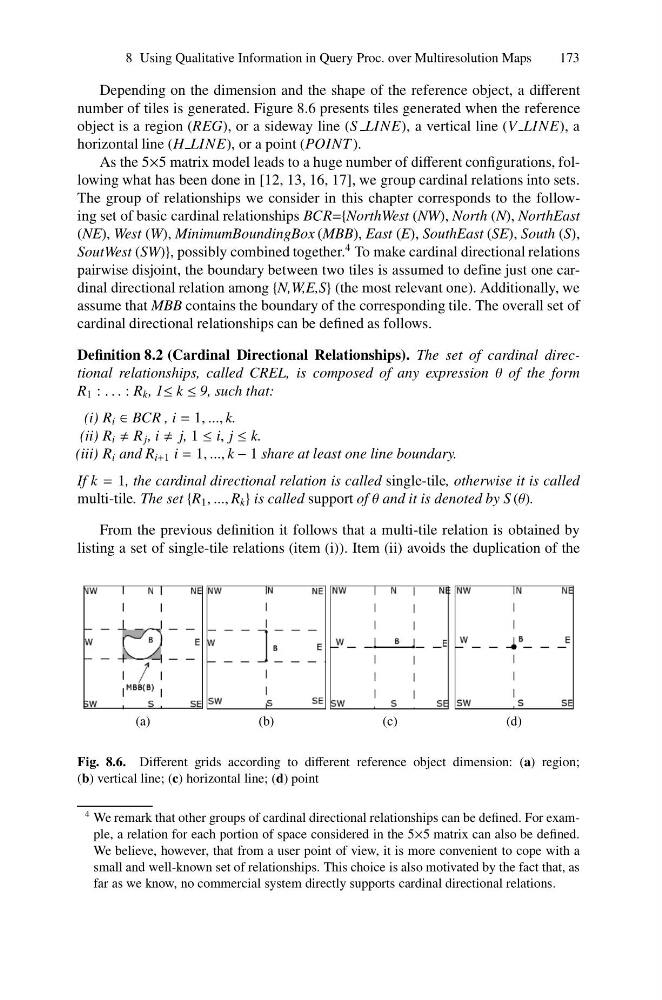
Depending on the dimension and the shape of the reference object, a different
number of tiles is generated. Figure 8.6 presents tiles generated when the reference
object is a region (REG), or a sideway line (S LINE), a vertical line (V LINE), a
horizontal line (H LINE), or a point (POINT ).
As the 5×5 matrix model leads to a huge number of different configurations, following what has been done in [12, 13, 16, 17], we group cardinal relations into sets.
The group of relationships we consider in this chapter corresponds to the following set of basic cardinal relationships BCR={NorthWest (NW), North (N), NorthEast
(NE), West (W), MinimumBoundingBox (MBB), East (E), SouthEast (SE), South (S),
SoutWest (SW)}, possibly combined together.
4 To make cardinal directional relations
pairwise disjoint, the boundary between two tiles is assumed to define just one cardinal directional relation among {N,W,E,S} (the most relevant one). Additionally, we
assume that MBB contains the boundary of the corresponding tile. The overall set of
cardinal directional relationships can be defined as follows.
Definition 8.2 (Cardinal Directional Relationships). The set of cardinal directional relationships, called CREL, is composed of any expression θ of the form
R 1 : . . . : R k , 1≤ k ≤ 9, such that:
(i) R i ∈ BCR , i = 1, ..., k.
(ii) R i R j , i j, 1 ≤ i, j ≤ k.
(iii) R i and R i+1 i = 1, ..., k − 1 share at least one line boundary.
If k = 1, the cardinal directional relation is called single-tile, otherwise it is called
multi-tile. The set {R 1 , ..., R k } is called support of θ and it is denoted by S (θ).
From the previous definition it follows that a multi-tile relation is obtained by
listing a set of single-tile relations (item (i)). Item (ii) avoids the duplication of the
(a)
(b)
(c)
(d)
Fig. 8.6. Different grids according to different reference object dimension: (a) region;
(b) vertical line; (c) horizontal line; (d) point
4 We remark that other groups of cardinal directional relationships can be defined. For example, a relation for each portion of space considered in the 5×5 matrix can also be defined.
We believe, however, that from a user point of view, it is more convenient to cope with a
small and well-known set of relationships. This choice is also motivated by the fact that, as
far as we know, no commercial system directly supports cardinal directional relations.
173
Depending on the dimension and the shape of the reference object, a different
number of tiles is generated. Figure 8.6 presents tiles generated when the reference
object is a region (REG), or a sideway line (S LINE), a vertical line (V LINE), a
horizontal line (H LINE), or a point (POINT ).
As the 5×5 matrix model leads to a huge number of different configurations, following what has been done in [12, 13, 16, 17], we group cardinal relations into sets.
The group of relationships we consider in this chapter corresponds to the following set of basic cardinal relationships BCR={NorthWest (NW), North (N), NorthEast
(NE), West (W), MinimumBoundingBox (MBB), East (E), SouthEast (SE), South (S),
SoutWest (SW)}, possibly combined together.
4 To make cardinal directional relations
pairwise disjoint, the boundary between two tiles is assumed to define just one cardinal directional relation among {N,W,E,S} (the most relevant one). Additionally, we
assume that MBB contains the boundary of the corresponding tile. The overall set of
cardinal directional relationships can be defined as follows.
Definition 8.2 (Cardinal Directional Relationships). The set of cardinal directional relationships, called CREL, is composed of any expression θ of the form
R 1 : . . . : R k , 1≤ k ≤ 9, such that:
(i) R i ∈ BCR , i = 1, ..., k.
(ii) R i R j , i j, 1 ≤ i, j ≤ k.
(iii) R i and R i+1 i = 1, ..., k − 1 share at least one line boundary.
If k = 1, the cardinal directional relation is called single-tile, otherwise it is called
multi-tile. The set {R 1 , ..., R k } is called support of θ and it is denoted by S (θ).
From the previous definition it follows that a multi-tile relation is obtained by
listing a set of single-tile relations (item (i)). Item (ii) avoids the duplication of the
(a)
(b)
(c)
(d)
Fig. 8.6. Different grids according to different reference object dimension: (a) region;
(b) vertical line; (c) horizontal line; (d) point
4 We remark that other groups of cardinal directional relationships can be defined. For example, a relation for each portion of space considered in the 5×5 matrix can also be defined.
We believe, however, that from a user point of view, it is more convenient to cope with a
small and well-known set of relationships. This choice is also motivated by the fact that, as
far as we know, no commercial system directly supports cardinal directional relations.