

172
Paola Podest` a, Barbara Catania, and Alberto Belussi
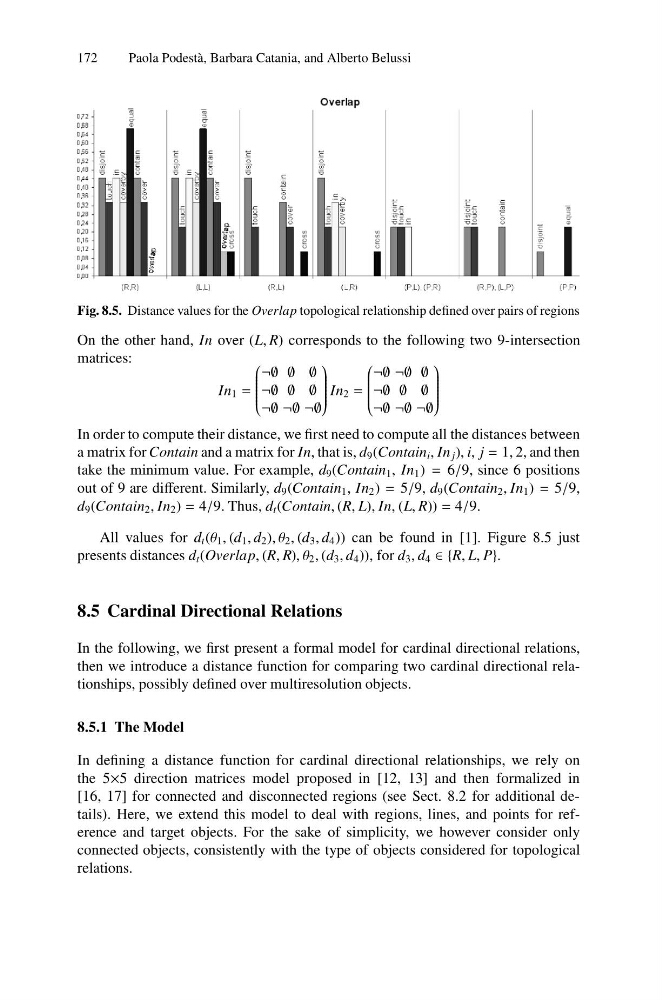
Fig. 8.5. Distance values for the Overlap topological relationship defined over pairs of regions
On the other hand, In over (L, R) corresponds to the following two 9-intersection
matrices:
In 1 =
⎛
⎜ ⎜ ⎜ ⎜ ⎜ ⎜ ⎜ ⎜ ⎝
¬∅ ∅ ∅
¬∅ ∅ ∅
¬∅ ¬∅ ¬∅
⎞
⎟ ⎟ ⎟ ⎟ ⎟ ⎟ ⎟ ⎟ ⎠
In 2 =
⎛
⎜ ⎜ ⎜ ⎜ ⎜ ⎜ ⎜ ⎜ ⎝
¬∅ ¬∅ ∅
¬∅ ∅ ∅
¬∅ ¬∅ ¬∅
⎞
⎟ ⎟ ⎟ ⎟ ⎟ ⎟ ⎟ ⎟ ⎠
In order to compute their distance, we first need to compute all the distances between
a matrix for Contain and a matrix for In, that is, d 9 (Contain i , In j ), i, j = 1, 2, and then
take the minimum value. For example, d 9 (Contain 1 , In 1 ) = 6/9, since 6 positions
out of 9 are different. Similarly, d 9 (Contain 1 , In 2 ) = 5/9, d 9 (Contain 2 , In 1 ) = 5/9,
d 9 (Contain 2 , In 2 ) = 4/9. Thus, d t (Contain, (R, L), In, (L, R)) = 4/9.
All values for d t (θ 1 , (d 1 , d 2 ), θ 2 , (d 3 , d 4 )) can be found in [1]. Figure 8.5 just
presents distances d t (Overlap, (R, R), θ 2 , (d 3 , d 4 )), for d 3 , d 4 ∈ {R, L, P}.
8.5 Cardinal Directional Relations
In the following, we first present a formal model for cardinal directional relations,
then we introduce a distance function for comparing two cardinal directional relationships, possibly defined over multiresolution objects.
8.5.1 The Model
In defining a distance function for cardinal directional relationships, we rely on
the 5×5 direction matrices model proposed in [12, 13] and then formalized in
[16, 17] for connected and disconnected regions (see Sect. 8.2 for additional details). Here, we extend this model to deal with regions, lines, and points for reference and target objects. For the sake of simplicity, we however consider only
connected objects, consistently with the type of objects considered for topological
relations.
Paola Podest` a, Barbara Catania, and Alberto Belussi
Fig. 8.5. Distance values for the Overlap topological relationship defined over pairs of regions
On the other hand, In over (L, R) corresponds to the following two 9-intersection
matrices:
In 1 =
⎛
⎜ ⎜ ⎜ ⎜ ⎜ ⎜ ⎜ ⎜ ⎝
¬∅ ∅ ∅
¬∅ ∅ ∅
¬∅ ¬∅ ¬∅
⎞
⎟ ⎟ ⎟ ⎟ ⎟ ⎟ ⎟ ⎟ ⎠
In 2 =
⎛
⎜ ⎜ ⎜ ⎜ ⎜ ⎜ ⎜ ⎜ ⎝
¬∅ ¬∅ ∅
¬∅ ∅ ∅
¬∅ ¬∅ ¬∅
⎞
⎟ ⎟ ⎟ ⎟ ⎟ ⎟ ⎟ ⎟ ⎠
In order to compute their distance, we first need to compute all the distances between
a matrix for Contain and a matrix for In, that is, d 9 (Contain i , In j ), i, j = 1, 2, and then
take the minimum value. For example, d 9 (Contain 1 , In 1 ) = 6/9, since 6 positions
out of 9 are different. Similarly, d 9 (Contain 1 , In 2 ) = 5/9, d 9 (Contain 2 , In 1 ) = 5/9,
d 9 (Contain 2 , In 2 ) = 4/9. Thus, d t (Contain, (R, L), In, (L, R)) = 4/9.
All values for d t (θ 1 , (d 1 , d 2 ), θ 2 , (d 3 , d 4 )) can be found in [1]. Figure 8.5 just
presents distances d t (Overlap, (R, R), θ 2 , (d 3 , d 4 )), for d 3 , d 4 ∈ {R, L, P}.
8.5 Cardinal Directional Relations
In the following, we first present a formal model for cardinal directional relations,
then we introduce a distance function for comparing two cardinal directional relationships, possibly defined over multiresolution objects.
8.5.1 The Model
In defining a distance function for cardinal directional relationships, we rely on
the 5×5 direction matrices model proposed in [12, 13] and then formalized in
[16, 17] for connected and disconnected regions (see Sect. 8.2 for additional details). Here, we extend this model to deal with regions, lines, and points for reference and target objects. For the sake of simplicity, we however consider only
connected objects, consistently with the type of objects considered for topological
relations.