

7 A Quality-enabled Spatial Integration System
153
1
1
R 1
R 2
R 3
[1%]
[1%]
[5%]
[5%]
[5%]
[5%]
[5%]
[1%]
[1%]
[1%]
[1%]
[1%]
[1%]
[1%]
[1%]
[1%]
[1%]
Geom
geom
Topo
topo
Desc
desc
Class
desc
Stat
desc
Road
vCommR
Road
roadL
Geom
geom
Class
class
Stat
stat
NbL
nbL
vCommL
Road
Topo
topo
Desc
desc
Class
desc
Stat
stat
21e05
[VHigh]
[VHigh]
[High]
10m
1m
[High]
[High]
[High]
[Low]
[1995]
[1995]
[1995]
[1995]
31hh202
1m
[High]
[High]
[High]
[Low]
[1995]
Geom
geom
b
B
[1996]
[1996]
[1996]
[1996]
[1996]
[1995]
21ee201
[1995]
[1995]
[1995]
[1995]
[1995]
[1995]
P
1
2
P
1
3
P
1
4
C
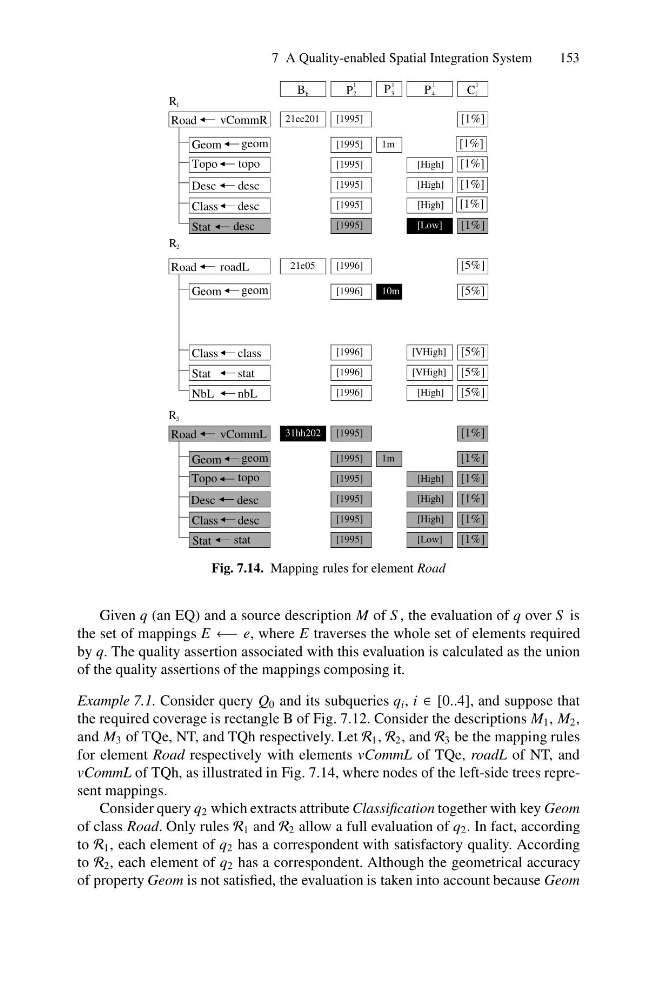
Fig. 7.14. Mapping rules for element Road
Given q (an EQ) and a source description M of S , the evaluation of q over S is
the set of mappings E ←− e, where E traverses the whole set of elements required
by q. The quality assertion associated with this evaluation is calculated as the union
of the quality assertions of the mappings composing it.
Example 7.1. Consider query Q 0 and its subqueries q i , i ∈ [0..4], and suppose that
the required coverage is rectangle B of Fig. 7.12. Consider the descriptions M 1 , M 2 ,
and M 3 of TQe, NT, and TQh respectively. Let R 1 , R 2 , and R 3 be the mapping rules
for element Road respectively with elements vCommL of TQe, roadL of NT, and
vCommL of TQh, as illustrated in Fig. 7.14, where nodes of the left-side trees represent mappings.
Consider query q 2 which extracts attribute Classification together with key Geom
of class Road. Only rules R 1 and R 2 allow a full evaluation of q 2 . In fact, according
to R 1 , each element of q 2 has a correspondent with satisfactory quality. According
to R 2 , each element of q 2 has a correspondent. Although the geometrical accuracy
of property Geom is not satisfied, the evaluation is taken into account because Geom
153
1
1
R 1
R 2
R 3
[1%]
[1%]
[5%]
[5%]
[5%]
[5%]
[5%]
[1%]
[1%]
[1%]
[1%]
[1%]
[1%]
[1%]
[1%]
[1%]
[1%]
Geom
geom
Topo
topo
Desc
desc
Class
desc
Stat
desc
Road
vCommR
Road
roadL
Geom
geom
Class
class
Stat
stat
NbL
nbL
vCommL
Road
Topo
topo
Desc
desc
Class
desc
Stat
stat
21e05
[VHigh]
[VHigh]
[High]
10m
1m
[High]
[High]
[High]
[Low]
[1995]
[1995]
[1995]
[1995]
31hh202
1m
[High]
[High]
[High]
[Low]
[1995]
Geom
geom
b
B
[1996]
[1996]
[1996]
[1996]
[1996]
[1995]
21ee201
[1995]
[1995]
[1995]
[1995]
[1995]
[1995]
P
1
2
P
1
3
P
1
4
C
Fig. 7.14. Mapping rules for element Road
Given q (an EQ) and a source description M of S , the evaluation of q over S is
the set of mappings E ←− e, where E traverses the whole set of elements required
by q. The quality assertion associated with this evaluation is calculated as the union
of the quality assertions of the mappings composing it.
Example 7.1. Consider query Q 0 and its subqueries q i , i ∈ [0..4], and suppose that
the required coverage is rectangle B of Fig. 7.12. Consider the descriptions M 1 , M 2 ,
and M 3 of TQe, NT, and TQh respectively. Let R 1 , R 2 , and R 3 be the mapping rules
for element Road respectively with elements vCommL of TQe, roadL of NT, and
vCommL of TQh, as illustrated in Fig. 7.14, where nodes of the left-side trees represent mappings.
Consider query q 2 which extracts attribute Classification together with key Geom
of class Road. Only rules R 1 and R 2 allow a full evaluation of q 2 . In fact, according
to R 1 , each element of q 2 has a correspondent with satisfactory quality. According
to R 2 , each element of q 2 has a correspondent. Although the geometrical accuracy
of property Geom is not satisfied, the evaluation is taken into account because Geom