

152
Omar Boucelma, Mehdi Essid, and Yassine Lassoued
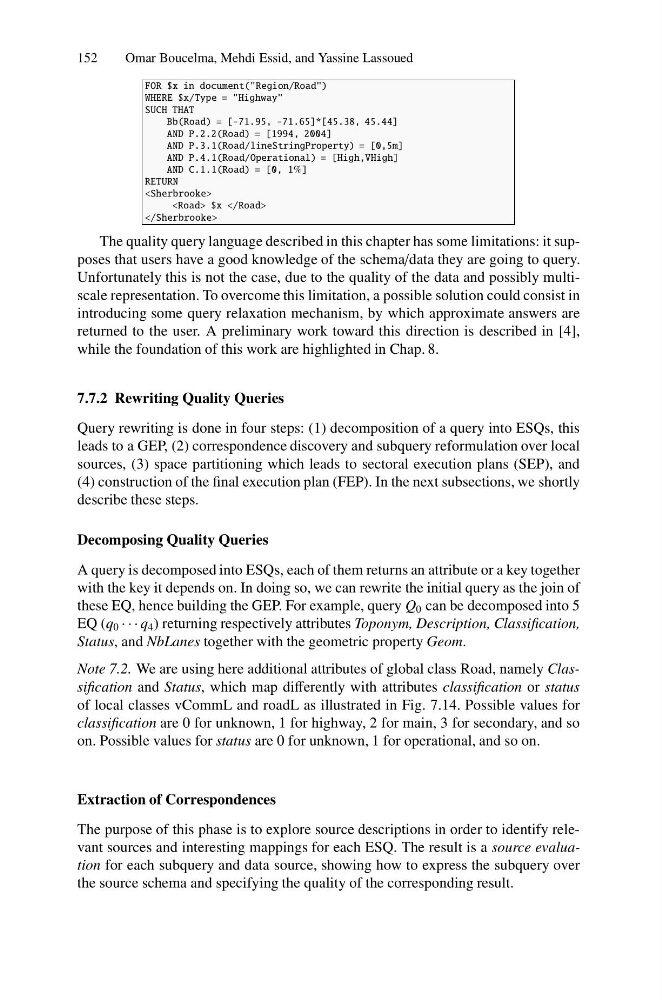
FOR $x in document("Region/Road")
WHERE $x/Type = "Highway"
SUCH THAT
Bb(Road) = [-71.95, -71.65]*[45.38, 45.44]
AND P.2.2(Road) = [1994, 2004]
AND P.3.1(Road/lineStringProperty) = [0,5m]
AND P.4.1(Road/Operational) = [High,VHigh]
AND C.1.1(Road) = [0, 1%]
RETURN
$x
The quality query language described in this chapter has some limitations: it supposes that users have a good knowledge of the schema/data they are going to query.
Unfortunately this is not the case, due to the quality of the data and possibly multiscale representation. To overcome this limitation, a possible solution could consist in
introducing some query relaxation mechanism, by which approximate answers are
returned to the user. A preliminary work toward this direction is described in [4],
while the foundation of this work are highlighted in Chap. 8.
7.7.2 Rewriting Quality Queries
Query rewriting is done in four steps: (1) decomposition of a query into ESQs, this
leads to a GEP, (2) correspondence discovery and subquery reformulation over local
sources, (3) space partitioning which leads to sectoral execution plans (SEP), and
(4) construction of the final execution plan (FEP). In the next subsections, we shortly
describe these steps.
Decomposing Quality Queries
A query is decomposed into ESQs, each of them returns an attribute or a key together
with the key it depends on. In doing so, we can rewrite the initial query as the join of
these EQ, hence building the GEP. For example, query Q 0 can be decomposed into 5
EQ (q 0 · · · q 4 ) returning respectively attributes Toponym, Description, Classification,
Status, and NbLanes together with the geometric property Geom.
Note 7.2. We are using here additional attributes of global class Road, namely Classification and Status, which map differently with attributes classification or status
of local classes vCommL and roadL as illustrated in Fig. 7.14. Possible values for
classification are 0 for unknown, 1 for highway, 2 for main, 3 for secondary, and so
on. Possible values for status are 0 for unknown, 1 for operational, and so on.
Extraction of Correspondences
The purpose of this phase is to explore source descriptions in order to identify relevant sources and interesting mappings for each ESQ. The result is a source evaluation for each subquery and data source, showing how to express the subquery over
the source schema and specifying the quality of the corresponding result.
Omar Boucelma, Mehdi Essid, and Yassine Lassoued
FOR $x in document("Region/Road")
WHERE $x/Type = "Highway"
SUCH THAT
Bb(Road) = [-71.95, -71.65]*[45.38, 45.44]
AND P.2.2(Road) = [1994, 2004]
AND P.3.1(Road/lineStringProperty) = [0,5m]
AND P.4.1(Road/Operational) = [High,VHigh]
AND C.1.1(Road) = [0, 1%]
RETURN
The quality query language described in this chapter has some limitations: it supposes that users have a good knowledge of the schema/data they are going to query.
Unfortunately this is not the case, due to the quality of the data and possibly multiscale representation. To overcome this limitation, a possible solution could consist in
introducing some query relaxation mechanism, by which approximate answers are
returned to the user. A preliminary work toward this direction is described in [4],
while the foundation of this work are highlighted in Chap. 8.
7.7.2 Rewriting Quality Queries
Query rewriting is done in four steps: (1) decomposition of a query into ESQs, this
leads to a GEP, (2) correspondence discovery and subquery reformulation over local
sources, (3) space partitioning which leads to sectoral execution plans (SEP), and
(4) construction of the final execution plan (FEP). In the next subsections, we shortly
describe these steps.
Decomposing Quality Queries
A query is decomposed into ESQs, each of them returns an attribute or a key together
with the key it depends on. In doing so, we can rewrite the initial query as the join of
these EQ, hence building the GEP. For example, query Q 0 can be decomposed into 5
EQ (q 0 · · · q 4 ) returning respectively attributes Toponym, Description, Classification,
Status, and NbLanes together with the geometric property Geom.
Note 7.2. We are using here additional attributes of global class Road, namely Classification and Status, which map differently with attributes classification or status
of local classes vCommL and roadL as illustrated in Fig. 7.14. Possible values for
classification are 0 for unknown, 1 for highway, 2 for main, 3 for secondary, and so
on. Possible values for status are 0 for unknown, 1 for operational, and so on.
Extraction of Correspondences
The purpose of this phase is to explore source descriptions in order to identify relevant sources and interesting mappings for each ESQ. The result is a source evaluation for each subquery and data source, showing how to express the subquery over
the source schema and specifying the quality of the corresponding result.