

6 Automated Geographical Information Fusion
115
Built-up
area
Forest
Woodland
Urban
Woodland Urban
Intensional
information
Extensional
information
Woodland
Forest Built-up
area
Forest Urban
Woodland Forest &
Urban
Built-up
area
Built-up
area
Woodland
Forest &
Urban
Woodland
Data set A
Data set B
Fused data set
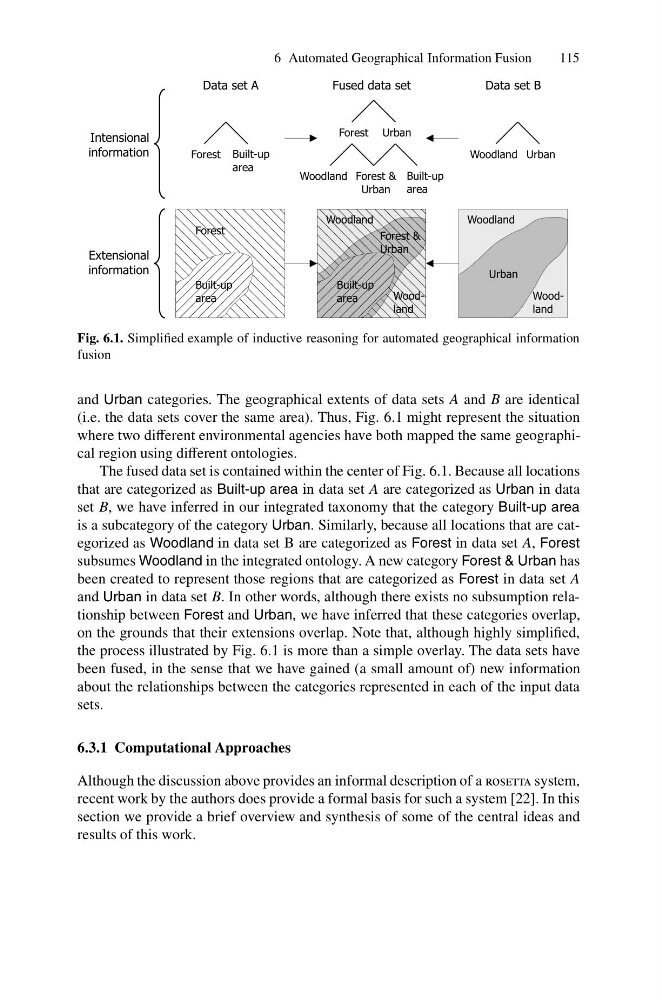
Fig. 6.1. Simplified example of inductive reasoning for automated geographical information
fusion
and Urban categories. The geographical extents of data sets A and B are identical
(i.e. the data sets cover the same area). Thus, Fig. 6.1 might represent the situation
where two different environmental agencies have both mapped the same geographical region using different ontologies.
The fused data set is contained within the center of Fig. 6.1. Because all locations
that are categorized as Built-up area in data set A are categorized as Urban in data
set B, we have inferred in our integrated taxonomy that the category Built-up area
is a subcategory of the category Urban. Similarly, because all locations that are categorized as Woodland in data set B are categorized as Forest in data set A, Forest
subsumes Woodland in the integrated ontology. A new category Forest & Urban has
been created to represent those regions that are categorized as Forest in data set A
and Urban in data set B. In other words, although there exists no subsumption relationship between Forest and Urban, we have inferred that these categories overlap,
on the grounds that their extensions overlap. Note that, although highly simplified,
the process illustrated by Fig. 6.1 is more than a simple overlay. The data sets have
been fused, in the sense that we have gained (a small amount of) new information
about the relationships between the categories represented in each of the input data
sets.
6.3.1 Computational Approaches
Although the discussion above provides an informal description of a rosetta system,
recent work by the authors does provide a formal basis for such a system [22]. In this
section we provide a brief overview and synthesis of some of the central ideas and
results of this work.
115
Built-up
area
Forest
Woodland
Urban
Woodland Urban
Intensional
information
Extensional
information
Woodland
Forest Built-up
area
Forest Urban
Woodland Forest &
Urban
Built-up
area
Built-up
area
Woodland
Forest &
Urban
Woodland
Data set A
Data set B
Fused data set
Fig. 6.1. Simplified example of inductive reasoning for automated geographical information
fusion
and Urban categories. The geographical extents of data sets A and B are identical
(i.e. the data sets cover the same area). Thus, Fig. 6.1 might represent the situation
where two different environmental agencies have both mapped the same geographical region using different ontologies.
The fused data set is contained within the center of Fig. 6.1. Because all locations
that are categorized as Built-up area in data set A are categorized as Urban in data
set B, we have inferred in our integrated taxonomy that the category Built-up area
is a subcategory of the category Urban. Similarly, because all locations that are categorized as Woodland in data set B are categorized as Forest in data set A, Forest
subsumes Woodland in the integrated ontology. A new category Forest & Urban has
been created to represent those regions that are categorized as Forest in data set A
and Urban in data set B. In other words, although there exists no subsumption relationship between Forest and Urban, we have inferred that these categories overlap,
on the grounds that their extensions overlap. Note that, although highly simplified,
the process illustrated by Fig. 6.1 is more than a simple overlay. The data sets have
been fused, in the sense that we have gained (a small amount of) new information
about the relationships between the categories represented in each of the input data
sets.
6.3.1 Computational Approaches
Although the discussion above provides an informal description of a rosetta system,
recent work by the authors does provide a formal basis for such a system [22]. In this
section we provide a brief overview and synthesis of some of the central ideas and
results of this work.