

process is working to achieve the elimination of the pathogen agents and to try to
reach a neutral pH.
The increment of the sludge volume index shows how the microorganisms grow
and how it helps in the organic matter removal. The amount of microorganisms let
us know the behavior of the WWTP and how fast the organic matter can be
eliminated from the wastewater to obtain treated water. The microorganisms’
growth is considered to be an exponential growth and it can be confirmed with the
data shown in Fig. 3.1.
Also from Fig. 3.2, it is possible to observe how the pH value from the
wastewater changes by an average value of 7.5, showing how much the water is
polluted with several substances such as chemical compounds with low toxicity
from material wash from the lecturing laboratories.
It took almost 6 months to achieve the optimal and sustainable amount of
microorganisms responsible in the organic matter removal. The flow of wastewater
increased gradually as demand grew in the UAQ, which allows the proper
microorganism growth.
After the wastewater is treated by the activated sludge process, the characteristics of the treated water are summarized in Table 3.2.
Once the majority of the organic matter has been removed, proper disinfection
process is needed to avoid the propagation of diseases to animals, plants, and
human beings.
3.3.2 Disinfection
Prior to the disinfection process, the titanium dioxide catalyst was synthesized by
the sol–gel method. The morphological characterization is not shown in these
results because they were already published (Esquivel et al. 2013). For the crystal
analysis, X-ray diffraction test were carried out. In Fig. 3.3 is presented the results
of the 0.1, 1, and 10 %w Ag-doped TiO 2 , showing that with thermal treatment at
550 °C which was presented in the experimental conditions, it is possible to see
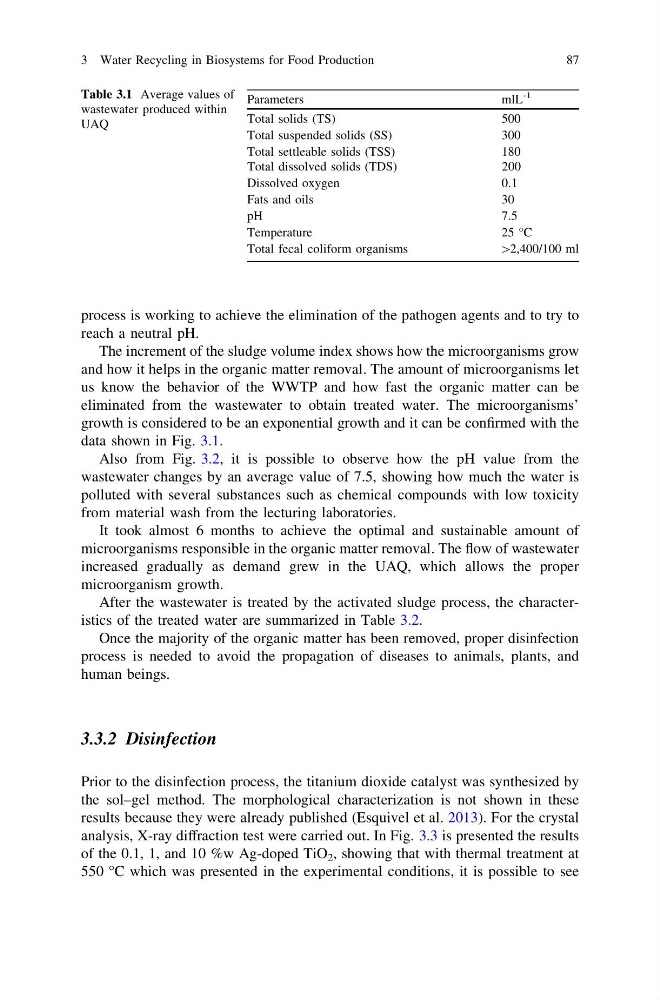
Table 3.1 Average values of
wastewater produced within
UAQ
Parameters
mlL
-1
Total solids (TS)
500
Total suspended solids (SS)
300
Total settleable solids (TSS)
Total dissolved solids (TDS)
180
200
Dissolved oxygen
0.1
Fats and oils
30
pH
7.5
Temperature
25 °C
Total fecal coliform organisms
[2,400/100 ml
3 Water Recycling in Biosystems for Food Production
87
reach a neutral pH.
The increment of the sludge volume index shows how the microorganisms grow
and how it helps in the organic matter removal. The amount of microorganisms let
us know the behavior of the WWTP and how fast the organic matter can be
eliminated from the wastewater to obtain treated water. The microorganisms’
growth is considered to be an exponential growth and it can be confirmed with the
data shown in Fig. 3.1.
Also from Fig. 3.2, it is possible to observe how the pH value from the
wastewater changes by an average value of 7.5, showing how much the water is
polluted with several substances such as chemical compounds with low toxicity
from material wash from the lecturing laboratories.
It took almost 6 months to achieve the optimal and sustainable amount of
microorganisms responsible in the organic matter removal. The flow of wastewater
increased gradually as demand grew in the UAQ, which allows the proper
microorganism growth.
After the wastewater is treated by the activated sludge process, the characteristics of the treated water are summarized in Table 3.2.
Once the majority of the organic matter has been removed, proper disinfection
process is needed to avoid the propagation of diseases to animals, plants, and
human beings.
3.3.2 Disinfection
Prior to the disinfection process, the titanium dioxide catalyst was synthesized by
the sol–gel method. The morphological characterization is not shown in these
results because they were already published (Esquivel et al. 2013). For the crystal
analysis, X-ray diffraction test were carried out. In Fig. 3.3 is presented the results
of the 0.1, 1, and 10 %w Ag-doped TiO 2 , showing that with thermal treatment at
550 °C which was presented in the experimental conditions, it is possible to see
Table 3.1 Average values of
wastewater produced within
UAQ
Parameters
mlL
-1
Total solids (TS)
500
Total suspended solids (SS)
300
Total settleable solids (TSS)
Total dissolved solids (TDS)
180
200
Dissolved oxygen
0.1
Fats and oils
30
pH
7.5
Temperature
25 °C
Total fecal coliform organisms
[2,400/100 ml
3 Water Recycling in Biosystems for Food Production
87