

deproteinization, and deacetylation and is reported elsewhere (Otakara and Yabuki
1991; Jing et al. 2012; Kumar et al. 2012; Reicha et al. 2012; Xu et al. 2011). The
modification consists in reducing the concentrations of sodium hydroxide (NaOH)
and hydrochloric acid (HCl), and substituting the alkali reagent for potassium
hydroxide (KOH) (Elizalde-Peña et al. 2007). Additionally, decalcification,
deproteinization, and deacetylation were carried out in a microwave reaction
system (Synthos 3000, Anton Paar) with the following conditions: Decalcification:
HCl 6 M for 30 min at 50 °C; Deproteinization: alkali solution 1 M for 30 min at
180 °C; and Deacetylation: alkali solution 30 % (v/v) for 15 min at 110 °C.
After deacetylation, the samples were washed thrice with hot deionized water
and filtered, with a final oven dried process at 60 °C, for 2 h. The samples were
characterized by infrared spectroscopy in a Perkin Elmer infrared spectrometer to
obtain the acetylation degree by means of the integration of characteristic bands at
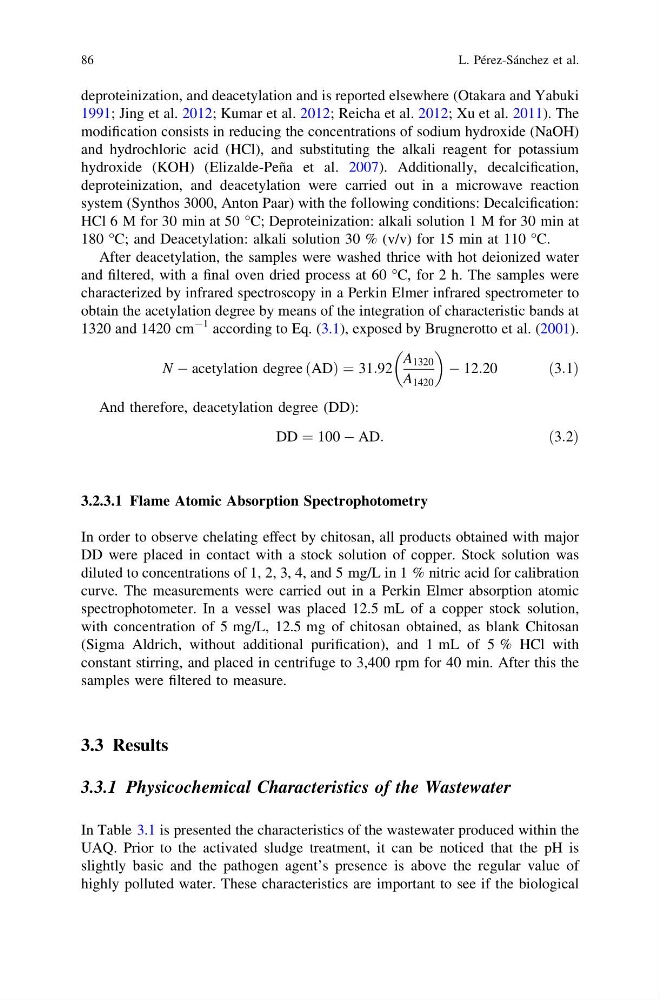
1320 and 1420 cm
-1 according to Eq. (3.1), exposed by Brugnerotto et al. (2001).
N À acetylation degree ðADÞ ¼ 31:92
A 1320
A 1420
À 12:20
ð3:1Þ
And therefore, deacetylation degree (DD):
DD ¼ 100 À AD:
ð3:2Þ
3.2.3.1 Flame Atomic Absorption Spectrophotometry
In order to observe chelating effect by chitosan, all products obtained with major
DD were placed in contact with a stock solution of copper. Stock solution was
diluted to concentrations of 1, 2, 3, 4, and 5 mg/L in 1 % nitric acid for calibration
curve. The measurements were carried out in a Perkin Elmer absorption atomic
spectrophotometer. In a vessel was placed 12.5 mL of a copper stock solution,
with concentration of 5 mg/L, 12.5 mg of chitosan obtained, as blank Chitosan
(Sigma Aldrich, without additional purification), and 1 mL of 5 % HCl with
constant stirring, and placed in centrifuge to 3,400 rpm for 40 min. After this the
samples were filtered to measure.
3.3 Results
3.3.1 Physicochemical Characteristics of the Wastewater
In Table 3.1 is presented the characteristics of the wastewater produced within the
UAQ. Prior to the activated sludge treatment, it can be noticed that the pH is
slightly basic and the pathogen agent’s presence is above the regular value of
highly polluted water. These characteristics are important to see if the biological
86
L. Pérez-Sánchez et al.
1991; Jing et al. 2012; Kumar et al. 2012; Reicha et al. 2012; Xu et al. 2011). The
modification consists in reducing the concentrations of sodium hydroxide (NaOH)
and hydrochloric acid (HCl), and substituting the alkali reagent for potassium
hydroxide (KOH) (Elizalde-Peña et al. 2007). Additionally, decalcification,
deproteinization, and deacetylation were carried out in a microwave reaction
system (Synthos 3000, Anton Paar) with the following conditions: Decalcification:
HCl 6 M for 30 min at 50 °C; Deproteinization: alkali solution 1 M for 30 min at
180 °C; and Deacetylation: alkali solution 30 % (v/v) for 15 min at 110 °C.
After deacetylation, the samples were washed thrice with hot deionized water
and filtered, with a final oven dried process at 60 °C, for 2 h. The samples were
characterized by infrared spectroscopy in a Perkin Elmer infrared spectrometer to
obtain the acetylation degree by means of the integration of characteristic bands at
1320 and 1420 cm
-1 according to Eq. (3.1), exposed by Brugnerotto et al. (2001).
N À acetylation degree ðADÞ ¼ 31:92
A 1320
A 1420
À 12:20
ð3:1Þ
And therefore, deacetylation degree (DD):
DD ¼ 100 À AD:
ð3:2Þ
3.2.3.1 Flame Atomic Absorption Spectrophotometry
In order to observe chelating effect by chitosan, all products obtained with major
DD were placed in contact with a stock solution of copper. Stock solution was
diluted to concentrations of 1, 2, 3, 4, and 5 mg/L in 1 % nitric acid for calibration
curve. The measurements were carried out in a Perkin Elmer absorption atomic
spectrophotometer. In a vessel was placed 12.5 mL of a copper stock solution,
with concentration of 5 mg/L, 12.5 mg of chitosan obtained, as blank Chitosan
(Sigma Aldrich, without additional purification), and 1 mL of 5 % HCl with
constant stirring, and placed in centrifuge to 3,400 rpm for 40 min. After this the
samples were filtered to measure.
3.3 Results
3.3.1 Physicochemical Characteristics of the Wastewater
In Table 3.1 is presented the characteristics of the wastewater produced within the
UAQ. Prior to the activated sludge treatment, it can be noticed that the pH is
slightly basic and the pathogen agent’s presence is above the regular value of
highly polluted water. These characteristics are important to see if the biological
86
L. Pérez-Sánchez et al.