

now perceived as workers; this implied that work was a commodity and that nature
was a product. Therefore, the development of the nation (in this case Mexico)
began to focus on the purchasing power of workers and on the potential that they
had to generate capital by means of the transformation of nature.
As for the relationship among the Government, capital, and the free market,
along with the impoverishment of society, it is clear that various amendments to
the Constitution giving freedom and concessions to foreign economies were
generated in the political sphere, and the adjustments and exchange rates that
would enable financial fluency in all dimensions were progressively established.
Subsequently, many of the industries and companies managed by the Government
began to collapse, creating a propitious scenario for the generation of policies
related to the privatization of the production and distribution of food.
In Mexico, for example, with the progressive proletarianization generated
during the 1970s along with the decrease in Government subsidies that had supported farmers and producers in rural areas, the proletariat began to suffer the
effects of such processes. Mass layoffs by companies and Government institutions,
and a national migration that began to head toward the large cities, along with
progressive international migration, emerged as social phenomena resulting from
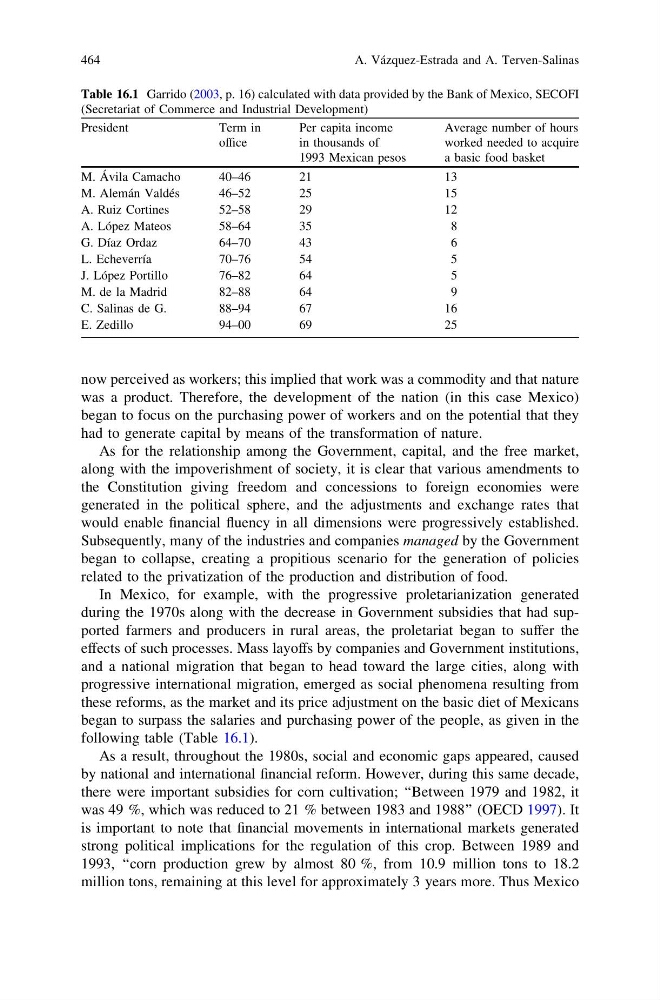
these reforms, as the market and its price adjustment on the basic diet of Mexicans
began to surpass the salaries and purchasing power of the people, as given in the
following table (Table 16.1).
As a result, throughout the 1980s, social and economic gaps appeared, caused
by national and international financial reform. However, during this same decade,
there were important subsidies for corn cultivation; ‘‘Between 1979 and 1982, it
was 49 %, which was reduced to 21 % between 1983 and 1988’’ (OECD 1997). It
is important to note that financial movements in international markets generated
strong political implications for the regulation of this crop. Between 1989 and
1993, ‘‘corn production grew by almost 80 %, from 10.9 million tons to 18.2
million tons, remaining at this level for approximately 3 years more. Thus Mexico
Table 16.1 Garrido (2003, p. 16) calculated with data provided by the Bank of Mexico, SECOFI
(Secretariat of Commerce and Industrial Development)
President
Term in
office
Per capita income
in thousands of
1993 Mexican pesos
Average number of hours
worked needed to acquire
a basic food basket
M. Ávila Camacho
40–46
21
13
M. Alemán Valdés
46–52
25
15
A. Ruiz Cortines
52–58
29
12
A. López Mateos
58–64
35
8
G. Díaz Ordaz
64–70
43
6
L. Echeverría
70–76
54
5
J. López Portillo
76–82
64
5
M. de la Madrid
82–88
64
9
C. Salinas de G.
88–94
67
16
E. Zedillo
94–00
69
25
464
A. Vázquez-Estrada and A. Terven-Salinas
was a product. Therefore, the development of the nation (in this case Mexico)
began to focus on the purchasing power of workers and on the potential that they
had to generate capital by means of the transformation of nature.
As for the relationship among the Government, capital, and the free market,
along with the impoverishment of society, it is clear that various amendments to
the Constitution giving freedom and concessions to foreign economies were
generated in the political sphere, and the adjustments and exchange rates that
would enable financial fluency in all dimensions were progressively established.
Subsequently, many of the industries and companies managed by the Government
began to collapse, creating a propitious scenario for the generation of policies
related to the privatization of the production and distribution of food.
In Mexico, for example, with the progressive proletarianization generated
during the 1970s along with the decrease in Government subsidies that had supported farmers and producers in rural areas, the proletariat began to suffer the
effects of such processes. Mass layoffs by companies and Government institutions,
and a national migration that began to head toward the large cities, along with
progressive international migration, emerged as social phenomena resulting from
these reforms, as the market and its price adjustment on the basic diet of Mexicans
began to surpass the salaries and purchasing power of the people, as given in the
following table (Table 16.1).
As a result, throughout the 1980s, social and economic gaps appeared, caused
by national and international financial reform. However, during this same decade,
there were important subsidies for corn cultivation; ‘‘Between 1979 and 1982, it
was 49 %, which was reduced to 21 % between 1983 and 1988’’ (OECD 1997). It
is important to note that financial movements in international markets generated
strong political implications for the regulation of this crop. Between 1989 and
1993, ‘‘corn production grew by almost 80 %, from 10.9 million tons to 18.2
million tons, remaining at this level for approximately 3 years more. Thus Mexico
Table 16.1 Garrido (2003, p. 16) calculated with data provided by the Bank of Mexico, SECOFI
(Secretariat of Commerce and Industrial Development)
President
Term in
office
Per capita income
in thousands of
1993 Mexican pesos
Average number of hours
worked needed to acquire
a basic food basket
M. Ávila Camacho
40–46
21
13
M. Alemán Valdés
46–52
25
15
A. Ruiz Cortines
52–58
29
12
A. López Mateos
58–64
35
8
G. Díaz Ordaz
64–70
43
6
L. Echeverría
70–76
54
5
J. López Portillo
76–82
64
5
M. de la Madrid
82–88
64
9
C. Salinas de G.
88–94
67
16
E. Zedillo
94–00
69
25
464
A. Vázquez-Estrada and A. Terven-Salinas