

actuators via the control system. A simple model from the greenhouse system can
be formulated by energy and mass balance principle (Boulard and Wang 2000).
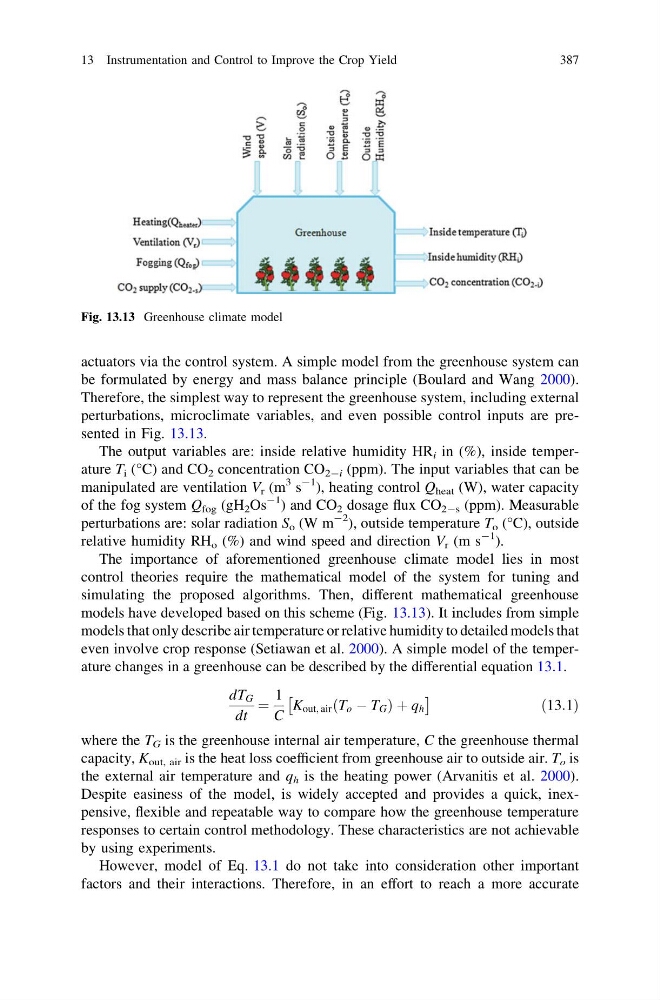
Therefore, the simplest way to represent the greenhouse system, including external
perturbations, microclimate variables, and even possible control inputs are presented in Fig. 13.13.
The output variables are: inside relative humidity HR i in (%), inside temperature T i (°C) and CO 2 concentration CO 2-i (ppm). The input variables that can be
manipulated are ventilation V r (m
3 s
-1 ), heating control Q heat (W), water capacity
of the fog system Q fog (gH 2 Os
-1 ) and CO 2 dosage flux CO 2-s (ppm). Measurable
perturbations are: solar radiation S o (W m
-2 ), outside temperature T o (°C), outside
relative humidity RH o (%) and wind speed and direction V r (m s
-1
).
The importance of aforementioned greenhouse climate model lies in most
control theories require the mathematical model of the system for tuning and
simulating the proposed algorithms. Then, different mathematical greenhouse
models have developed based on this scheme (Fig. 13.13). It includes from simple
models that only describe air temperature or relative humidity to detailed models that
even involve crop response (Setiawan et al. 2000). A simple model of the temperature changes in a greenhouse can be described by the differential equation 13.1.
dT G
dt
¼
1
C
K out; air T o À T G
ð
Þþq h
Â
Ã
ð13:1Þ
where the T G is the greenhouse internal air temperature, C the greenhouse thermal
capacity, K out, air is the heat loss coefficient from greenhouse air to outside air. T o is
the external air temperature and q h is the heating power (Arvanitis et al. 2000).
Despite easiness of the model, is widely accepted and provides a quick, inexpensive, flexible and repeatable way to compare how the greenhouse temperature
responses to certain control methodology. These characteristics are not achievable
by using experiments.
However, model of Eq. 13.1 do not take into consideration other important
factors and their interactions. Therefore, in an effort to reach a more accurate
Fig. 13.13 Greenhouse climate model
13 Instrumentation and Control to Improve the Crop Yield
387
be formulated by energy and mass balance principle (Boulard and Wang 2000).
Therefore, the simplest way to represent the greenhouse system, including external
perturbations, microclimate variables, and even possible control inputs are presented in Fig. 13.13.
The output variables are: inside relative humidity HR i in (%), inside temperature T i (°C) and CO 2 concentration CO 2-i (ppm). The input variables that can be
manipulated are ventilation V r (m
3 s
-1 ), heating control Q heat (W), water capacity
of the fog system Q fog (gH 2 Os
-1 ) and CO 2 dosage flux CO 2-s (ppm). Measurable
perturbations are: solar radiation S o (W m
-2 ), outside temperature T o (°C), outside
relative humidity RH o (%) and wind speed and direction V r (m s
-1
).
The importance of aforementioned greenhouse climate model lies in most
control theories require the mathematical model of the system for tuning and
simulating the proposed algorithms. Then, different mathematical greenhouse
models have developed based on this scheme (Fig. 13.13). It includes from simple
models that only describe air temperature or relative humidity to detailed models that
even involve crop response (Setiawan et al. 2000). A simple model of the temperature changes in a greenhouse can be described by the differential equation 13.1.
dT G
dt
¼
1
C
K out; air T o À T G
ð
Þþq h
Â
Ã
ð13:1Þ
where the T G is the greenhouse internal air temperature, C the greenhouse thermal
capacity, K out, air is the heat loss coefficient from greenhouse air to outside air. T o is
the external air temperature and q h is the heating power (Arvanitis et al. 2000).
Despite easiness of the model, is widely accepted and provides a quick, inexpensive, flexible and repeatable way to compare how the greenhouse temperature
responses to certain control methodology. These characteristics are not achievable
by using experiments.
However, model of Eq. 13.1 do not take into consideration other important
factors and their interactions. Therefore, in an effort to reach a more accurate
Fig. 13.13 Greenhouse climate model
13 Instrumentation and Control to Improve the Crop Yield
387