

exchange technique is the difference between the initial and final concentrations,
this is, it is smaller compared to CO 2 exchange systems and by this reason, the O 2
exchange systems require high precision sensors and expensive data acquisition
devices (Hunt 2003). Another disadvantage is that the oxygen gas is more unstable
than CO 2 and has to be maintained at a high and very stable temperature (around
700 °C) to maintain a stable molar concentration.
13.7 Sap Flow Sensors
In plants, there are two main vascular tissues at stems which are responsible of
water and nutrition transport in the sap. Xylem is the first one and the responsible
of water transport at the inner radius of a plant stem. In contrast, phloem is located
in the outer radius of plant stem and is responsible of transporting photosynthesis
products and other nutrients such as sugars (Taiz and Zeiger 2006). Sap flow
measurement is an instrumentation technique which consists on introducing
sensors in the plant xylem at stems or trunk to measure temperature differences
that indicates sap flow information such as direction and density (Granier 1987).
Sap flow measurement has been utilized for many years to analyze different
kinds of plant and its relations to water, soil and atmosphere conditions (Herzog
1995). In plants, sap flow has a specific trend to increase at middle day hours and
starts to decrease at evening to finally reach its minimum value during night
(Herzog 1995). Transpiration is another useful variable which allows detecting
water related stress phenomena in plants (Millan-Almaraz et al. 2010). However, it
results complex and costly when it is compared to sap flow technique that only
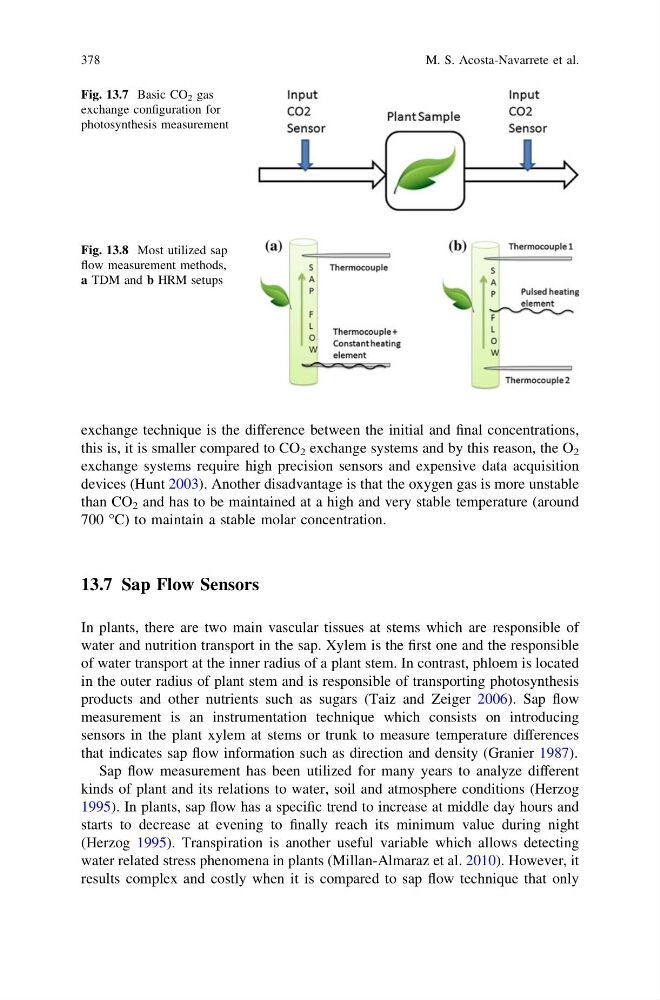
Fig. 13.8 Most utilized sap
flow measurement methods,
a TDM and b HRM setups
Fig. 13.7 Basic CO 2 gas
exchange configuration for
photosynthesis measurement
378
M. S. Acosta-Navarrete et al.
this is, it is smaller compared to CO 2 exchange systems and by this reason, the O 2
exchange systems require high precision sensors and expensive data acquisition
devices (Hunt 2003). Another disadvantage is that the oxygen gas is more unstable
than CO 2 and has to be maintained at a high and very stable temperature (around
700 °C) to maintain a stable molar concentration.
13.7 Sap Flow Sensors
In plants, there are two main vascular tissues at stems which are responsible of
water and nutrition transport in the sap. Xylem is the first one and the responsible
of water transport at the inner radius of a plant stem. In contrast, phloem is located
in the outer radius of plant stem and is responsible of transporting photosynthesis
products and other nutrients such as sugars (Taiz and Zeiger 2006). Sap flow
measurement is an instrumentation technique which consists on introducing
sensors in the plant xylem at stems or trunk to measure temperature differences
that indicates sap flow information such as direction and density (Granier 1987).
Sap flow measurement has been utilized for many years to analyze different
kinds of plant and its relations to water, soil and atmosphere conditions (Herzog
1995). In plants, sap flow has a specific trend to increase at middle day hours and
starts to decrease at evening to finally reach its minimum value during night
(Herzog 1995). Transpiration is another useful variable which allows detecting
water related stress phenomena in plants (Millan-Almaraz et al. 2010). However, it
results complex and costly when it is compared to sap flow technique that only
Fig. 13.8 Most utilized sap
flow measurement methods,
a TDM and b HRM setups
Fig. 13.7 Basic CO 2 gas
exchange configuration for
photosynthesis measurement
378
M. S. Acosta-Navarrete et al.