

adjustment requires a span of known concentration of CO 2 to be carried out with
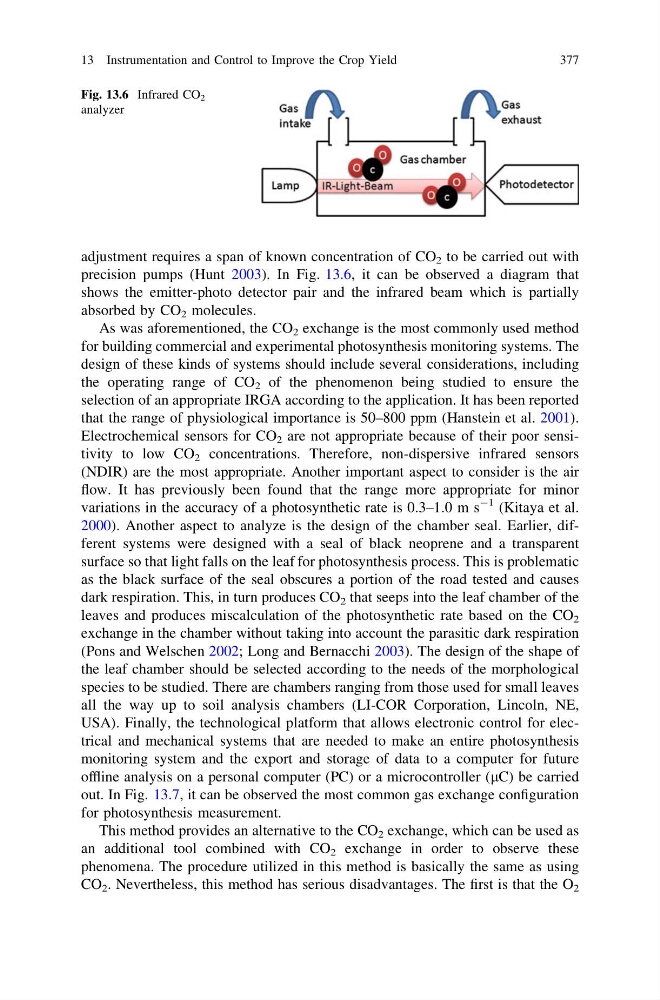
precision pumps (Hunt 2003). In Fig. 13.6, it can be observed a diagram that
shows the emitter-photo detector pair and the infrared beam which is partially
absorbed by CO 2 molecules.
As was aforementioned, the CO 2 exchange is the most commonly used method
for building commercial and experimental photosynthesis monitoring systems. The
design of these kinds of systems should include several considerations, including
the operating range of CO 2 of the phenomenon being studied to ensure the
selection of an appropriate IRGA according to the application. It has been reported
that the range of physiological importance is 50–800 ppm (Hanstein et al. 2001).
Electrochemical sensors for CO 2 are not appropriate because of their poor sensitivity to low CO 2 concentrations. Therefore, non-dispersive infrared sensors
(NDIR) are the most appropriate. Another important aspect to consider is the air
flow. It has previously been found that the range more appropriate for minor
variations in the accuracy of a photosynthetic rate is 0.3–1.0 m s
-1 (Kitaya et al.
2000). Another aspect to analyze is the design of the chamber seal. Earlier, different systems were designed with a seal of black neoprene and a transparent
surface so that light falls on the leaf for photosynthesis process. This is problematic
as the black surface of the seal obscures a portion of the road tested and causes
dark respiration. This, in turn produces CO 2 that seeps into the leaf chamber of the
leaves and produces miscalculation of the photosynthetic rate based on the CO 2
exchange in the chamber without taking into account the parasitic dark respiration
(Pons and Welschen 2002; Long and Bernacchi 2003). The design of the shape of
the leaf chamber should be selected according to the needs of the morphological
species to be studied. There are chambers ranging from those used for small leaves
all the way up to soil analysis chambers (LI-COR Corporation, Lincoln, NE,
USA). Finally, the technological platform that allows electronic control for electrical and mechanical systems that are needed to make an entire photosynthesis
monitoring system and the export and storage of data to a computer for future
offline analysis on a personal computer (PC) or a microcontroller (lC) be carried
out. In Fig. 13.7, it can be observed the most common gas exchange configuration
for photosynthesis measurement.
This method provides an alternative to the CO 2 exchange, which can be used as
an additional tool combined with CO 2 exchange in order to observe these
phenomena. The procedure utilized in this method is basically the same as using
CO 2 . Nevertheless, this method has serious disadvantages. The first is that the O 2
Fig. 13.6 Infrared CO 2
analyzer
13 Instrumentation and Control to Improve the Crop Yield
377
precision pumps (Hunt 2003). In Fig. 13.6, it can be observed a diagram that
shows the emitter-photo detector pair and the infrared beam which is partially
absorbed by CO 2 molecules.
As was aforementioned, the CO 2 exchange is the most commonly used method
for building commercial and experimental photosynthesis monitoring systems. The
design of these kinds of systems should include several considerations, including
the operating range of CO 2 of the phenomenon being studied to ensure the
selection of an appropriate IRGA according to the application. It has been reported
that the range of physiological importance is 50–800 ppm (Hanstein et al. 2001).
Electrochemical sensors for CO 2 are not appropriate because of their poor sensitivity to low CO 2 concentrations. Therefore, non-dispersive infrared sensors
(NDIR) are the most appropriate. Another important aspect to consider is the air
flow. It has previously been found that the range more appropriate for minor
variations in the accuracy of a photosynthetic rate is 0.3–1.0 m s
-1 (Kitaya et al.
2000). Another aspect to analyze is the design of the chamber seal. Earlier, different systems were designed with a seal of black neoprene and a transparent
surface so that light falls on the leaf for photosynthesis process. This is problematic
as the black surface of the seal obscures a portion of the road tested and causes
dark respiration. This, in turn produces CO 2 that seeps into the leaf chamber of the
leaves and produces miscalculation of the photosynthetic rate based on the CO 2
exchange in the chamber without taking into account the parasitic dark respiration
(Pons and Welschen 2002; Long and Bernacchi 2003). The design of the shape of
the leaf chamber should be selected according to the needs of the morphological
species to be studied. There are chambers ranging from those used for small leaves
all the way up to soil analysis chambers (LI-COR Corporation, Lincoln, NE,
USA). Finally, the technological platform that allows electronic control for electrical and mechanical systems that are needed to make an entire photosynthesis
monitoring system and the export and storage of data to a computer for future
offline analysis on a personal computer (PC) or a microcontroller (lC) be carried
out. In Fig. 13.7, it can be observed the most common gas exchange configuration
for photosynthesis measurement.
This method provides an alternative to the CO 2 exchange, which can be used as
an additional tool combined with CO 2 exchange in order to observe these
phenomena. The procedure utilized in this method is basically the same as using
CO 2 . Nevertheless, this method has serious disadvantages. The first is that the O 2
Fig. 13.6 Infrared CO 2
analyzer
13 Instrumentation and Control to Improve the Crop Yield
377