

13.4 Results
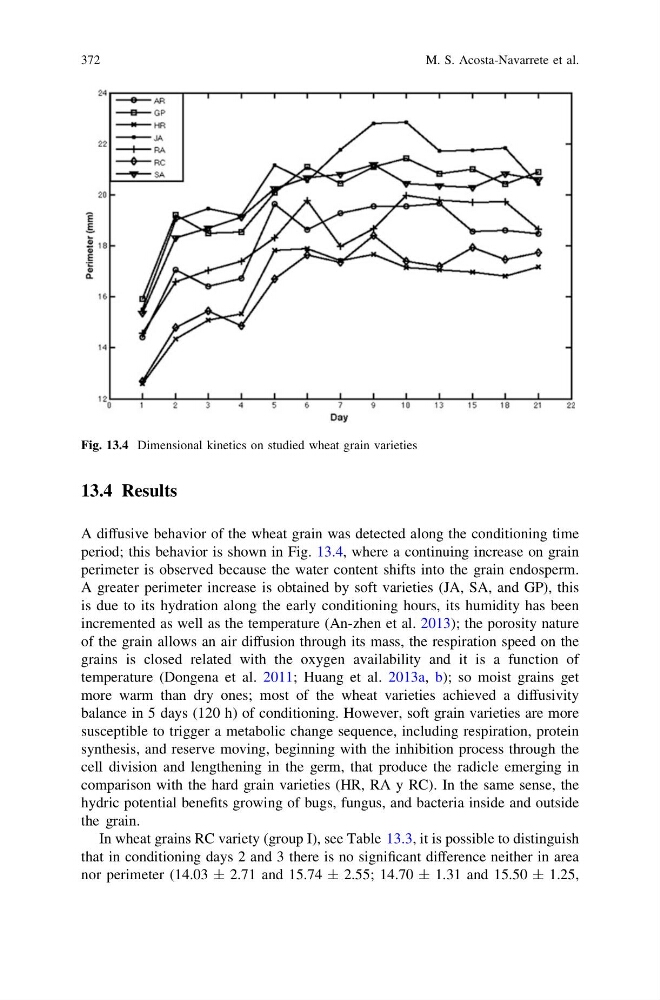
A diffusive behavior of the wheat grain was detected along the conditioning time
period; this behavior is shown in Fig. 13.4, where a continuing increase on grain
perimeter is observed because the water content shifts into the grain endosperm.
A greater perimeter increase is obtained by soft varieties (JA, SA, and GP), this
is due to its hydration along the early conditioning hours, its humidity has been
incremented as well as the temperature (An-zhen et al. 2013); the porosity nature
of the grain allows an air diffusion through its mass, the respiration speed on the
grains is closed related with the oxygen availability and it is a function of
temperature (Dongena et al. 2011; Huang et al. 2013a, b); so moist grains get
more warm than dry ones; most of the wheat varieties achieved a diffusivity
balance in 5 days (120 h) of conditioning. However, soft grain varieties are more
susceptible to trigger a metabolic change sequence, including respiration, protein
synthesis, and reserve moving, beginning with the inhibition process through the
cell division and lengthening in the germ, that produce the radicle emerging in
comparison with the hard grain varieties (HR, RA y RC). In the same sense, the
hydric potential benefits growing of bugs, fungus, and bacteria inside and outside
the grain.
In wheat grains RC variety (group I), see Table 13.3, it is possible to distinguish
that in conditioning days 2 and 3 there is no significant difference neither in area
nor perimeter (14.03 ± 2.71 and 15.74 ± 2.55; 14.70 ± 1.31 and 15.50 ± 1.25,
Fig. 13.4 Dimensional kinetics on studied wheat grain varieties
372
M. S. Acosta-Navarrete et al.
A diffusive behavior of the wheat grain was detected along the conditioning time
period; this behavior is shown in Fig. 13.4, where a continuing increase on grain
perimeter is observed because the water content shifts into the grain endosperm.
A greater perimeter increase is obtained by soft varieties (JA, SA, and GP), this
is due to its hydration along the early conditioning hours, its humidity has been
incremented as well as the temperature (An-zhen et al. 2013); the porosity nature
of the grain allows an air diffusion through its mass, the respiration speed on the
grains is closed related with the oxygen availability and it is a function of
temperature (Dongena et al. 2011; Huang et al. 2013a, b); so moist grains get
more warm than dry ones; most of the wheat varieties achieved a diffusivity
balance in 5 days (120 h) of conditioning. However, soft grain varieties are more
susceptible to trigger a metabolic change sequence, including respiration, protein
synthesis, and reserve moving, beginning with the inhibition process through the
cell division and lengthening in the germ, that produce the radicle emerging in
comparison with the hard grain varieties (HR, RA y RC). In the same sense, the
hydric potential benefits growing of bugs, fungus, and bacteria inside and outside
the grain.
In wheat grains RC variety (group I), see Table 13.3, it is possible to distinguish
that in conditioning days 2 and 3 there is no significant difference neither in area
nor perimeter (14.03 ± 2.71 and 15.74 ± 2.55; 14.70 ± 1.31 and 15.50 ± 1.25,
Fig. 13.4 Dimensional kinetics on studied wheat grain varieties
372
M. S. Acosta-Navarrete et al.