

captured with a resolution of 640 9 480 pixels using the digital microscope Dinolite with a USB port connection to a personal computer and located at a distance of
29 cm.
The pixel/length and pixel/area ratios for the optical system were determined
considering a geometric object with known length and area, based on an area
reference of 1 cm
2 the ratios of 21/220 mm/pixel and 3.46/38013 cm
2 /pixel were
obtained.
The digital image processing and parameter computing algorithms were
developed in MATLAB 13.2a (R2011b). A captured image sample by the used
microscope is shown in Fig. 13.2b, as well as the pre-processed image in
Fig. 13.2b, which is used to evaluate the considered parameters for estimating the
morphometric of the wheat grains varieties.
The grains sphericity parameter was computed assuming an ellipsoidal shape
for each wheat grain; this implies the computing of the largest and smallest axes,
as well as the seed thickness, see Fig. 13.3.
13.3.3 Experiments Design and Statistics Analysis
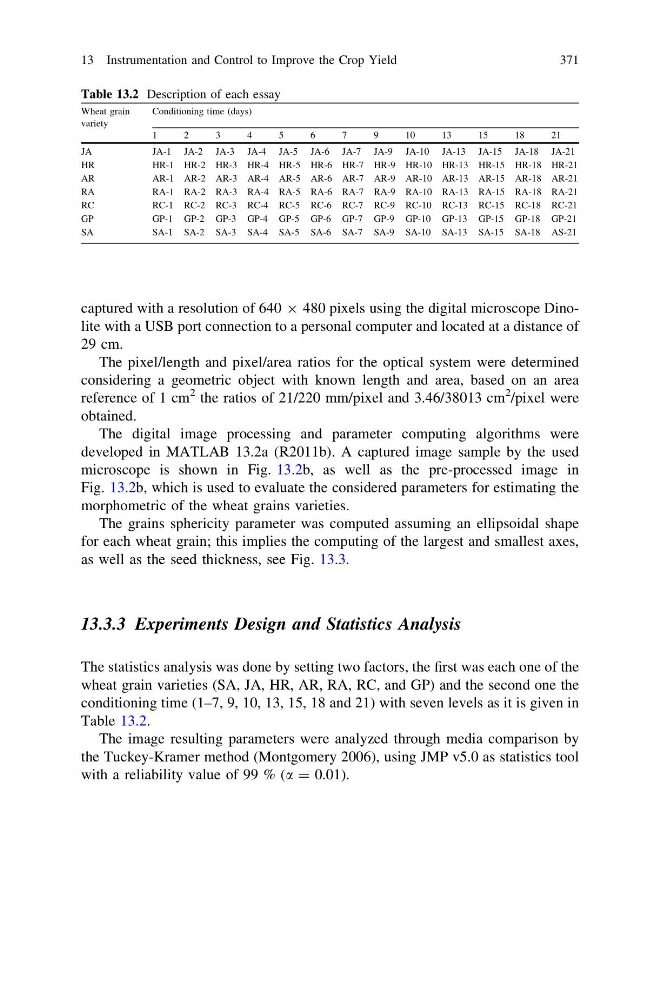
The statistics analysis was done by setting two factors, the first was each one of the
wheat grain varieties (SA, JA, HR, AR, RA, RC, and GP) and the second one the
conditioning time (1–7, 9, 10, 13, 15, 18 and 21) with seven levels as it is given in
Table 13.2.
The image resulting parameters were analyzed through media comparison by
the Tuckey-Kramer method (Montgomery 2006), using JMP v5.0 as statistics tool
with a reliability value of 99 % (a = 0.01).
Table 13.2 Description of each essay
Wheat grain
variety
Conditioning time (days)
1
2
3
4
5
6
7
9
1 0
1 3
1 5
1 8
2 1
JA
JA-1 JA-2 JA-3 JA-4 JA-5 JA-6 JA-7 JA-9 JA-10 JA-13 JA-15 JA-18 JA-21
HR
HR-1 HR-2 HR-3 HR-4 HR-5 HR-6 HR-7 HR-9 HR-10 HR-13 HR-15 HR-18 HR-21
AR
AR-1 AR-2 AR-3 AR-4 AR-5 AR-6 AR-7 AR-9 AR-10 AR-13 AR-15 AR-18 AR-21
RA
RA-1 RA-2 RA-3 RA-4 RA-5 RA-6 RA-7 RA-9 RA-10 RA-13 RA-15 RA-18 RA-21
RC
RC-1 RC-2 RC-3 RC-4 RC-5 RC-6 RC-7 RC-9 RC-10 RC-13 RC-15 RC-18 RC-21
GP
GP-1 GP-2 GP-3 GP-4 GP-5 GP-6 GP-7 GP-9 GP-10 GP-13 GP-15 GP-18 GP-21
SA
SA-1 SA-2 SA-3 SA-4 SA-5 SA-6 SA-7 SA-9 SA-10 SA-13 SA-15 SA-18 AS-21
13 Instrumentation and Control to Improve the Crop Yield
371
29 cm.
The pixel/length and pixel/area ratios for the optical system were determined
considering a geometric object with known length and area, based on an area
reference of 1 cm
2 the ratios of 21/220 mm/pixel and 3.46/38013 cm
2 /pixel were
obtained.
The digital image processing and parameter computing algorithms were
developed in MATLAB 13.2a (R2011b). A captured image sample by the used
microscope is shown in Fig. 13.2b, as well as the pre-processed image in
Fig. 13.2b, which is used to evaluate the considered parameters for estimating the
morphometric of the wheat grains varieties.
The grains sphericity parameter was computed assuming an ellipsoidal shape
for each wheat grain; this implies the computing of the largest and smallest axes,
as well as the seed thickness, see Fig. 13.3.
13.3.3 Experiments Design and Statistics Analysis
The statistics analysis was done by setting two factors, the first was each one of the
wheat grain varieties (SA, JA, HR, AR, RA, RC, and GP) and the second one the
conditioning time (1–7, 9, 10, 13, 15, 18 and 21) with seven levels as it is given in
Table 13.2.
The image resulting parameters were analyzed through media comparison by
the Tuckey-Kramer method (Montgomery 2006), using JMP v5.0 as statistics tool
with a reliability value of 99 % (a = 0.01).
Table 13.2 Description of each essay
Wheat grain
variety
Conditioning time (days)
1
2
3
4
5
6
7
9
1 0
1 3
1 5
1 8
2 1
JA
JA-1 JA-2 JA-3 JA-4 JA-5 JA-6 JA-7 JA-9 JA-10 JA-13 JA-15 JA-18 JA-21
HR
HR-1 HR-2 HR-3 HR-4 HR-5 HR-6 HR-7 HR-9 HR-10 HR-13 HR-15 HR-18 HR-21
AR
AR-1 AR-2 AR-3 AR-4 AR-5 AR-6 AR-7 AR-9 AR-10 AR-13 AR-15 AR-18 AR-21
RA
RA-1 RA-2 RA-3 RA-4 RA-5 RA-6 RA-7 RA-9 RA-10 RA-13 RA-15 RA-18 RA-21
RC
RC-1 RC-2 RC-3 RC-4 RC-5 RC-6 RC-7 RC-9 RC-10 RC-13 RC-15 RC-18 RC-21
GP
GP-1 GP-2 GP-3 GP-4 GP-5 GP-6 GP-7 GP-9 GP-10 GP-13 GP-15 GP-18 GP-21
SA
SA-1 SA-2 SA-3 SA-4 SA-5 SA-6 SA-7 SA-9 SA-10 SA-13 SA-15 SA-18 AS-21
13 Instrumentation and Control to Improve the Crop Yield
371