

and the result in crop response (Baxevanou et al. 2008). Other studies evaluated
the incorporation of pigments (von Elsner et al. 2000) taking into account the
convection and thermal gradients.
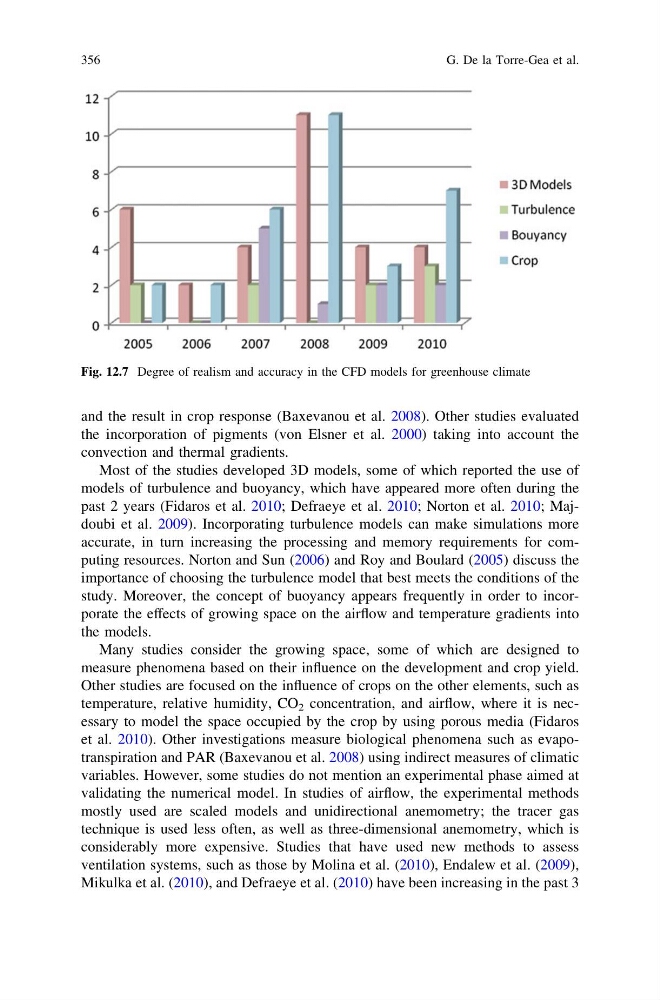
Most of the studies developed 3D models, some of which reported the use of
models of turbulence and buoyancy, which have appeared more often during the
past 2 years (Fidaros et al. 2010; Defraeye et al. 2010; Norton et al. 2010; Majdoubi et al. 2009). Incorporating turbulence models can make simulations more
accurate, in turn increasing the processing and memory requirements for computing resources. Norton and Sun (2006) and Roy and Boulard (2005) discuss the
importance of choosing the turbulence model that best meets the conditions of the
study. Moreover, the concept of buoyancy appears frequently in order to incorporate the effects of growing space on the airflow and temperature gradients into
the models.
Many studies consider the growing space, some of which are designed to
measure phenomena based on their influence on the development and crop yield.
Other studies are focused on the influence of crops on the other elements, such as
temperature, relative humidity, CO 2 concentration, and airflow, where it is necessary to model the space occupied by the crop by using porous media (Fidaros
et al. 2010). Other investigations measure biological phenomena such as evapotranspiration and PAR (Baxevanou et al. 2008) using indirect measures of climatic
variables. However, some studies do not mention an experimental phase aimed at
validating the numerical model. In studies of airflow, the experimental methods
mostly used are scaled models and unidirectional anemometry; the tracer gas
technique is used less often, as well as three-dimensional anemometry, which is
considerably more expensive. Studies that have used new methods to assess
ventilation systems, such as those by Molina et al. (2010), Endalew et al. (2009),
Mikulka et al. (2010), and Defraeye et al. (2010) have been increasing in the past 3
Fig. 12.7 Degree of realism and accuracy in the CFD models for greenhouse climate
356
G. De la Torre-Gea et al.
the incorporation of pigments (von Elsner et al. 2000) taking into account the
convection and thermal gradients.
Most of the studies developed 3D models, some of which reported the use of
models of turbulence and buoyancy, which have appeared more often during the
past 2 years (Fidaros et al. 2010; Defraeye et al. 2010; Norton et al. 2010; Majdoubi et al. 2009). Incorporating turbulence models can make simulations more
accurate, in turn increasing the processing and memory requirements for computing resources. Norton and Sun (2006) and Roy and Boulard (2005) discuss the
importance of choosing the turbulence model that best meets the conditions of the
study. Moreover, the concept of buoyancy appears frequently in order to incorporate the effects of growing space on the airflow and temperature gradients into
the models.
Many studies consider the growing space, some of which are designed to
measure phenomena based on their influence on the development and crop yield.
Other studies are focused on the influence of crops on the other elements, such as
temperature, relative humidity, CO 2 concentration, and airflow, where it is necessary to model the space occupied by the crop by using porous media (Fidaros
et al. 2010). Other investigations measure biological phenomena such as evapotranspiration and PAR (Baxevanou et al. 2008) using indirect measures of climatic
variables. However, some studies do not mention an experimental phase aimed at
validating the numerical model. In studies of airflow, the experimental methods
mostly used are scaled models and unidirectional anemometry; the tracer gas
technique is used less often, as well as three-dimensional anemometry, which is
considerably more expensive. Studies that have used new methods to assess
ventilation systems, such as those by Molina et al. (2010), Endalew et al. (2009),
Mikulka et al. (2010), and Defraeye et al. (2010) have been increasing in the past 3
Fig. 12.7 Degree of realism and accuracy in the CFD models for greenhouse climate
356
G. De la Torre-Gea et al.