

Boulard 2010). A simple model of transpiration of a crop was developed by Sun
and Wang (2010), who related it to the characteristics of ventilation in a greenhouse in eastern China, obtaining a good approximation. In general, there have
been enormous efforts devoted to the analysis of ventilation in greenhouses
(Norton et al. 2007); each new study provides new elements not only in the
movement of air in the greenhouse but also in the forms it takes due to interactions
occurring in the environment, such as position, shape, and size of windows, and
(one of the most important), the presence of a crop (De la Torre-Gea et al. 2011b).
12.5 CFD Models in Greenhouses
Many CFD studies are focused on defining the conditions for a suitable environment. There has been less work on automation and control variables. Investigations that seek for a greater understanding of the interactions among climatic
variables are increasing. Studies such as those of Teittel (2010), and Fidaros et al.
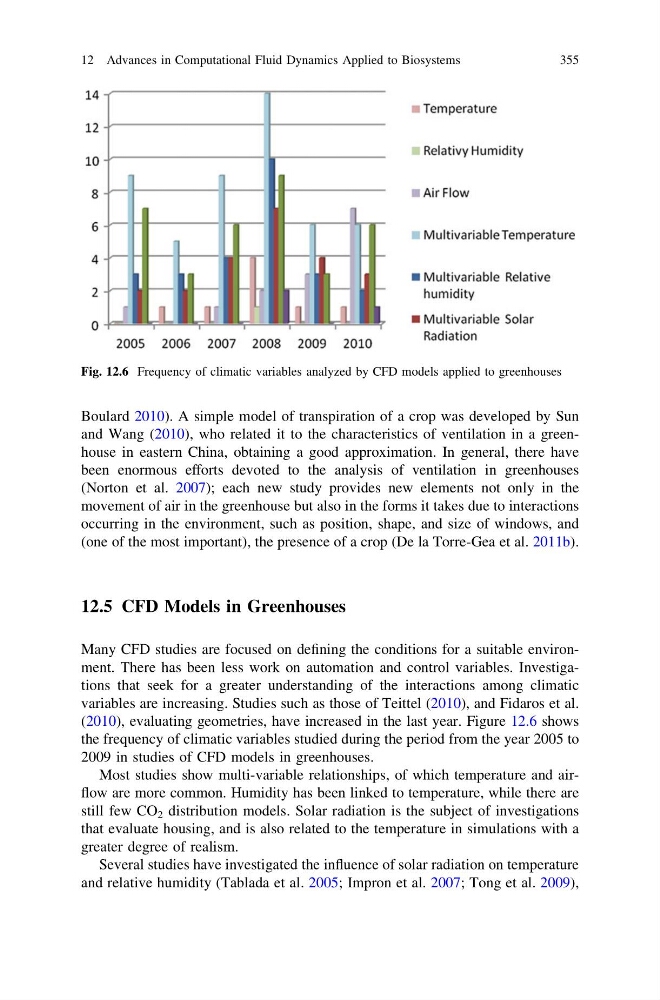
(2010), evaluating geometries, have increased in the last year. Figure 12.6 shows
the frequency of climatic variables studied during the period from the year 2005 to
2009 in studies of CFD models in greenhouses.
Most studies show multi-variable relationships, of which temperature and airflow are more common. Humidity has been linked to temperature, while there are
still few CO 2 distribution models. Solar radiation is the subject of investigations
that evaluate housing, and is also related to the temperature in simulations with a
greater degree of realism.
Several studies have investigated the influence of solar radiation on temperature
and relative humidity (Tablada et al. 2005; Impron et al. 2007; Tong et al. 2009),
Fig. 12.6 Frequency of climatic variables analyzed by CFD models applied to greenhouses
12 Advances in Computational Fluid Dynamics Applied to Biosystems
355
and Wang (2010), who related it to the characteristics of ventilation in a greenhouse in eastern China, obtaining a good approximation. In general, there have
been enormous efforts devoted to the analysis of ventilation in greenhouses
(Norton et al. 2007); each new study provides new elements not only in the
movement of air in the greenhouse but also in the forms it takes due to interactions
occurring in the environment, such as position, shape, and size of windows, and
(one of the most important), the presence of a crop (De la Torre-Gea et al. 2011b).
12.5 CFD Models in Greenhouses
Many CFD studies are focused on defining the conditions for a suitable environment. There has been less work on automation and control variables. Investigations that seek for a greater understanding of the interactions among climatic
variables are increasing. Studies such as those of Teittel (2010), and Fidaros et al.
(2010), evaluating geometries, have increased in the last year. Figure 12.6 shows
the frequency of climatic variables studied during the period from the year 2005 to
2009 in studies of CFD models in greenhouses.
Most studies show multi-variable relationships, of which temperature and airflow are more common. Humidity has been linked to temperature, while there are
still few CO 2 distribution models. Solar radiation is the subject of investigations
that evaluate housing, and is also related to the temperature in simulations with a
greater degree of realism.
Several studies have investigated the influence of solar radiation on temperature
and relative humidity (Tablada et al. 2005; Impron et al. 2007; Tong et al. 2009),
Fig. 12.6 Frequency of climatic variables analyzed by CFD models applied to greenhouses
12 Advances in Computational Fluid Dynamics Applied to Biosystems
355