

12.2.1 Substantial Derivative
The substantial derivative is physically the exchange rate of any substance that
moves with a fluid element. It consists of two parts, where the first part is called
the local derivative, which is physically the rate of change over time in a fixed
point. The second part is called the convective derivative, which is physically the
exchange rate due to movement of the fluid from one point to another in the field
of fluid, where the fluid properties are spatially different. The resulting material can
be applied to any field variable fluid, for example: pressure (p) or temperature
(T) (Anderson 1995).
r i
o
ox
þ j
o
oy
þ k
o
oz
ð12:1Þ
V ðu; v; wÞ
o
ot
ZZZ
V
qdV þ
ZZ
S
qV Á dS ¼ 0
ð12:2Þ
q
Du
Dt
¼ À
op
ox
þ
ot xx
ox
þ
ot yx
ox
þ
ot zx
ox
þ qf x
q
Dv
Dt
¼ À
op
ox
þ
ot xy
ox
þ
ot yy
ox
þ
ot zy
ox
þ qf y
q
Dw
Dt
¼ À
op
ox
þ
ot xz
ox
þ
ot yz
ox
þ
ot zz
ox
þ qf z
ð12:3Þ
q
Dw
Dt
e þ
V
2
2
¼ qq þ
o k þ
oT
ox
þ
o
oy
k þ
oT
oy
þ
o
oz
k þ
oT
oz
À
oðupÞ
ox
À
oðvpÞ
oy
À
oðwpÞ þ
oðut xx Þ
ox
þ
oðut yx Þ
oy
þ
oðut zx Þ
oz
þ
oðvt xy Þ
ox
þ
oðvt yy Þ
oy
þ
oðvt zy Þ
oz
þ
oðwt xz Þ
ox
þ
oðwt yz Þ
oy
þ
oðwt zz Þ
oz
þ pf Á V
ð12:4Þ
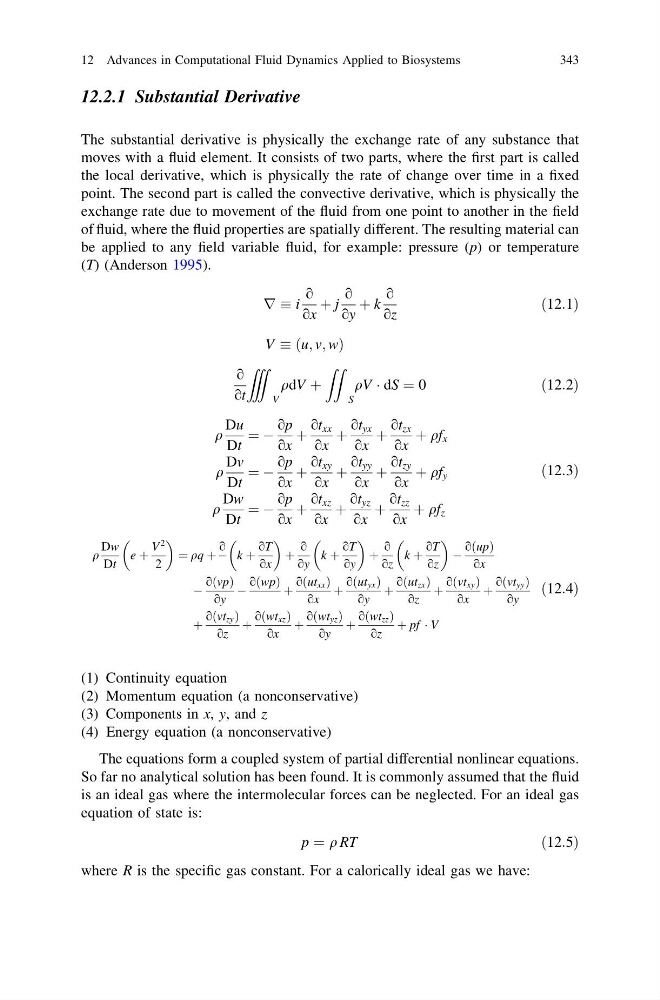
(1) Continuity equation
(2) Momentum equation (a nonconservative)
(3) Components in x, y, and z
(4) Energy equation (a nonconservative)
The equations form a coupled system of partial differential nonlinear equations.
So far no analytical solution has been found. It is commonly assumed that the fluid
is an ideal gas where the intermolecular forces can be neglected. For an ideal gas
equation of state is:
p ¼ q RT
ð12:5Þ
where R is the specific gas constant. For a calorically ideal gas we have:
12 Advances in Computational Fluid Dynamics Applied to Biosystems
343
The substantial derivative is physically the exchange rate of any substance that
moves with a fluid element. It consists of two parts, where the first part is called
the local derivative, which is physically the rate of change over time in a fixed
point. The second part is called the convective derivative, which is physically the
exchange rate due to movement of the fluid from one point to another in the field
of fluid, where the fluid properties are spatially different. The resulting material can
be applied to any field variable fluid, for example: pressure (p) or temperature
(T) (Anderson 1995).
r i
o
ox
þ j
o
oy
þ k
o
oz
ð12:1Þ
V ðu; v; wÞ
o
ot
ZZZ
V
qdV þ
ZZ
S
qV Á dS ¼ 0
ð12:2Þ
q
Du
Dt
¼ À
op
ox
þ
ot xx
ox
þ
ot yx
ox
þ
ot zx
ox
þ qf x
q
Dv
Dt
¼ À
op
ox
þ
ot xy
ox
þ
ot yy
ox
þ
ot zy
ox
þ qf y
q
Dw
Dt
¼ À
op
ox
þ
ot xz
ox
þ
ot yz
ox
þ
ot zz
ox
þ qf z
ð12:3Þ
q
Dw
Dt
e þ
V
2
2
¼ qq þ
o k þ
oT
ox
þ
o
oy
k þ
oT
oy
þ
o
oz
k þ
oT
oz
À
oðupÞ
ox
À
oðvpÞ
oy
À
oðwpÞ þ
oðut xx Þ
ox
þ
oðut yx Þ
oy
þ
oðut zx Þ
oz
þ
oðvt xy Þ
ox
þ
oðvt yy Þ
oy
þ
oðvt zy Þ
oz
þ
oðwt xz Þ
ox
þ
oðwt yz Þ
oy
þ
oðwt zz Þ
oz
þ pf Á V
ð12:4Þ
(1) Continuity equation
(2) Momentum equation (a nonconservative)
(3) Components in x, y, and z
(4) Energy equation (a nonconservative)
The equations form a coupled system of partial differential nonlinear equations.
So far no analytical solution has been found. It is commonly assumed that the fluid
is an ideal gas where the intermolecular forces can be neglected. For an ideal gas
equation of state is:
p ¼ q RT
ð12:5Þ
where R is the specific gas constant. For a calorically ideal gas we have:
12 Advances in Computational Fluid Dynamics Applied to Biosystems
343