

8.4.1 Open System
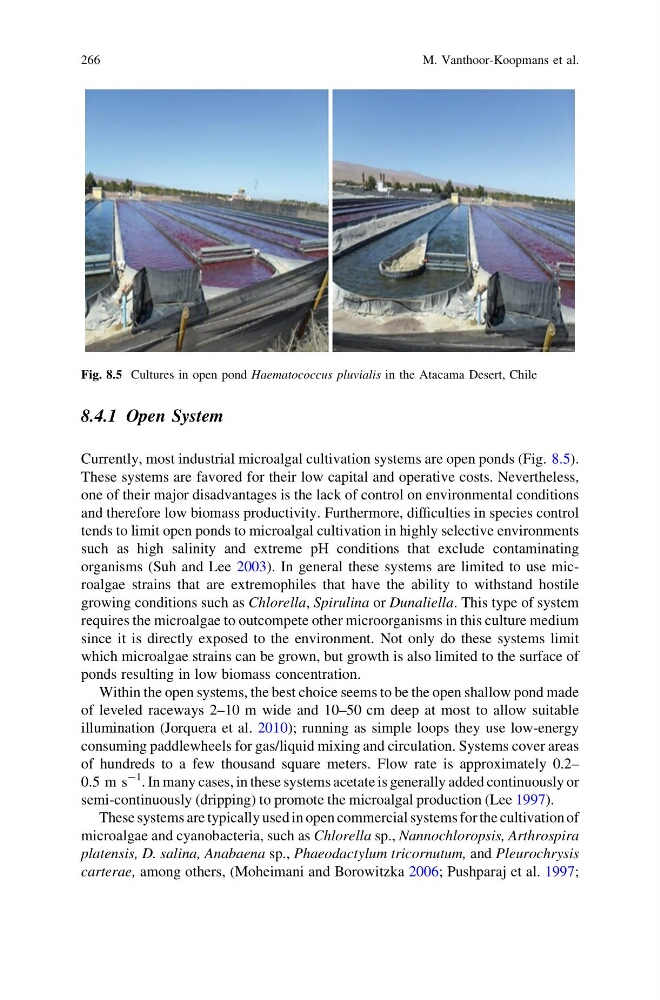
Currently, most industrial microalgal cultivation systems are open ponds (Fig. 8.5).
These systems are favored for their low capital and operative costs. Nevertheless,
one of their major disadvantages is the lack of control on environmental conditions
and therefore low biomass productivity. Furthermore, difficulties in species control
tends to limit open ponds to microalgal cultivation in highly selective environments
such as high salinity and extreme pH conditions that exclude contaminating
organisms (Suh and Lee 2003). In general these systems are limited to use microalgae strains that are extremophiles that have the ability to withstand hostile
growing conditions such as Chlorella, Spirulina or Dunaliella. This type of system
requires the microalgae to outcompete other microorganisms in this culture medium
since it is directly exposed to the environment. Not only do these systems limit
which microalgae strains can be grown, but growth is also limited to the surface of
ponds resulting in low biomass concentration.
Within the open systems, the best choice seems to be the open shallow pond made
of leveled raceways 2–10 m wide and 10–50 cm deep at most to allow suitable
illumination (Jorquera et al. 2010); running as simple loops they use low-energy
consuming paddlewheels for gas/liquid mixing and circulation. Systems cover areas
of hundreds to a few thousand square meters. Flow rate is approximately 0.2–
0.5 m s
-1 . In many cases, in these systems acetate is generally added continuously or
semi-continuously (dripping) to promote the microalgal production (Lee 1997).
These systems are typically used in open commercial systems for the cultivation of
microalgae and cyanobacteria, such as Chlorella sp., Nannochloropsis, Arthrospira
platensis, D. salina, Anabaena sp., Phaeodactylum tricornutum, and Pleurochrysis
carterae, among others, (Moheimani and Borowitzka 2006; Pushparaj et al. 1997;
Fig. 8.5 Cultures in open pond Haematococcus pluvialis in the Atacama Desert, Chile
266
M. Vanthoor-Koopmans et al.
Currently, most industrial microalgal cultivation systems are open ponds (Fig. 8.5).
These systems are favored for their low capital and operative costs. Nevertheless,
one of their major disadvantages is the lack of control on environmental conditions
and therefore low biomass productivity. Furthermore, difficulties in species control
tends to limit open ponds to microalgal cultivation in highly selective environments
such as high salinity and extreme pH conditions that exclude contaminating
organisms (Suh and Lee 2003). In general these systems are limited to use microalgae strains that are extremophiles that have the ability to withstand hostile
growing conditions such as Chlorella, Spirulina or Dunaliella. This type of system
requires the microalgae to outcompete other microorganisms in this culture medium
since it is directly exposed to the environment. Not only do these systems limit
which microalgae strains can be grown, but growth is also limited to the surface of
ponds resulting in low biomass concentration.
Within the open systems, the best choice seems to be the open shallow pond made
of leveled raceways 2–10 m wide and 10–50 cm deep at most to allow suitable
illumination (Jorquera et al. 2010); running as simple loops they use low-energy
consuming paddlewheels for gas/liquid mixing and circulation. Systems cover areas
of hundreds to a few thousand square meters. Flow rate is approximately 0.2–
0.5 m s
-1 . In many cases, in these systems acetate is generally added continuously or
semi-continuously (dripping) to promote the microalgal production (Lee 1997).
These systems are typically used in open commercial systems for the cultivation of
microalgae and cyanobacteria, such as Chlorella sp., Nannochloropsis, Arthrospira
platensis, D. salina, Anabaena sp., Phaeodactylum tricornutum, and Pleurochrysis
carterae, among others, (Moheimani and Borowitzka 2006; Pushparaj et al. 1997;
Fig. 8.5 Cultures in open pond Haematococcus pluvialis in the Atacama Desert, Chile
266
M. Vanthoor-Koopmans et al.