

cultures. Depending on the culture system chosen to culture the microalgae more
or less control of the environmental conditions is possible. When culture conditions can be well controlled the selected microalgae will be less vulnerable to
changes. Moreover, in controlled environments product quality can be guaranteed
better. However, every manner of control has its price. It is preferable to optimize
production by limiting the number of artificial controls, thereby reducing production costs.
8.4 Production Systems
Another factor that has effected the mainstream adoption of microalgae as a
possible food staple or as a biofuel is the cost of production. Microalgae are
expensive to produce, although efforts are under way addressing cost-efficient
mass cultivation of these organisms. Presently, many different systems for microalgal biomass production have been evaluated (Richmond 2004; Tredici 2004;
Carvalho et al. 2006; Ugwu et al. 2008). All the cultivation systems must take into
account (1) light utilization, (2) CO 2 /O 2 balance and gas exchange, (3) temperature, (4) pH, (5) sterility, and perhaps most important for evaluating the economic
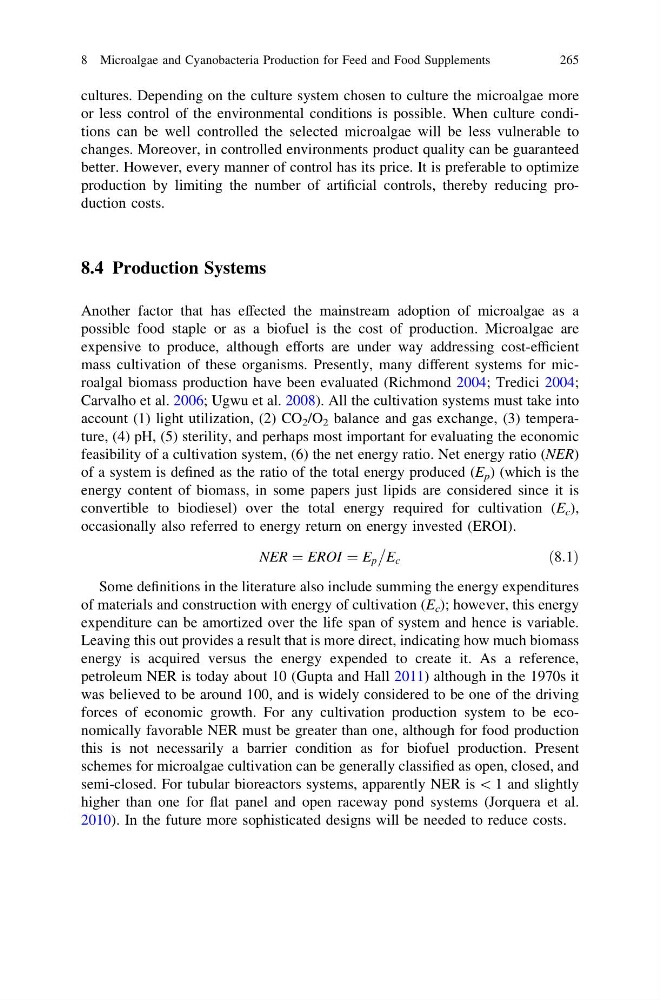
feasibility of a cultivation system, (6) the net energy ratio. Net energy ratio (NER)
of a system is defined as the ratio of the total energy produced (E p ) (which is the
energy content of biomass, in some papers just lipids are considered since it is
convertible to biodiesel) over the total energy required for cultivation (E c ),
occasionally also referred to energy return on energy invested (EROI).
NER ¼ EROI ¼ E p
E c
ð8:1Þ
Some definitions in the literature also include summing the energy expenditures
of materials and construction with energy of cultivation (E c ); however, this energy
expenditure can be amortized over the life span of system and hence is variable.
Leaving this out provides a result that is more direct, indicating how much biomass
energy is acquired versus the energy expended to create it. As a reference,
petroleum NER is today about 10 (Gupta and Hall 2011) although in the 1970s it
was believed to be around 100, and is widely considered to be one of the driving
forces of economic growth. For any cultivation production system to be economically favorable NER must be greater than one, although for food production
this is not necessarily a barrier condition as for biofuel production. Present
schemes for microalgae cultivation can be generally classified as open, closed, and
semi-closed. For tubular bioreactors systems, apparently NER is \ 1 and slightly
higher than one for flat panel and open raceway pond systems (Jorquera et al.
2010). In the future more sophisticated designs will be needed to reduce costs.
8 Microalgae and Cyanobacteria Production for Feed and Food Supplements
265
or less control of the environmental conditions is possible. When culture conditions can be well controlled the selected microalgae will be less vulnerable to
changes. Moreover, in controlled environments product quality can be guaranteed
better. However, every manner of control has its price. It is preferable to optimize
production by limiting the number of artificial controls, thereby reducing production costs.
8.4 Production Systems
Another factor that has effected the mainstream adoption of microalgae as a
possible food staple or as a biofuel is the cost of production. Microalgae are
expensive to produce, although efforts are under way addressing cost-efficient
mass cultivation of these organisms. Presently, many different systems for microalgal biomass production have been evaluated (Richmond 2004; Tredici 2004;
Carvalho et al. 2006; Ugwu et al. 2008). All the cultivation systems must take into
account (1) light utilization, (2) CO 2 /O 2 balance and gas exchange, (3) temperature, (4) pH, (5) sterility, and perhaps most important for evaluating the economic
feasibility of a cultivation system, (6) the net energy ratio. Net energy ratio (NER)
of a system is defined as the ratio of the total energy produced (E p ) (which is the
energy content of biomass, in some papers just lipids are considered since it is
convertible to biodiesel) over the total energy required for cultivation (E c ),
occasionally also referred to energy return on energy invested (EROI).
NER ¼ EROI ¼ E p
E c
ð8:1Þ
Some definitions in the literature also include summing the energy expenditures
of materials and construction with energy of cultivation (E c ); however, this energy
expenditure can be amortized over the life span of system and hence is variable.
Leaving this out provides a result that is more direct, indicating how much biomass
energy is acquired versus the energy expended to create it. As a reference,
petroleum NER is today about 10 (Gupta and Hall 2011) although in the 1970s it
was believed to be around 100, and is widely considered to be one of the driving
forces of economic growth. For any cultivation production system to be economically favorable NER must be greater than one, although for food production
this is not necessarily a barrier condition as for biofuel production. Present
schemes for microalgae cultivation can be generally classified as open, closed, and
semi-closed. For tubular bioreactors systems, apparently NER is \ 1 and slightly
higher than one for flat panel and open raceway pond systems (Jorquera et al.
2010). In the future more sophisticated designs will be needed to reduce costs.
8 Microalgae and Cyanobacteria Production for Feed and Food Supplements
265