

nicotinamide/niacin (B3), pirodoxin (B6), folic acid (B9), cyanocolamin (B12),
vitamins C, D, and E. Some pigments found in Arthrospira are chlorophyll a,
xanthophyll,
b-carotene, myxoxanthophyll, zeaxanthin, canthaxanthin, 3-hydroxy echinenone,
b-cryptoxanthin, among others, as well as phycobiliproteins, c-phycocyanin, and
allophycocyanin (Vonshak 1997; Phang et al. 2000; Basurto-Peña 2009).
Arthrospira is a well-known cyanobacterium that was consumed long back in
Chad Lake in Africa and by the Aztecs in Central Mexico (Fig. 8.5). The Aztecs
picked it from Texcoco Lake to use it for cooking ‘‘tamales,’’ a little corn cake
enveloped with corn leaves or as food additive. The Aztecs kept this tradition until
the sixteenth century (Farrer 1966; González 1987; Basurto-Peña 2009). Actually,
Arthrospira is produced in many countries such as Japan, USA, Italy, India, China,
Chile, Thailand, Singapore, where it is used as a food supplement (Basurto-Peña
2009). Ecuador has set up a governmental program dedicated to the rustic
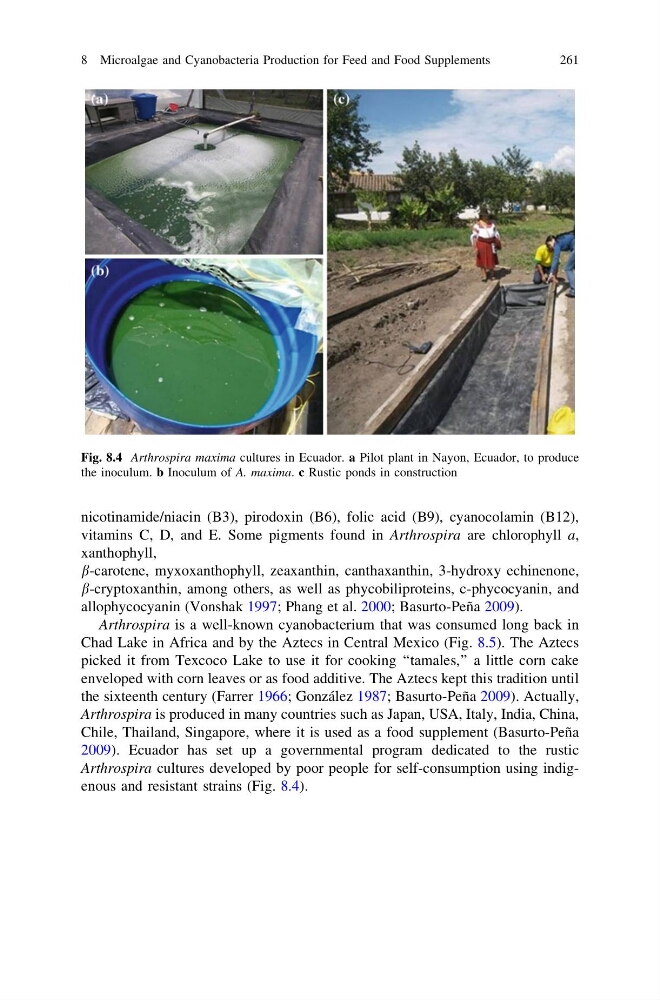
Arthrospira cultures developed by poor people for self-consumption using indigenous and resistant strains (Fig. 8.4).
Fig. 8.4 Arthrospira maxima cultures in Ecuador. a Pilot plant in Nayon, Ecuador, to produce
the inoculum. b Inoculum of A. maxima. c Rustic ponds in construction
8 Microalgae and Cyanobacteria Production for Feed and Food Supplements
261
vitamins C, D, and E. Some pigments found in Arthrospira are chlorophyll a,
xanthophyll,
b-carotene, myxoxanthophyll, zeaxanthin, canthaxanthin, 3-hydroxy echinenone,
b-cryptoxanthin, among others, as well as phycobiliproteins, c-phycocyanin, and
allophycocyanin (Vonshak 1997; Phang et al. 2000; Basurto-Peña 2009).
Arthrospira is a well-known cyanobacterium that was consumed long back in
Chad Lake in Africa and by the Aztecs in Central Mexico (Fig. 8.5). The Aztecs
picked it from Texcoco Lake to use it for cooking ‘‘tamales,’’ a little corn cake
enveloped with corn leaves or as food additive. The Aztecs kept this tradition until
the sixteenth century (Farrer 1966; González 1987; Basurto-Peña 2009). Actually,
Arthrospira is produced in many countries such as Japan, USA, Italy, India, China,
Chile, Thailand, Singapore, where it is used as a food supplement (Basurto-Peña
2009). Ecuador has set up a governmental program dedicated to the rustic
Arthrospira cultures developed by poor people for self-consumption using indigenous and resistant strains (Fig. 8.4).
Fig. 8.4 Arthrospira maxima cultures in Ecuador. a Pilot plant in Nayon, Ecuador, to produce
the inoculum. b Inoculum of A. maxima. c Rustic ponds in construction
8 Microalgae and Cyanobacteria Production for Feed and Food Supplements
261