

fungal species (Carrasco-Hernández et al. 2011); (iii) some EEMs could be a
factor of drought tolerance to the associated hosts more efficiently than others, for
example Hebeloma species can confer more resistance than Laccaria species
(Perea-Estrada et al. 2009); and iv) In the last 4 years, it has been possible to
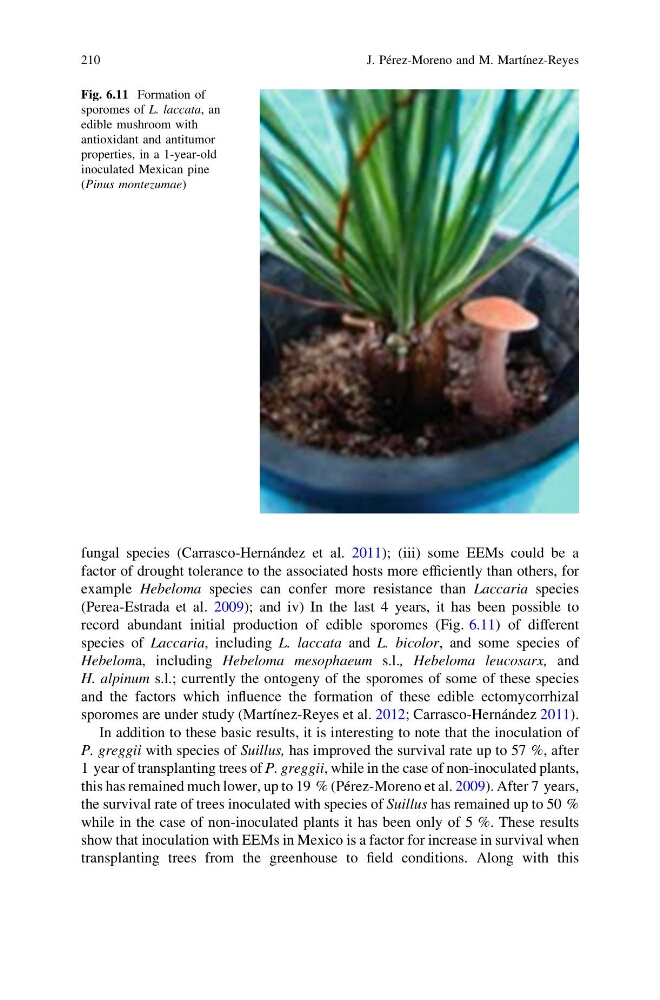
record abundant initial production of edible sporomes (Fig. 6.11) of different
species of Laccaria, including L. laccata and L. bicolor, and some species of
Hebeloma, including Hebeloma mesophaeum s.l., Hebeloma leucosarx, and
H. alpinum s.l.; currently the ontogeny of the sporomes of some of these species
and the factors which influence the formation of these edible ectomycorrhizal
sporomes are under study (Martínez-Reyes et al. 2012; Carrasco-Hernández 2011).
In addition to these basic results, it is interesting to note that the inoculation of
P. greggii with species of Suillus, has improved the survival rate up to 57 %, after
1 year of transplanting trees of P. greggii, while in the case of non-inoculated plants,
this has remained much lower, up to 19 % (Pérez-Moreno et al. 2009). After 7 years,
the survival rate of trees inoculated with species of Suillus has remained up to 50 %
while in the case of non-inoculated plants it has been only of 5 %. These results
show that inoculation with EEMs in Mexico is a factor for increase in survival when
transplanting trees from the greenhouse to field conditions. Along with this
Fig. 6.11 Formation of
sporomes of L. laccata, an
edible mushroom with
antioxidant and antitumor
properties, in a 1-year-old
inoculated Mexican pine
(Pinus montezumae)
210
J. Pérez-Moreno and M. Martínez-Reyes
factor of drought tolerance to the associated hosts more efficiently than others, for
example Hebeloma species can confer more resistance than Laccaria species
(Perea-Estrada et al. 2009); and iv) In the last 4 years, it has been possible to
record abundant initial production of edible sporomes (Fig. 6.11) of different
species of Laccaria, including L. laccata and L. bicolor, and some species of
Hebeloma, including Hebeloma mesophaeum s.l., Hebeloma leucosarx, and
H. alpinum s.l.; currently the ontogeny of the sporomes of some of these species
and the factors which influence the formation of these edible ectomycorrhizal
sporomes are under study (Martínez-Reyes et al. 2012; Carrasco-Hernández 2011).
In addition to these basic results, it is interesting to note that the inoculation of
P. greggii with species of Suillus, has improved the survival rate up to 57 %, after
1 year of transplanting trees of P. greggii, while in the case of non-inoculated plants,
this has remained much lower, up to 19 % (Pérez-Moreno et al. 2009). After 7 years,
the survival rate of trees inoculated with species of Suillus has remained up to 50 %
while in the case of non-inoculated plants it has been only of 5 %. These results
show that inoculation with EEMs in Mexico is a factor for increase in survival when
transplanting trees from the greenhouse to field conditions. Along with this
Fig. 6.11 Formation of
sporomes of L. laccata, an
edible mushroom with
antioxidant and antitumor
properties, in a 1-year-old
inoculated Mexican pine
(Pinus montezumae)
210
J. Pérez-Moreno and M. Martínez-Reyes