

central Mexico as human food (Pérez-Moreno et al. 1993, 2008). As a consequence
of this root colonization by EEMs, beneficial effects in terms of plant growth and
nutrient contents have been recorded in Pinus hartwegii Lindl. (Perea-Estrada et al.
2009), Pinus patula Schiede ex Schltdl. and Cham, Pinus pseudostrobus Lindl.
(Carrasco-Hernández et al. 2011) and Pinus greggii Engelm. ex Parl. (Méndez-Neri
et al. 2011; Martínez-Reyes et al. 2012).
Among the main findings it has been observed that: (i) there is an evident
nutrient transfer of N, P, K, Ca, and Mg, to the forest trees inoculated with edible
EEMs compared with non-inoculated plants. Of particular importance has been the
finding that the external ectomycorrhizal mycelium is able, not only to transfer P
and Mg to the roots of the associated trees, but also to the shoots of these plants
(Martínez-Reyes et al. 2012); (ii) when multiple simultaneous inoculation, with up
to six ectomycorrhizal fungi have been carried out, dominance of one of the
inoculated species in terms of root colonizations has been recorded. But the
beneficial effects reported to the host trees in these cases are comparable with
those observed in plants inoculated exclusively with the dominant ectomycorrhizal
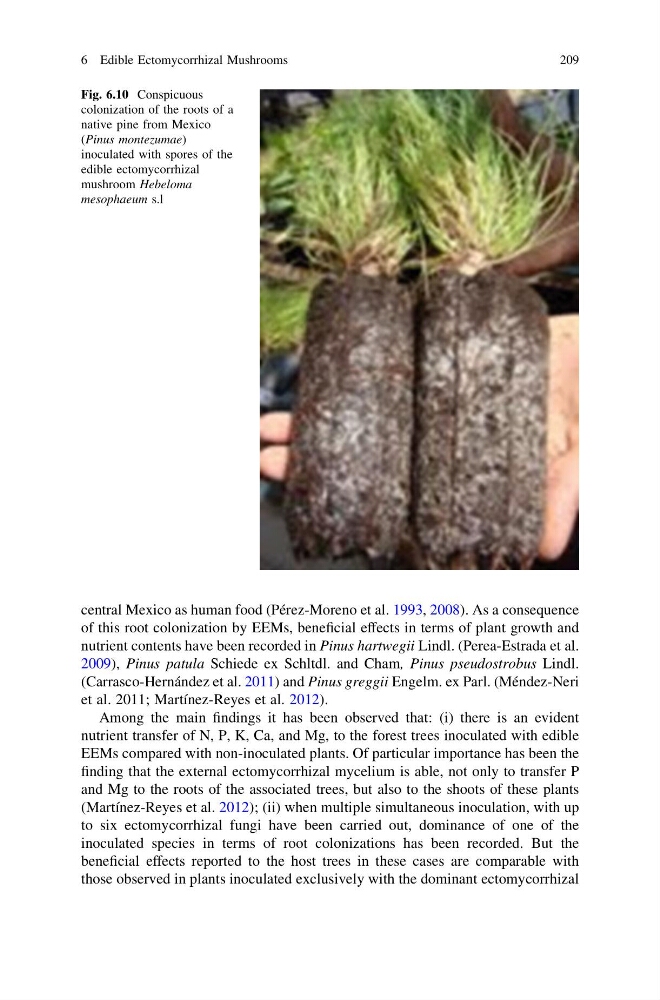
Fig. 6.10 Conspicuous
colonization of the roots of a
native pine from Mexico
(Pinus montezumae)
inoculated with spores of the
edible ectomycorrhizal
mushroom Hebeloma
mesophaeum s.l
6 Edible Ectomycorrhizal Mushrooms
209
of this root colonization by EEMs, beneficial effects in terms of plant growth and
nutrient contents have been recorded in Pinus hartwegii Lindl. (Perea-Estrada et al.
2009), Pinus patula Schiede ex Schltdl. and Cham, Pinus pseudostrobus Lindl.
(Carrasco-Hernández et al. 2011) and Pinus greggii Engelm. ex Parl. (Méndez-Neri
et al. 2011; Martínez-Reyes et al. 2012).
Among the main findings it has been observed that: (i) there is an evident
nutrient transfer of N, P, K, Ca, and Mg, to the forest trees inoculated with edible
EEMs compared with non-inoculated plants. Of particular importance has been the
finding that the external ectomycorrhizal mycelium is able, not only to transfer P
and Mg to the roots of the associated trees, but also to the shoots of these plants
(Martínez-Reyes et al. 2012); (ii) when multiple simultaneous inoculation, with up
to six ectomycorrhizal fungi have been carried out, dominance of one of the
inoculated species in terms of root colonizations has been recorded. But the
beneficial effects reported to the host trees in these cases are comparable with
those observed in plants inoculated exclusively with the dominant ectomycorrhizal
Fig. 6.10 Conspicuous
colonization of the roots of a
native pine from Mexico
(Pinus montezumae)
inoculated with spores of the
edible ectomycorrhizal
mushroom Hebeloma
mesophaeum s.l
6 Edible Ectomycorrhizal Mushrooms
209