

Fortas 2011; Mandeel and Al-Laith, 2007; Janakat et al. 2005). This examples
show that despite their inherent cultivation difficulties, including slow growth, low
strain isolation rate in vitro or difficulties to obtain cultivation of sporomes, it is
worth the screening of extracts of sporomes or mycelium of edible EEMs due to
the fact that they can be a very important source of novel antimicrobial metabolites
active against new human pathogen targets.
6.2.4 Anti-HIV and Other Virucidal Compounds
Very recently, Zhu et al. (2013) extracted from Hygrophorus russula a common
edible EEM in China (Liu et al. 2009) and Mexico (Pérez-Moreno et al. 2010), a
novel ribonuclease with significant HIV-1 reverse transcriptase inhibitory activity.
Previously, Suzuki et al. (2012) extracted from the same mushroom, a novel
mannose-specific lectin which showed a mitogenic activity against spleen lymph
cells of an F344 rat, activating the proliferation of both T and B cells responsible
of the immune system. These authors also made another interesting discovery
because this novel lectin, named HRL, strongly binds to the gp120 protein present
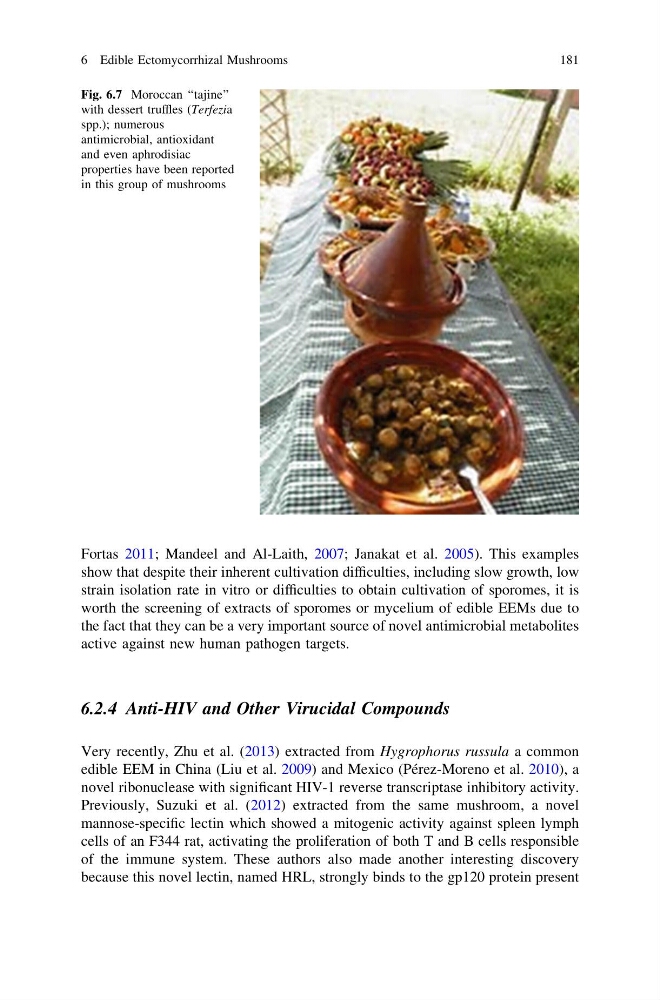
Fig. 6.7 Moroccan ‘‘tajine’’
with dessert truffles (Terfezia
spp.); numerous
antimicrobial, antioxidant
and even aphrodisiac
properties have been reported
in this group of mushrooms
6 Edible Ectomycorrhizal Mushrooms
181
show that despite their inherent cultivation difficulties, including slow growth, low
strain isolation rate in vitro or difficulties to obtain cultivation of sporomes, it is
worth the screening of extracts of sporomes or mycelium of edible EEMs due to
the fact that they can be a very important source of novel antimicrobial metabolites
active against new human pathogen targets.
6.2.4 Anti-HIV and Other Virucidal Compounds
Very recently, Zhu et al. (2013) extracted from Hygrophorus russula a common
edible EEM in China (Liu et al. 2009) and Mexico (Pérez-Moreno et al. 2010), a
novel ribonuclease with significant HIV-1 reverse transcriptase inhibitory activity.
Previously, Suzuki et al. (2012) extracted from the same mushroom, a novel
mannose-specific lectin which showed a mitogenic activity against spleen lymph
cells of an F344 rat, activating the proliferation of both T and B cells responsible
of the immune system. These authors also made another interesting discovery
because this novel lectin, named HRL, strongly binds to the gp120 protein present
Fig. 6.7 Moroccan ‘‘tajine’’
with dessert truffles (Terfezia
spp.); numerous
antimicrobial, antioxidant
and even aphrodisiac
properties have been reported
in this group of mushrooms
6 Edible Ectomycorrhizal Mushrooms
181